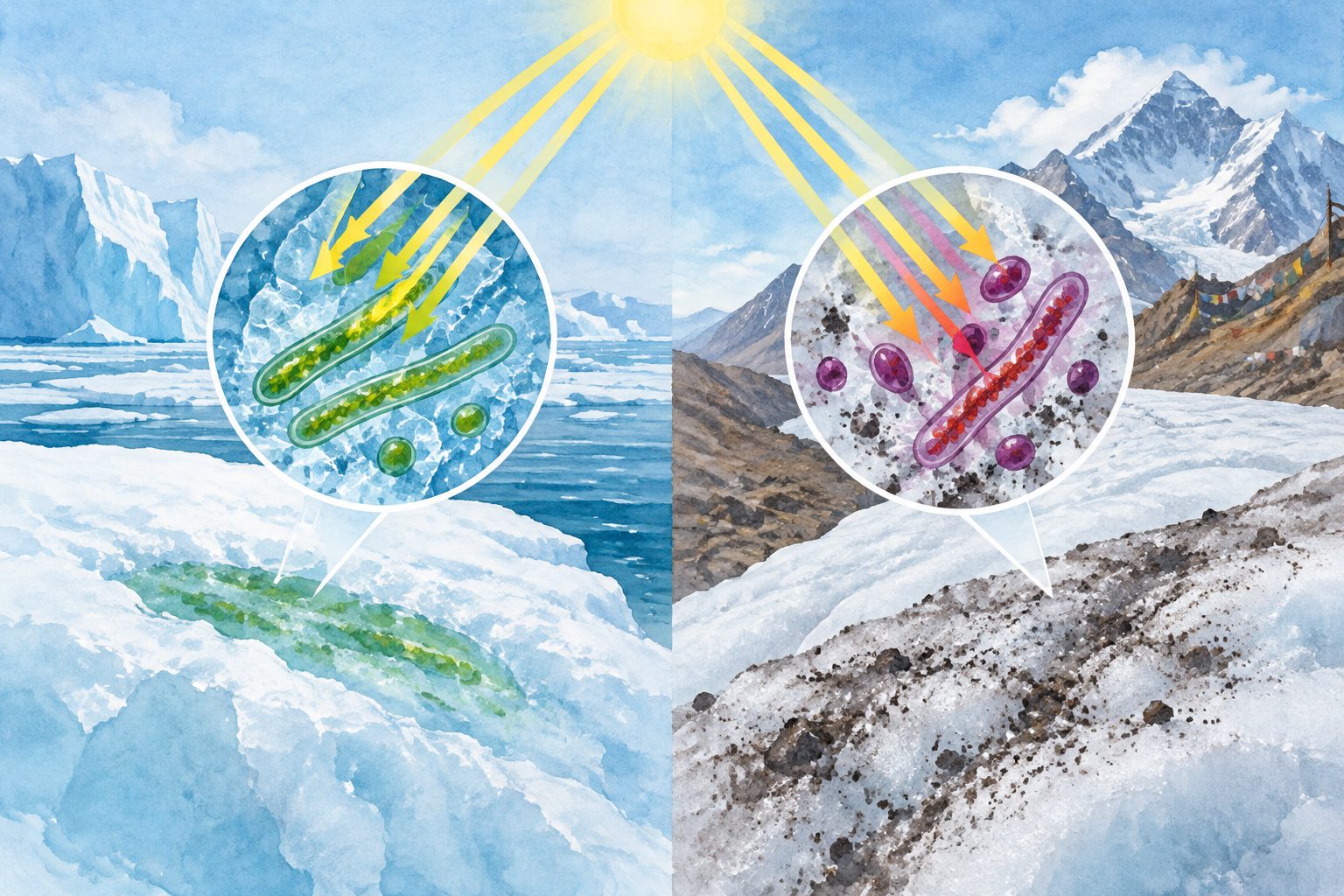
Arctic communities favored light-sensitive proteins called rhodopsins, while Tibetan communities had more genes linked to photosynthesis and more complex microbial networks.
Researchers analyzed 85 metagenomes from cryoconite, the dark sediment that collects on glacier surfaces. The set included 47 samples from Arctic glaciers and 38 from glaciers on the Tibetan Plateau, which experience different long-term radiation conditions.
Arctic communities showed greater representation of rhodopsin-based light harvesting, while Tibetan communities showed more potential for photosynthesis. The two regions also had different inferred microbial interaction networks: Tibetan networks were more complex and included photosynthetic organisms as highly connected members, while Arctic networks were simpler and centered on rhodopsin-containing organisms that obtain energy in other ways.
Different ways to use light
The metagenomic comparison linked contrasting radiation environments with different microbial energy strategies. Arctic cryoconite communities had more genes associated with rhodopsin-based phototrophy, in which light-sensitive proteins help organisms obtain energy. Tibetan Plateau communities had more potential for photosynthesis.
These differences coincided with different community structures and inferred interaction networks. Tibetan networks were more complex, with phototrophic organisms as highly connected nodes. Arctic networks were simpler and centered on rhodopsin-containing heterotrophs. Trait analyses also indicated greater potential for biomass production in Tibetan communities.