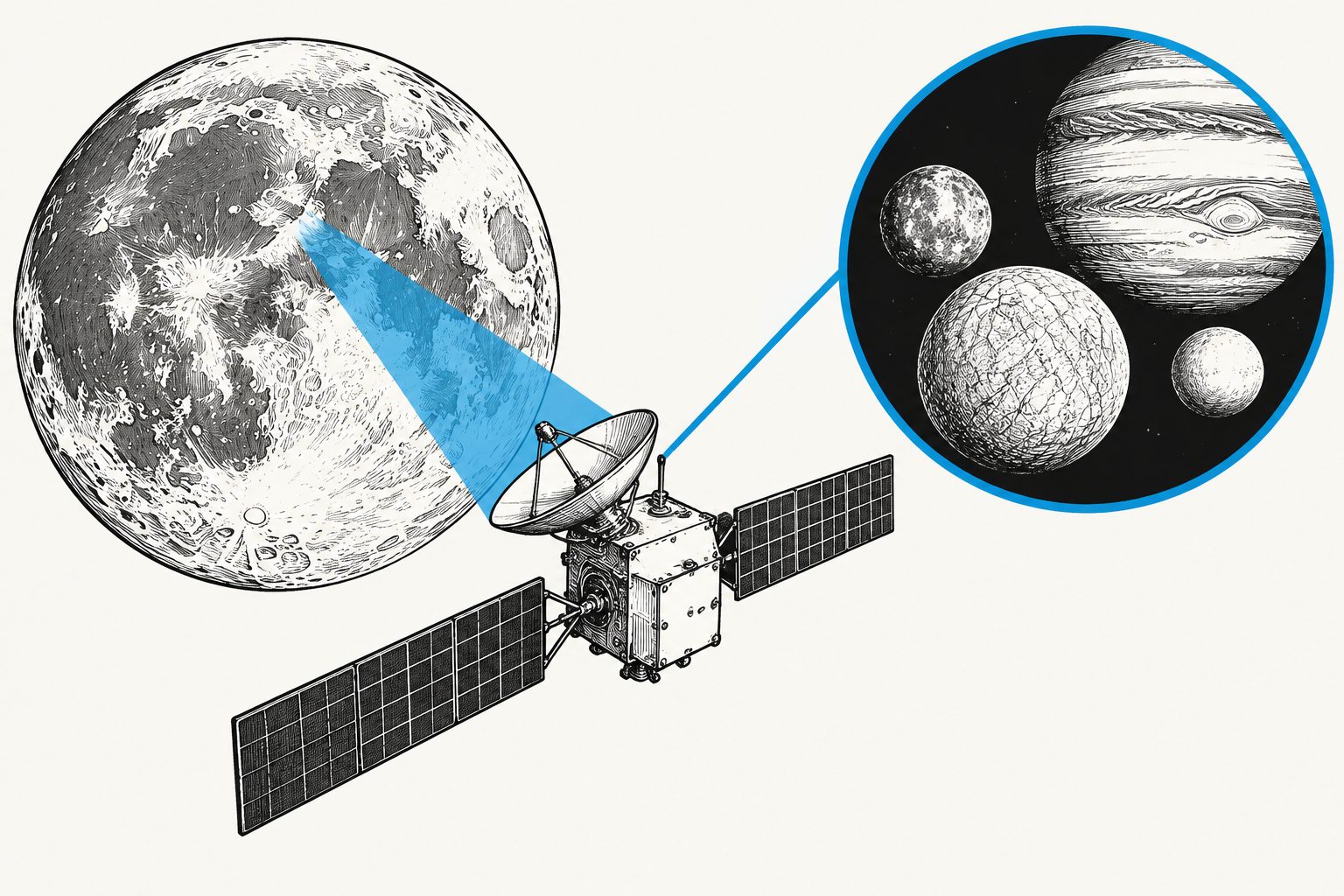
Measurements from the Moon help show that the spacecraft’s mineral-mapping instrument is working as intended for its journey to Jupiter.
MAJIS recorded hyperspectral measurements—many closely spaced wavelengths of light—from parts of the lunar nearside, including Mare Tranquillitatis, Mare Fecunditatis and nearby highlands. The analysis focused on two observations because the lighting conditions were challenging.
The spectra showed features near 1 and 2 micrometres associated with low- and high-calcium pyroxenes, minerals common in dark lunar maria and fresh impact features. Results from areas including the Maskelyne G and Messier/Messier A craters were consistent with earlier lunar measurements, supporting MAJIS’s use for future studies in the Jupiter system.
What MAJIS saw on the Moon
MAJIS detected absorption features near 1 and 2 micrometres, indicating the presence of both low- and high-calcium pyroxenes. Mafic minerals—dark, iron- and magnesium-rich minerals—dominated the mare regions and fresh impact craters and their ejecta examined in the study. These areas had deeper absorption bands than surrounding terrain.
The researchers also found differences in spectral slope, which were associated with surface maturity and composition. They applied a correction for heat emitted by the lunar surface to examine possible features beyond 2.6 micrometres, but further work is needed to interpret that part of the data fully. Comparisons with earlier missions showed strong consistency in the measured spectral properties.
Evidence and limits
This is a mineralogical and spectral analysis of MAJIS observations, compared with measurements from earlier lunar missions. The study covered a portion of the lunar nearside and concentrated mainly on two observations because the Moon was viewed under high-phase and high-incidence illumination, conditions that make analysis more difficult.
The researchers could not yet fully assess possible spectral features above 2.6 micrometres, even after correcting for thermal emission. The findings therefore support the instrument’s performance for the regions and observations analysed, rather than providing a complete survey of the Moon.
// Source
Annales Geophysicae · 2026 · DOI: 10.5194/angeo-44-1167-2026
Authors: Francesca Zambon, Francesca Altieri, Maria Cristina De Sanctis, Stéphane Le Mouëlic, Giuseppe Piccioni, François Poulet, Y. Langevin, Clément Royer, F. Tosi, Özgür Karatekin, A. Mura, Cristian Carli
Institutions: Centre National de la Recherche Scientifique, Université Paris-Saclay, Nantes Université, Institute for Space Astrophysics and Planetology, National Institute for Astrophysics, Institut d'Astrophysique Spatiale, Laboratoire de Planétologie et Géosciences, Royal Belgian Institute for Space Aeronomy