A genomic and deep-learning analysis finds that proteins vary continuously in how strongly their binding depends on surrounding DNA packaging.
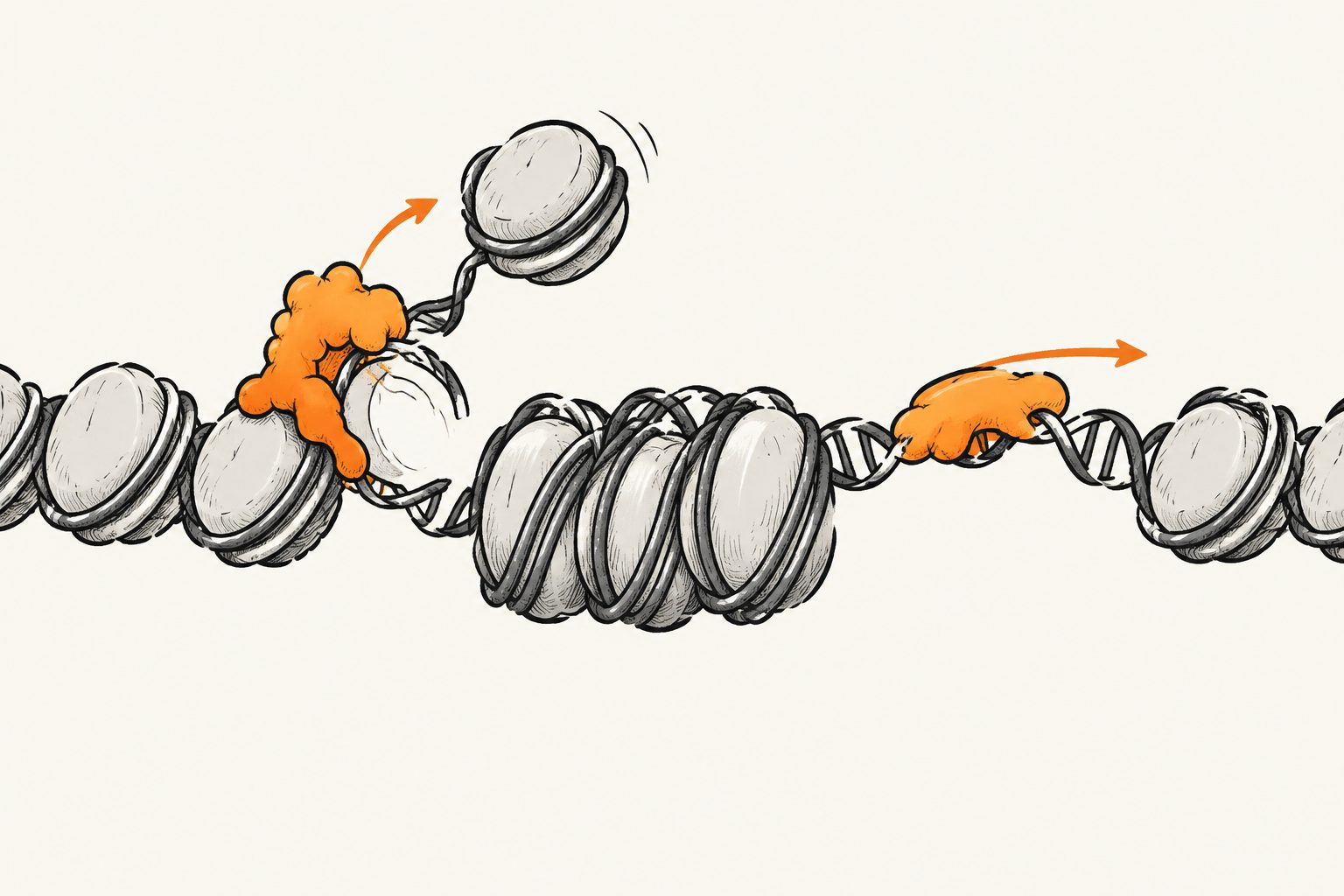
Researchers developed a quantitative framework combining genomic data with an Enformer-based deep-learning model to measure how much transcription-factor binding is explained by DNA sequence and how much depends on the surrounding chromatin context. Across mouse and human data, the resulting chromatin-sensitivity scores formed a continuum rather than two distinct classes.
The analysis also found that sensitivity can change at different binding sites for the same transcription factor, depending on the strength of the underlying DNA motif. The findings support a mixture of hierarchical and cooperative binding mechanisms, with the balance likely differing from one regulatory region to another.
A continuum of binding sensitivity
The researchers assessed binding at the 250 strongest predicted motifs for each transcription factor, defining a motif as bound when its signal was enriched twofold or fourfold over control in a 200-base-pair window. CTCF and MAFK bound almost all of these strongest motifs, while NFYA bound fewer than 10%. A substantial group, including SOX2 and NRF1, bound between 10% and 60% of their top motifs. Their binding-signal distributions suggested that these intermediate values reflected mixtures of bound and unbound sites, rather than simply weak signals near the cutoff.
When the analysis included weaker motifs, chromatin sensitivity became more complex. Even CTCF, which appeared largely insensitive at its strongest motifs, showed greater variation at motifs of intermediate strength. Overall, the analysis indicated that chromatin sensitivity is not a fixed property of a transcription factor: it generally varies with motif strength and the local DNA context. The researchers’ global scores across many mouse and human transcription factors formed a continuum, arguing against both a purely hierarchical model and a purely cooperative model of regulatory-region activation.
Why the range matters
The results offer a more flexible explanation for how genes’ regulatory regions become active. Some transcription factors can bind many strong DNA sites with relatively little dependence on chromatin context, while others bind only a subset of potential sites; many fall between these extremes.
This means that whether a regulatory region is opened may depend on the particular combination of transcription factors present and on the precise motif versions at that location. A single general rule—either an initial pioneer factor opening chromatin or all factors cooperating equally—does not capture the range of binding behaviours identified by the study.
Evidence and caveats
The conclusions come from analyses of genomic binding patterns and a deep-learning framework that separates the contribution of motif strength from that of the surrounding sequence. The study examined data from mouse and human transcription factors, but the global scores are estimates of binding behaviour rather than a direct test of every proposed opening mechanism at individual regulatory regions.
The researchers note that the exact sensitivity assigned to a particular factor may depend on how its motifs are defined; CTCF is one possible example. Expression levels were not included in the framework, although they could affect binding. The analysis also focuses on individual motif instances, which may understate factors that bind strongly only when several motifs occur together. The authors therefore say that more detailed studies, including experiments that vary transcription-factor expression, would be needed for a more complete account.