
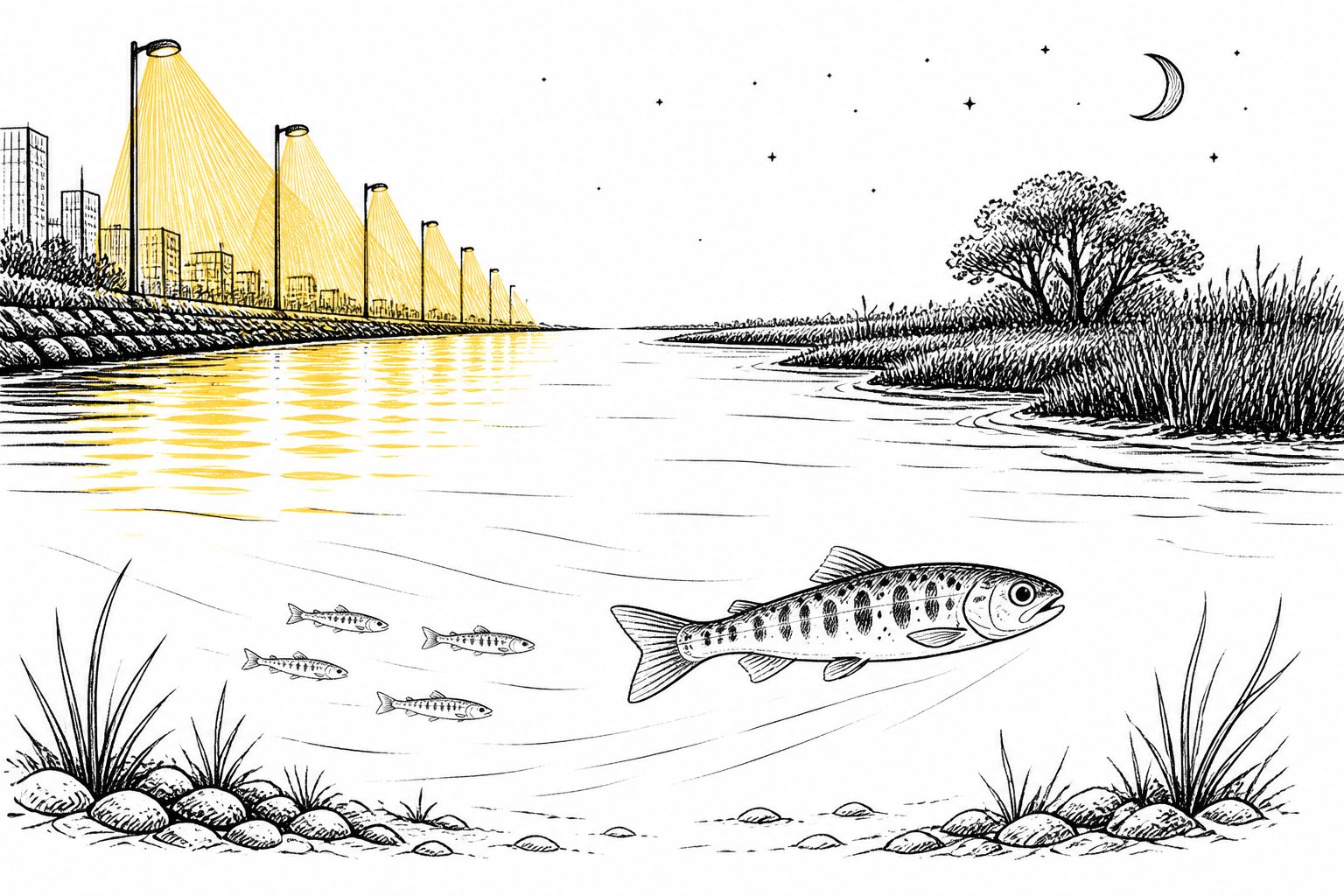
Researchers examined how artificial light at night may affect juvenile Chinook salmon migrating through the Sacramento-San Joaquin Delta toward the ocean. Light can alter the fish's behavior and make them more vulnerable to predators during this journey.
Climate & Environment1 month ago
Dimming night lights could help more young salmon cross California's delta
Removing artificial light along the Sacramento-San Joaquin Delta was predicted to add up to 1,123 successful migrants per million attempts.
What dimming could do
The researchers conservatively predicted that removing all sources of artificial light at night in the Delta could allow up to 1,123 additional successful salmon migrants per million migration attempts. The estimate varied with the baseline rate at which salmon successfully travel through the Delta and with how strongly the fish are attracted to or move toward light.
Why the light matters
The findings suggest that reducing artificial light could provide a small but worthwhile benefit for migrating salmon. The researchers argue that addressing light in this system could be less costly and contentious than many other habitat restoration actions, although the abstract does not quantify those costs or compare specific projects.
Evidence and caveats
This is a population-level estimate based on the relationship between artificial light, juvenile salmon behavior and vulnerability to predation during migration. It is not a report of a completed corridor-wide light-removal experiment. The predicted benefit depends on assumptions about migration success and the fish's light-related behavior, and the abstract does not provide the underlying sample sizes or observed effect sizes.
// Source
Biology Letters · 2026 · DOI: 10.1098/rsbl.2026.0304
Authors: Brendan M. Lehman, Benjamin P. Burford, Thomas R. Nelson, Nicholas J. Demetras, Cyril Michel
Institutions: George Mason University, University of California, Santa Cruz, National Oceanic and Atmospheric Administration, NOAA National Marine Fisheries Service


