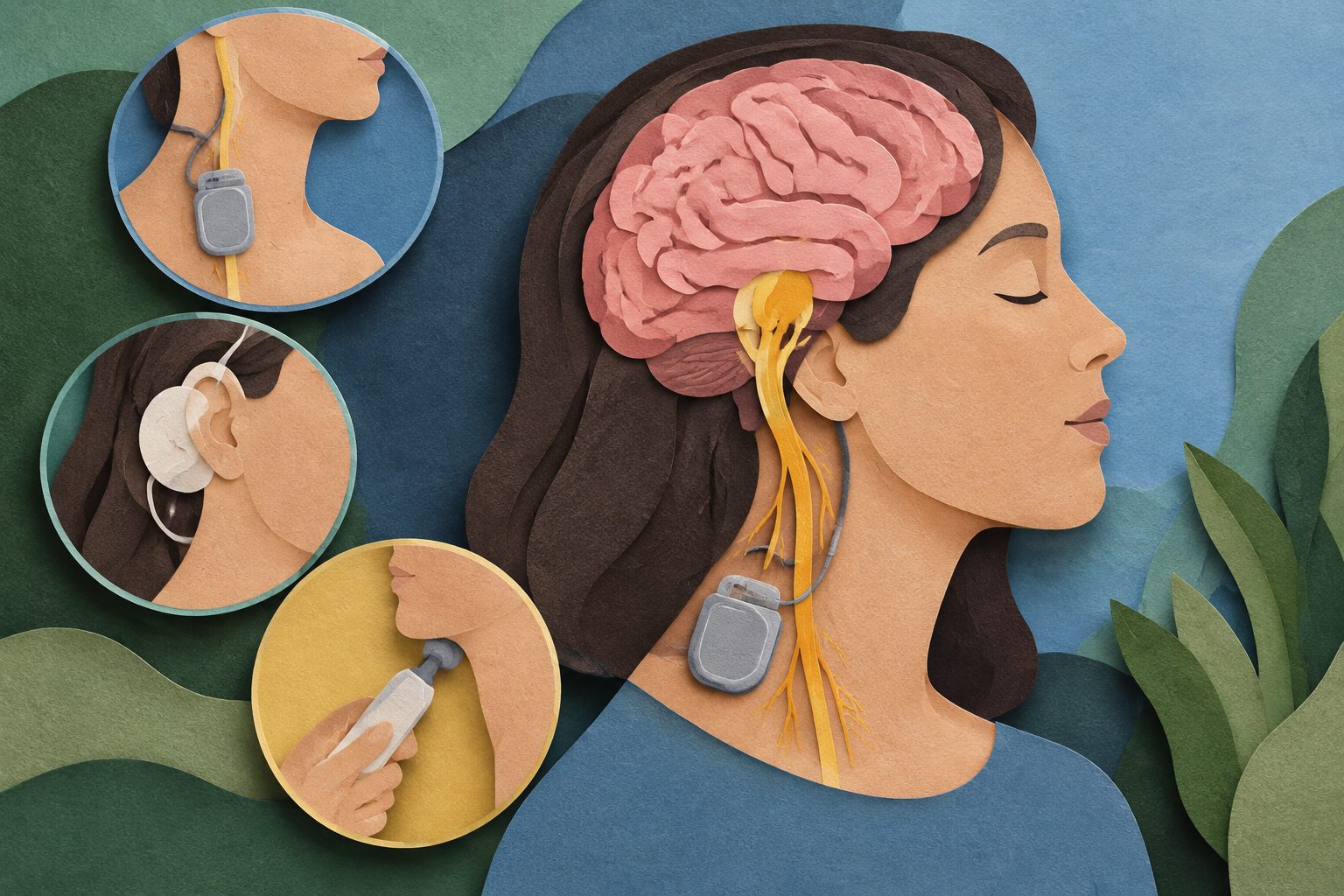
A review of 33 trials found possible benefits across several approaches, but the evidence remains low certainty.
Researchers reviewed 33 randomised controlled trials involving 2,664 people with depression and compared nine electrical-stimulation methods. Overall, electrical stimulation was associated with a higher clinical response rate, lower depression scores and a generally favourable safety profile.
The methods did not perform identically. Transcutaneous auricular vagus nerve stimulation ranked highest for improving response rates, while transcranial direct current stimulation ranked highest for reducing scores on a standard depression scale. The authors say larger, higher-quality trials are needed to confirm these comparisons.
What the review found
Across the included trials, electrical stimulation was associated with a higher clinical response rate than comparison treatments, with an odds ratio of 2.78 and a 95% confidence interval of 1.50 to 5.16. It was also associated with lower depressive symptom severity, with a standardised mean difference of −0.90 (95% confidence interval −1.27 to −0.54). The analysis found no clear sign of worse safety overall; its estimate for safety had an odds ratio of 0.88 (95% confidence interval 0.52 to 1.49).
The results varied by method. Transcutaneous auricular vagus nerve stimulation ranked highest for improving clinical response, with an odds ratio of 4.12 (95% confidence interval 3.08 to 5.16). Transcranial direct current stimulation ranked highest for reducing Hamilton Depression Rating Scale scores, with a standardised mean difference of −1.70 (95% confidence interval −2.80 to −0.60). These rankings describe relative performance within the network analysis, not proof that either method is best for every patient.
Why the comparison matters
Depression treatments can differ in how well they work and how well people tolerate them. By comparing several electrical-stimulation approaches in one analysis, the review offers an indication that some methods may be more useful for improving response rates while others may be more useful for reducing symptom scores.
The findings do not establish that one method should replace existing treatments or that the apparent differences will apply to all patients. Their main importance is in identifying comparisons that can be tested in stronger clinical trials.
Evidence and caveats
This was a systematic review and network meta-analysis of randomised controlled trials. The researchers searched 13 databases for trials published through 16 July 2026, assessed risk of bias with the Cochrane RoB 2 tool and rated certainty using the GRADE framework. Sensitivity analyses supported the reported results.
However, the authors judged the certainty of the evidence to be low. The analysis included only 33 trials and 2,664 participants across nine modalities, and the abstract does not provide further details about differences between the studies or the comparison treatments. The results therefore require confirmation in larger, higher-quality randomised trials.
// Source
Frontiers in Psychiatry · 2026 · DOI: 10.3389/fpsyt.2026.1962608
Authors: Jiajin Chai, Song Li, Junhao Huang, 姚绍岩, Lei Zhou, Xichen Chen, Fei Liu, Changliang Ji, Hanyu Chen, Shu Tan, Rui Li, Runjuan Ma, Shikun Li, Shouping Zhao
Institutions: Kunming Medical University, First Affiliated Hospital of Kunming Medical University, Heilongjiang University of Chinese Medicine, Yunnan University of Traditional Chinese Medicine