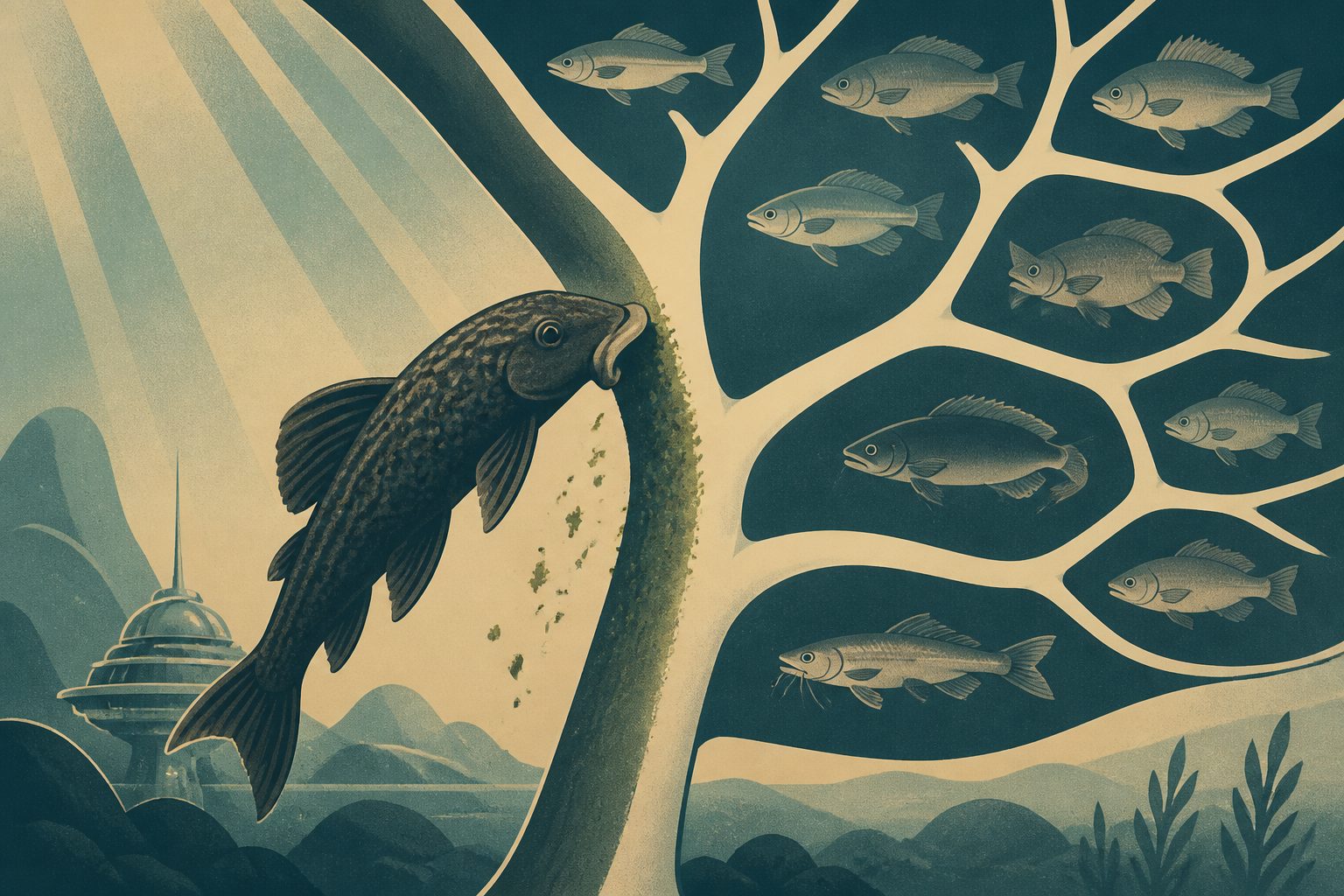
A new genome places its wider group as the earliest branch of the cypriniform fish lineage and clarifies two others.
Researchers generated the first chromosome-level genome assembly and annotation for the Chinese algae eater, a member of the algae-eater family that has been poorly represented in genomic resources. They combined this genome with 42 other fish genomes to compare conventional DNA-sequence analyses with analyses based on conserved blocks of gene order.
Both approaches placed algae eaters as the sister lineage to all other cypriniform fishes, resolving a long-standing uncertainty. Sequence-based analyses gave weak support for the remaining major branches, while the gene-order analysis strongly supported suckers as the sister group to minnows and carps.
The fish family tree
The study found that algae eaters are the sister lineage to all other cypriniform fishes, which include minnows, carps, loaches and suckers. The researchers also found a strongly supported sister relationship between Catostomidae, the sucker family, and Cyprinoidei, the group containing minnows and carps.
This result came from microsynteny, the conservation of small blocks of neighboring genes in the same order. The sucker–minnow-and-carp relationship was supported by three to 12 times more shared gene-order clusters than the alternative evolutionary arrangements. The study also found that these shared patterns often arose through expansions of gene families. Larger chromosome-level gene order was broadly conserved across cypriniform fishes, but smaller-scale gene order was more useful for resolving deep branches.
Why the branches matter
Cypriniform fishes are one of the most species-rich groups of freshwater fishes, yet relationships among their four major subgroups have remained uncertain. The study provides a more clearly supported framework for their early evolutionary history, which can help organize future research on this diverse lineage.
More broadly, the results suggest that gene order can provide useful evolutionary information when DNA-sequence comparisons do not clearly resolve older branches. The conserved blocks identified in particular genomic regions may also offer clues to genetic features shared by specific fish groups, although the study does not establish what those features do.
Evidence and caveats
This was a comparative phylogenomic study using a newly generated chromosome-level genome for the Chinese algae eater and 42 other fish genomes. The researchers compared sequence-based trees with trees built from microsynteny patterns, and the two approaches agreed on the early branching position of algae eaters but differed in how strongly they supported relationships among the other groups.
The conclusions depend on the quality and completeness of the reference genomes. The researchers report that including fragmented genome assemblies can produce spurious results. The abstract also describes possible functional implications of conserved gene-order blocks but does not present direct tests showing that those blocks cause particular traits.
// Source
Systematic Biology · 2026 · DOI: 10.1093/sysbio/syag068
Authors: Daniel J. MacGuigan, Hannah Waterman, Jessie A. Pelosi, Nathan J. C. Backenstose, Sarah L. Chang, Milton Tan, Fabricio Almeida‐Silva, Trevor J. Krabbenhoft
Institutions: University at Buffalo, State University of New York, Ghent University, University of Arizona, University of Illinois Urbana-Champaign, Purdue University West Lafayette, Smithsonian Institution, National Oceanic and Atmospheric Administration, National Museum of Natural History, VIB-UGent Center for Plant Systems Biology, Illinois Archaeological Survey