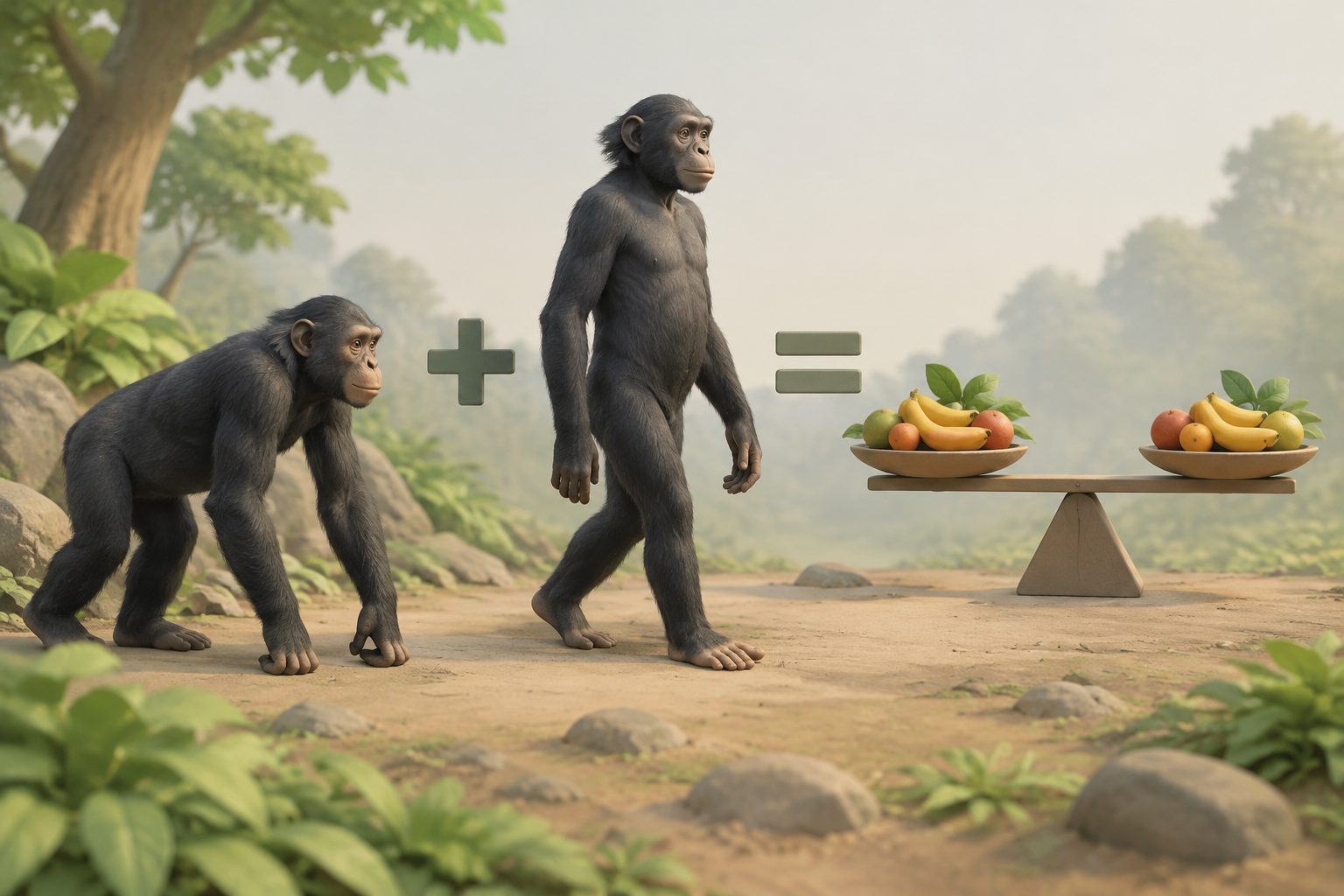
Energy estimates indicate that a mixed movement pattern, including substantial bipedalism, could have supported daily travel.
Researchers combined three-dimensional movement tracking with a biomechanical model to estimate the energy bonobos use across different forms of locomotion. Quadrupedal movement was more costly than expected from broad mammal-based predictions, while climbing vertically was the most expensive mode.
The researchers also considered bonobos’ daily travel distances and movement patterns. They estimated that travel of 0.4 to 6 kilometers accounts for 3% to 53% of daily energy use, and that even a pattern including 35% bipedalism could support 2 kilometers of daily travel.
Bonobo movement costs
The estimated net metabolic cost of transport was 10–12 joules per kilogram per meter for quadrupedal movement, compared with a mammalian prediction of about 3 joules. Vertical ascent was more costly, at 26–32 joules per kilogram per meter.
The researchers found no major overall energy penalty for arboreal movement, in part because bonobos may recover energy through exchanges between movement and height during vertical descent and while moving suspended from branches. In their model, daily travel distances of 0.4–6 kilometers used 3–53% of daily energy expenditure. Reversing the modeled proportions of quadrupedal and bipedal movement changed that estimate to 4–62%. Even with bipedalism making up 35% of movement, 2 kilometers of daily travel remained energetically feasible.
Evidence and caveats
The study uses three-dimensional tracking, a point-mass biomechanical model, estimates of muscle efficiency and field-based information about bonobo movement repertoires. Its energy values are therefore model-based estimates rather than direct measurements of every locomotor mode in the wild.
The application to early hominins is an inference from bonobo data and modeled travel patterns. The abstract does not report the number of bonobos studied or the extent to which the estimates were tested against direct metabolic measurements.