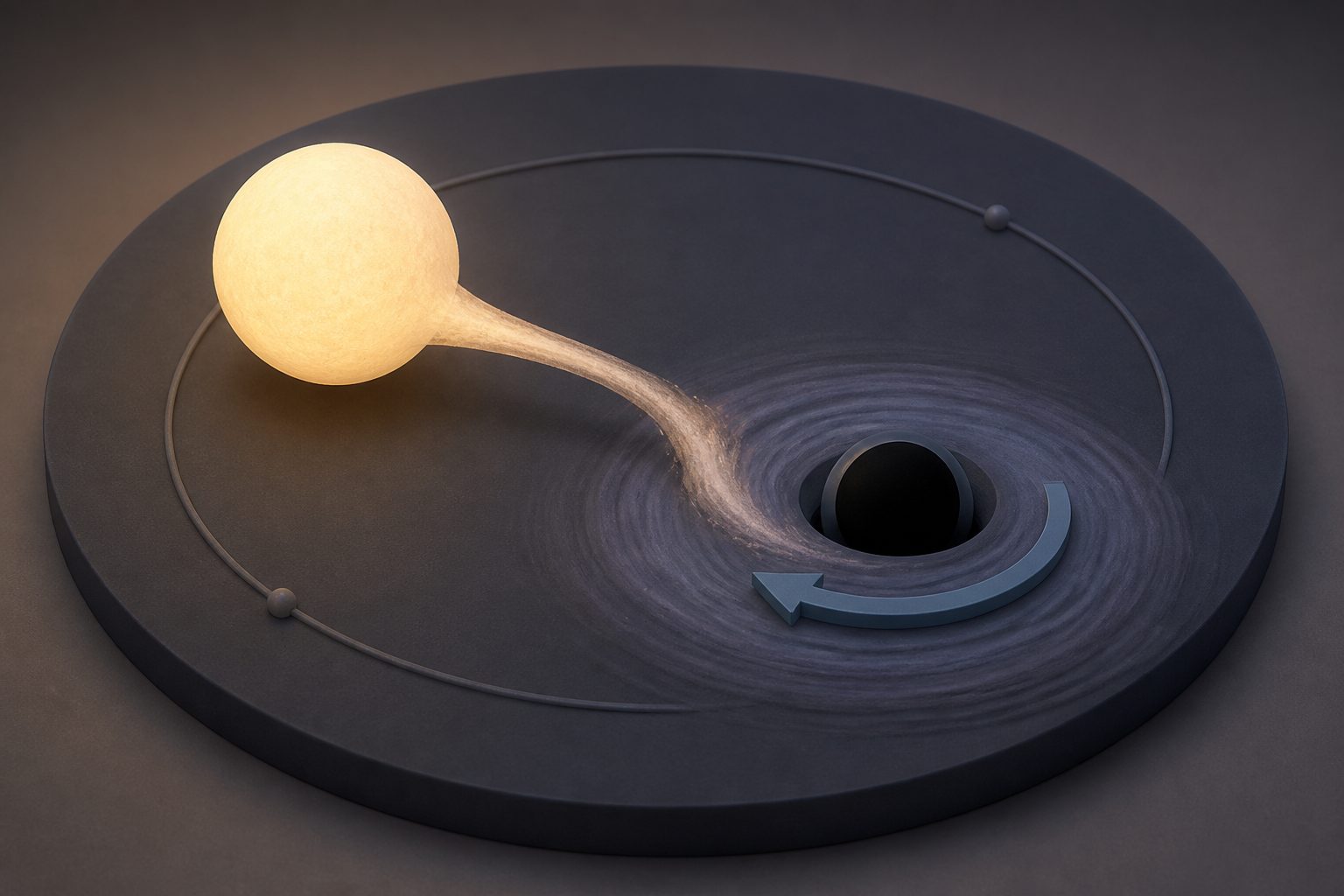
Modeling suggests isolated pairs of black holes can develop tilted or backward spins, not only pairs formed in crowded environments.
Researchers explored several ways black holes could be spun up before or during their formation, including spin inherited at birth and processes linked to the kicks that can accompany black-hole formation. They considered spins that are randomly oriented, aligned with those kicks, or perpendicular to them.
The different mechanisms produce different patterns in spin strength, spin-orbit misalignment and the effective inspiral spin, a quantity used to describe how the black holes' spins affect their approach. In the models, isolated binary systems could show spin precession and an effective inspiral spin below zero, indicating a spin component opposite to the direction of the orbit.
How isolated pairs can spin
The study relaxes the usual assumption that black holes formed from isolated massive-star binaries should have spins aligned with the orbital motion. Its models allow black holes in these systems to have misaligned spins, precessing spins and retrograde spin, meaning a spin component directed opposite to the orbital angular momentum.
The researchers considered several possible spin-up mechanisms before or during black-hole formation. These included natal spins, isotropic spin-up, and spin-up aligned with or perpendicular to the kicks received during formation. Each mechanism leaves a different pattern in spin magnitudes, spin-orbit misalignments and effective inspiral spin. In particular, the models allow isolated binaries to have an effective inspiral spin below zero.
Why spin direction matters
Spin orientation has often been used to distinguish black-hole pairs that evolved from isolated stars from pairs assembled dynamically through encounters. If isolated systems can also produce tilted or backward spins, those features are less uniquely associated with dynamically assembled binaries.
The work therefore expands the range of spin patterns that models of isolated binary evolution need to consider. It also shows why interpreting the spins of merging black holes requires accounting for more than the assumption that they simply inherit aligned spins from their progenitor stars.
Models and open questions
This is a theoretical modeling study. The abstract describes possible spin-up mechanisms and the observable patterns they would produce; it does not report a new observational sample or a direct test of which mechanism occurs in nature.
The origin of black-hole spins remains uncertain, and the abstract does not establish how common any of the proposed mechanisms are. The results show that isolated binaries can occupy regions of spin parameter space previously associated with dynamically assembled systems, but they do not by themselves determine the formation history of an individual observed binary.
// Source
The Astrophysical Journal · 2026 · DOI: 10.3847/1538-4357/ae9f4f
Authors: Vishal Baibhav, Vicky Kalogera
Institutions: Northwestern University, Columbia University