An organic solar cell reaches 20% efficiency with simpler solution processing
A solvent mixture helped researchers control how the cell’s materials separated as the device was made, avoiding an extra processing step.
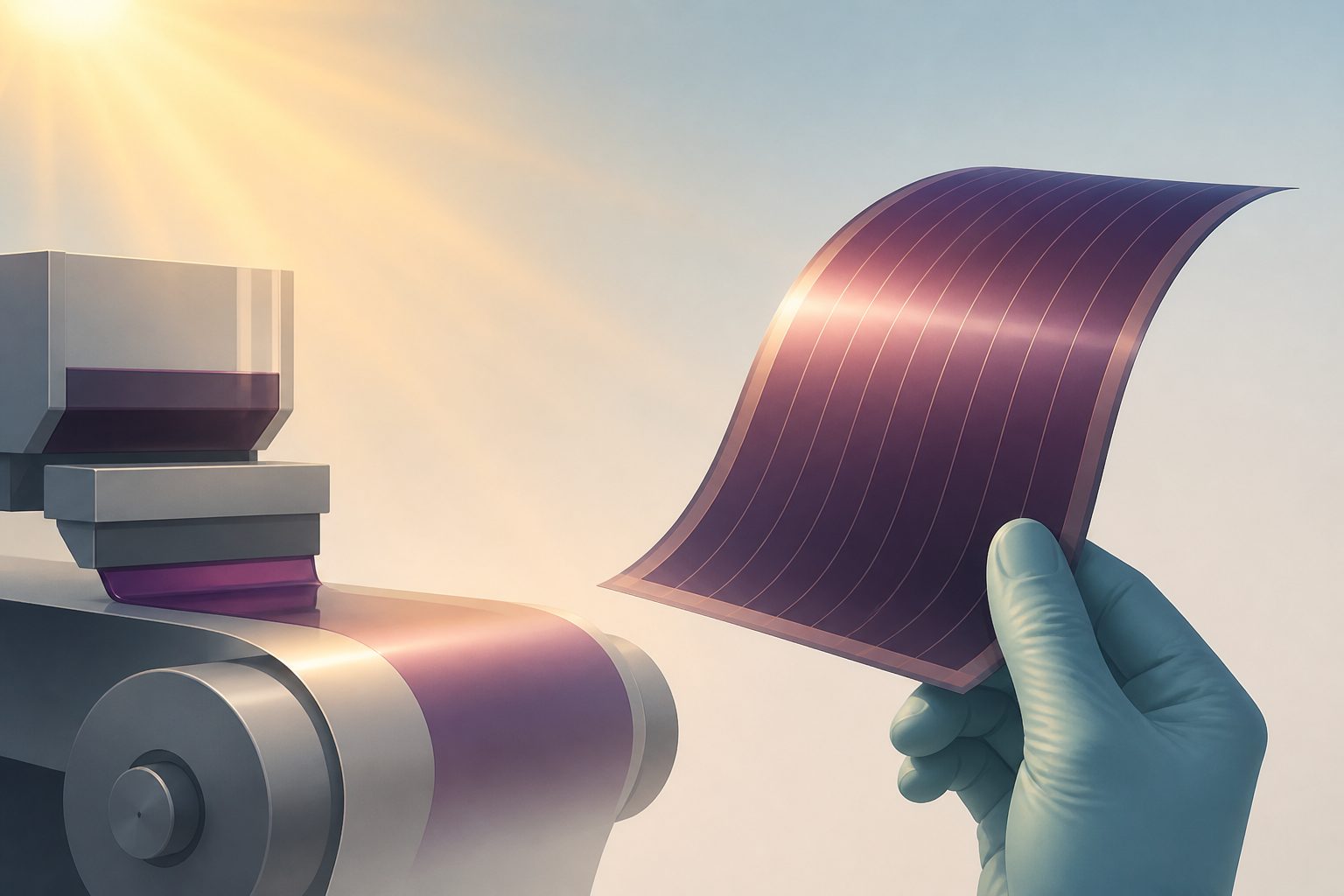
Editorial illustration — not from the study.
The team used a mixture of chloroform and carbon disulfide to control how two light-absorbing materials mixed and separated while the solar-cell layer dried. This produced a structure intended to help split light-generated excitons, move electrical charges and reduce their recombination.
A device made from the D18 and L8-BO materials reached 20.11% efficiency, with a certified value of 19.69%. Devices made with a 300-nanometer-thick active layer reached 18.89%, while a 20.17-square-centimeter device reached 15.12%.
How the cells were made
The researchers engineered the interaction between the donor and acceptor materials during solution casting by adjusting the solvent system. They report that the chloroform–carbon disulfide mixture created a useful balance between mixing and separation, forming a network that supported charge transport and reduced recombination.
The resulting as-cast D18:L8-BO solar cell reached a power-conversion efficiency of 20.11%, with a certified efficiency of 19.69%. The researchers also report enhanced photostability, an efficiency of 18.89% for a 300-nanometer-thick device and 15.12% for a 20.17-square-centimeter device. They established a quantitative relationship between efficiency and the Flory–Huggins interaction parameter, a measure of how well the materials mix.
Why simpler processing matters
As-cast processing means the active solar-cell layer is made directly from a solution without the additional treatment often used to create the desired internal structure. Controlling material mixing during this step could simplify fabrication while retaining high efficiency.
The results are relevant because they combine high efficiency in a small device with demonstrations using a thicker layer and a larger 20.17-square-centimeter device. The large-area device was less efficient than the small device, but it shows that the processing approach can be applied beyond the smallest test format.
Evidence and caveats
This is a journal research article reporting laboratory measurements of organic solar-cell devices. The abstract identifies the materials, solvent mixture, efficiencies, device thickness and large-device area, and says the efficiency of the main device was independently certified at 19.69%.
The reported results concern a specific material pair and solvent system. The abstract does not give the duration or conditions of the photostability tests, nor does it establish performance in commercial-scale manufacturing or across a broad range of materials. The large-area device reached 15.12% efficiency, below the 20.11% result for the main device.
Researchers developed a system that analyzes live data from grid sensors and other devices to predict faults in a simulated power network. In tests using a 33-bus IEEE network with injected faults, it achieved up to 96.4% accuracy while making predictions in less than a second.
Researchers developed a Schirmer strip that simultaneously indicates glucose and pH through color changes, with smartphone image analysis helping assess the results. In tests using artificial tear fluid, the glucose signal appeared within 30 seconds and had a visual detection limit of 0.5 mM.
Researchers have used hydrogen plasma to process Nd-Fe-B magnet machining waste, separating it into metallic iron and a rare-earth oxide-rich fraction. The process also formed rare-earth hydrides, creating feedstocks that could be used in further magnet production without acid.