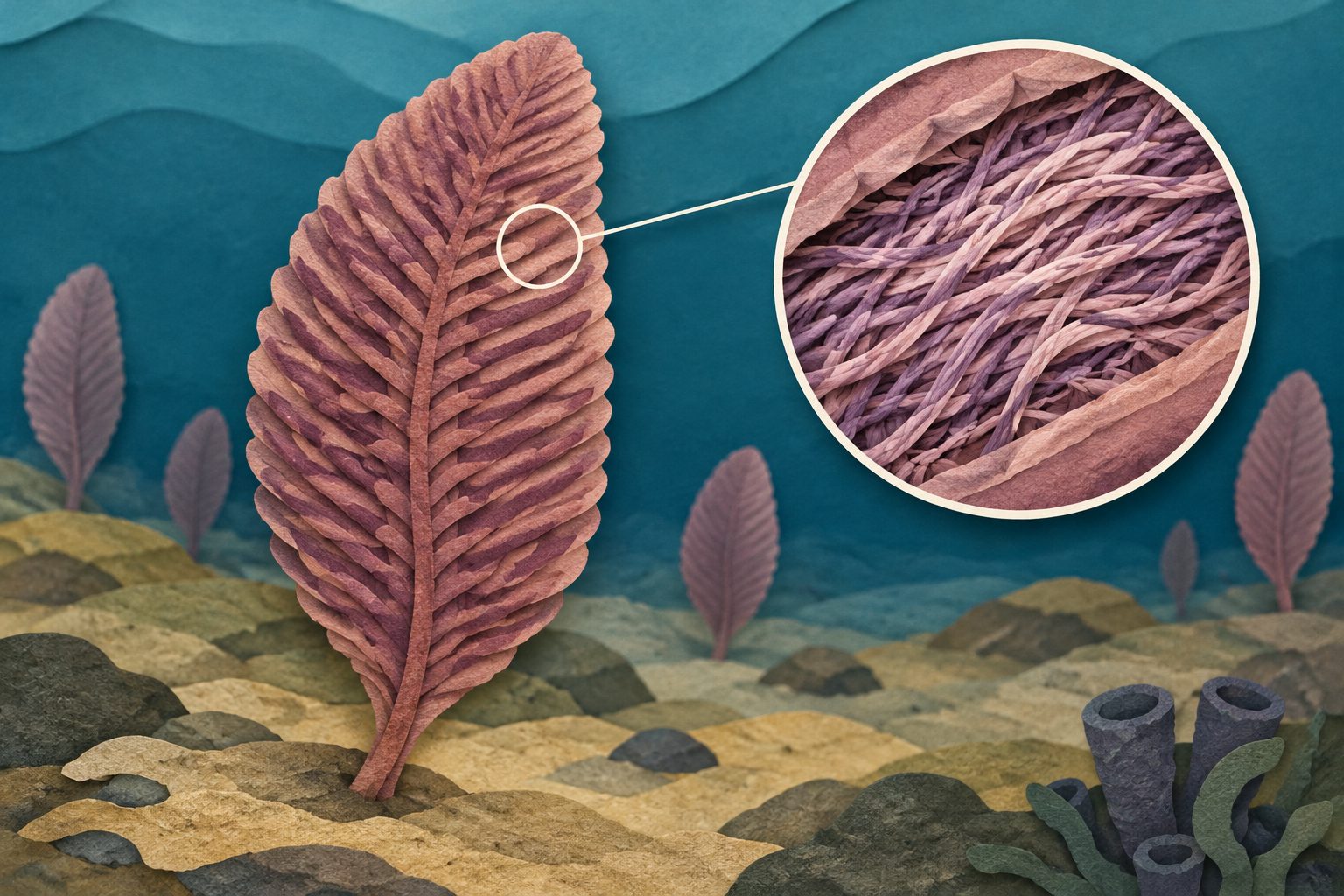
Biomechanical analyses suggest the fossil frond Charniodiscus had collagen-like tissues and a stem able to bear loads.
Researchers combined fossil shape analysis, numerical simulations and mathematical scaling methods to investigate the twisted forms commonly preserved in Charniodiscus. They concluded that the twists are consistent with three-dimensional deformation caused by instability in sediment-laden water flows.
The mechanical properties inferred from these deformations are consistent with densely aligned collagen fibres when assessed under a broad early-animal framework. The results also point to a load-bearing stem and specialized functions within the organism, strengthening the proposal that Charniodiscus was part of the early animal lineage known as total-group eumetazoans.
What the frond was made of
The analyses indicate that Charniodiscus’s commonly preserved twisted forms reflect three-dimensional twisting caused by flow-related instability. Mapping these deformation patterns allowed the researchers to estimate the organism’s Young’s modulus, a measure of stiffness. The estimated stiffness is consistent with densely aligned collagen-like fibres under a eumetazoan framework.
The results point to a load-bearing stem and substantial functional specialization. The inferred tissue properties are largely incompatible with tissues expected in non-animal organisms, sponges or placozoans, and independently strengthen the proposal that Charniodiscus was a total-group eumetazoan.
Why the body plan matters
The study offers mechanical evidence about the internal construction of an organism from the Ediacaran, when large and complex fossils first appear but their tissues are difficult to determine. If the interpretation is correct, collagen-like, load-bearing tissues were present in an early animal lineage and helped support larger size, more complex body plans and functional specialization.
That would place Charniodiscus among organisms showing an important stage in the evolution of complex animal bodies, while also adding evidence to an ongoing question about the biological identity of Ediacaran fronds.
Evidence and caveats
The conclusions are based on fossil morphology, numerical simulations and dimensional analysis rather than direct preservation of collagen fibres or other internal tissues. The researchers inferred tissue stiffness by comparing deformation patterns with biomechanical models, including a model framed around eumetazoan tissues.
The abstract does not provide the numerical stiffness estimate or describe the fossil sample size. The results therefore support, rather than directly demonstrate, the presence of collagen-like fibres and the organism’s placement within the early animal lineage.
// Source
Proceedings of the Royal Society B Biological Sciences · 2026 · DOI: 10.1098/rspb.2026.1630
Authors: Zekun Wang, Princess Buma-at, Nile P. Stephenson, Frances S. Dunn, Qianze Zhuang, Emily G. Mitchell, Imran Alexander Rahman
Institutions: University of Bristol, University of Cambridge, Dalian University of Technology, Dalian University, Bridge University, Natural History Museum, Museum of London