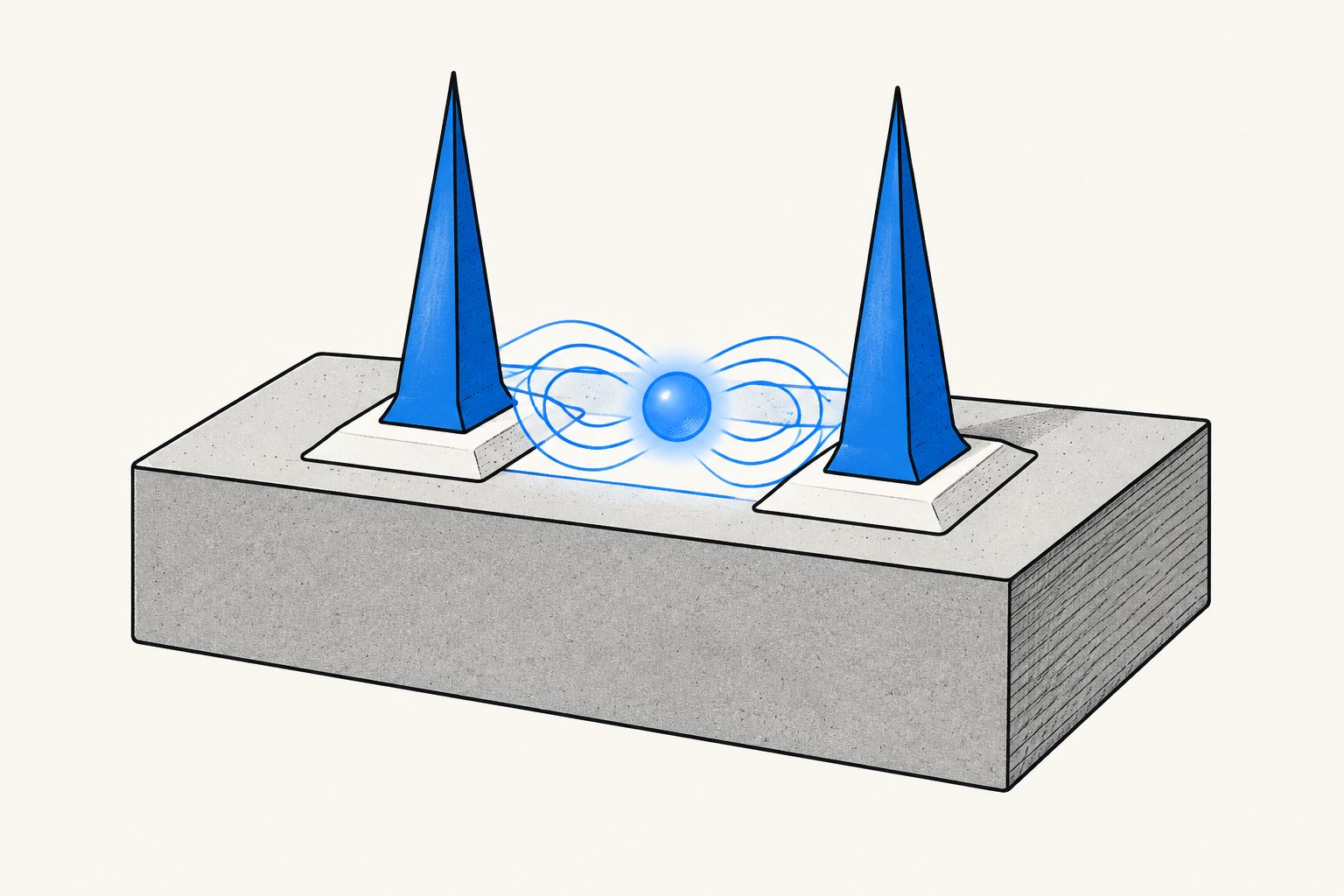
The experiment used a strongly nonlinear light–ion interaction to create and probe localized states with two to five components.
The team worked with the ion’s center-of-mass motion, a mechanical quantum oscillator, outside the usual regime where the interaction between light and the ion can be treated as nearly linear. By using this stronger nonlinearity and controlled dissipation, they engineered stable manifolds of nonclassical states with rotational patterns containing two to five components.
They also selected Hamiltonians—descriptions of the system’s energy and evolution—that enabled measurements on these state manifolds. The work shows that high-order nonlinear processes can be used not only as a complication but as a resource for controlling quantum oscillator states.
What the ion created
Using a single beryllium ion in a surface Penning trap, the researchers controlled its center-of-mass motion with a light field while operating outside the linearized Lamb–Dicke regime. They used nonlinear reservoir engineering, in which carefully chosen drives and optical pumping guide the oscillator toward selected states.
The experiment generated localized manifolds resembling Schrödinger-cat states with two, three, four and five components. The researchers engineered combinations of excitation-raising and excitation-lowering processes and examined the resulting steady states. They also selected system Hamiltonians that allowed measurements to be performed on these manifolds.
Why these states matter
Quantum oscillators are being explored as building blocks for error-corrected qubits, quantum computers, sensors and transducers. The demonstrated control of states with higher-order rotational symmetry expands the range of nonclassical oscillator states that can be prepared and measured.
The authors say this approach could contribute to bosonic quantum error correction, computation and sensing. In particular, multicomponent cat states are being considered as possible ways to address errors such as oscillator dephasing, but this experiment demonstrates state control rather than a complete error-correction system.
Evidence and open questions
This is an experimental study using one trapped beryllium ion and its single motional oscillator. The work demonstrates state preparation and measurement methods in a strongly nonlinear regime; it does not establish the performance of a quantum error-correction code, computer or sensor based on these states.
The authors note that designing controls in this regime remains difficult and may require heuristic or numerical optimization. They also identify open questions about controlling multiple interacting oscillators, including how ion transport and changes to the trapping potential would affect stabilized cat-state manifolds. The provided excerpts do not report a quantitative error-protection advantage or application-level performance.
// Source
Science Advances · 2026 · DOI: 10.1126/sciadv.aee5380
Authors: Matteo Simoni, Ivan Rojkov, M. Mazzanti, Wojciech Adamczyk, A. Ferk, Pavel Hrmo, Shreyans Jain, Tobias Sägesser, Daniel Kienzler, Jonathan Home
Institutions: ETH Zurich, Institute for Quantum Electronics