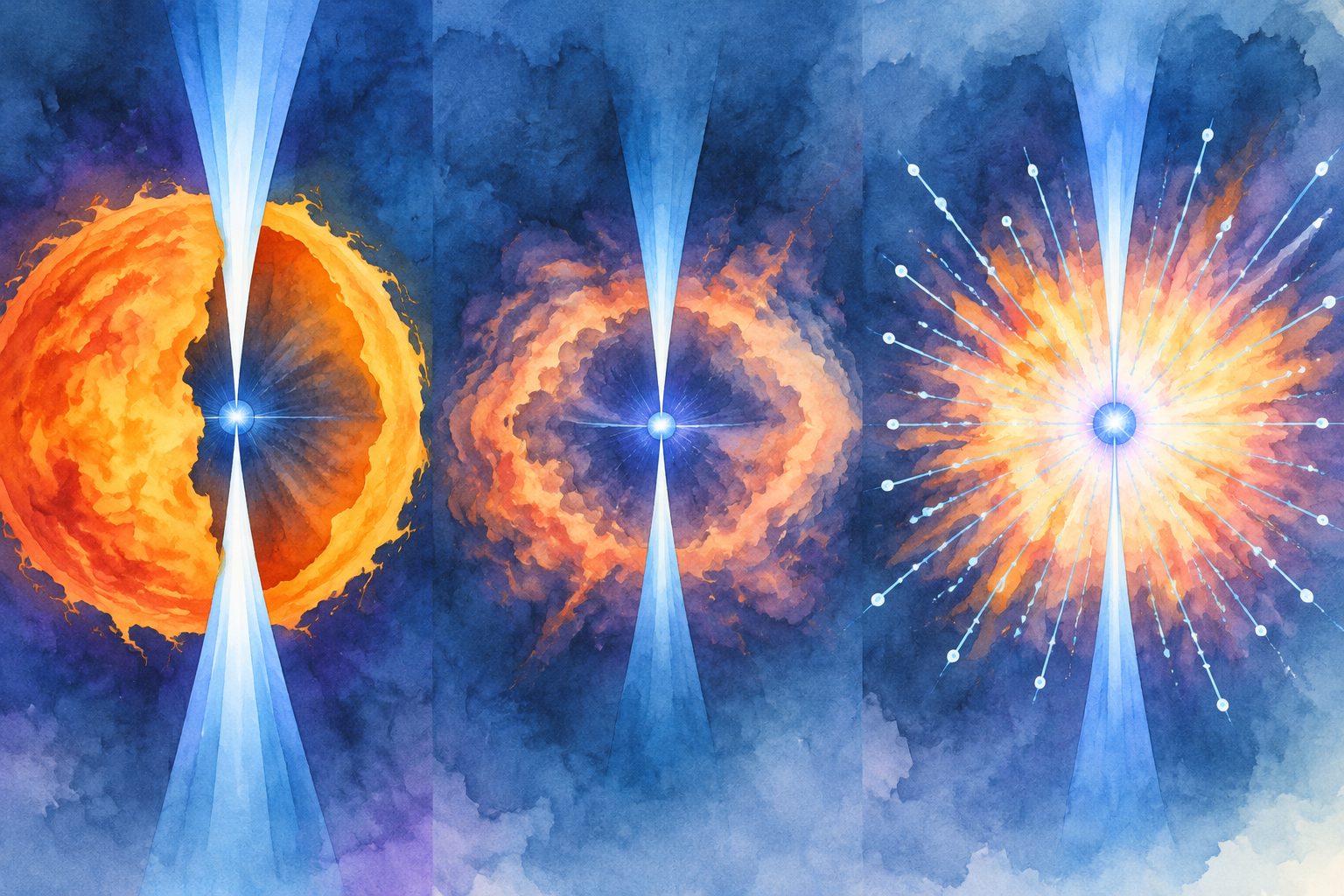
One-dimensional models suggest the jittering-jets process would begin first in most, but not all, tested massive-star models.
Researchers used the MESA stellar-evolution code to estimate when the jittering jets explosion mechanism could begin. They treated that point as the time when the innermost convective layer is accreted onto the newly formed neutron star, potentially supplying the fluctuations needed for intermittent jets.
The models covered hydrogen-rich, hydrogen-stripped and helium-and-hydrogen-stripped stars. In most, but not all, models, a strong convective zone lay within the inner region corresponding to a maximum neutron-star baryonic mass of about 2.65 times the Sun’s mass. The authors compared the resulting expected timing with the delayed neutrino mechanism.
When the jets could begin
Across the tested models, the jittering jets mechanism was expected to start before the neutrino-driven mechanism had fully revived the stalled shock in most cases, including cases where the neutrino mechanism might eventually have produced an explosion. The result did not apply to every model.
Most, but not all, of the models with initial masses from 12 to 40 times the Sun’s mass contained at least one strong convective zone inside the roughly 2.65-solar-mass neutron-star mass limit. Such a zone can provide the conditions the jittering-jets mechanism needs. The simulations included 12 initial masses and three envelope conditions: full envelopes, hydrogen-stripped envelopes, and envelopes stripped of both hydrogen and helium.
Why the timing matters
The study addresses a basic difference between two competing explanations for core-collapse supernova explosions: whether jets or delayed neutrino heating would begin powering the explosion first. Its timing comparison supports the possibility that jittering jets could operate early enough to be important in many of the stellar models examined.
The authors say the results add support to the jittering-jets mechanism as a viable explanation for core-collapse supernova explosions. They do not show that it is the mechanism used by every such explosion, because some models did not meet the study’s condition for the process to begin first.
Evidence and caveats
The evidence comes from one-dimensional stellar-evolution calculations with MESA, not from a direct three-dimensional simulation of a jet-powered explosion. The study estimates the jittering-jets start time using the accretion of an inner convective layer onto the newborn neutron star. It then compares that estimate with the expected timing of shock revival by the neutrino-driven mechanism.
The authors note that three-dimensional calculations find larger convective velocities and fluctuations than one-dimensional models. They also do not include precollapse core rotation, and current numerical codes cannot directly resolve the small-scale magnetic reconnection involved in launching the intermittent jets. These limitations mean the simulations test whether the required conditions and timing are plausible, rather than directly demonstrating that the jets produce an observed supernova.
// Source
The Astrophysical Journal · 2026 · DOI: 10.3847/1538-4357/aeb542
Authors: Nikki Yat Ning Wang, Dmitry Shishkin, Noam Soker
Institutions: Technion – Israel Institute of Technology