A thorium clock searches for signs that dark matter changes nature’s constants
Researchers stabilized a laser to a thorium-229 nuclear transition and used the clock to look for changes linked to dark matter.
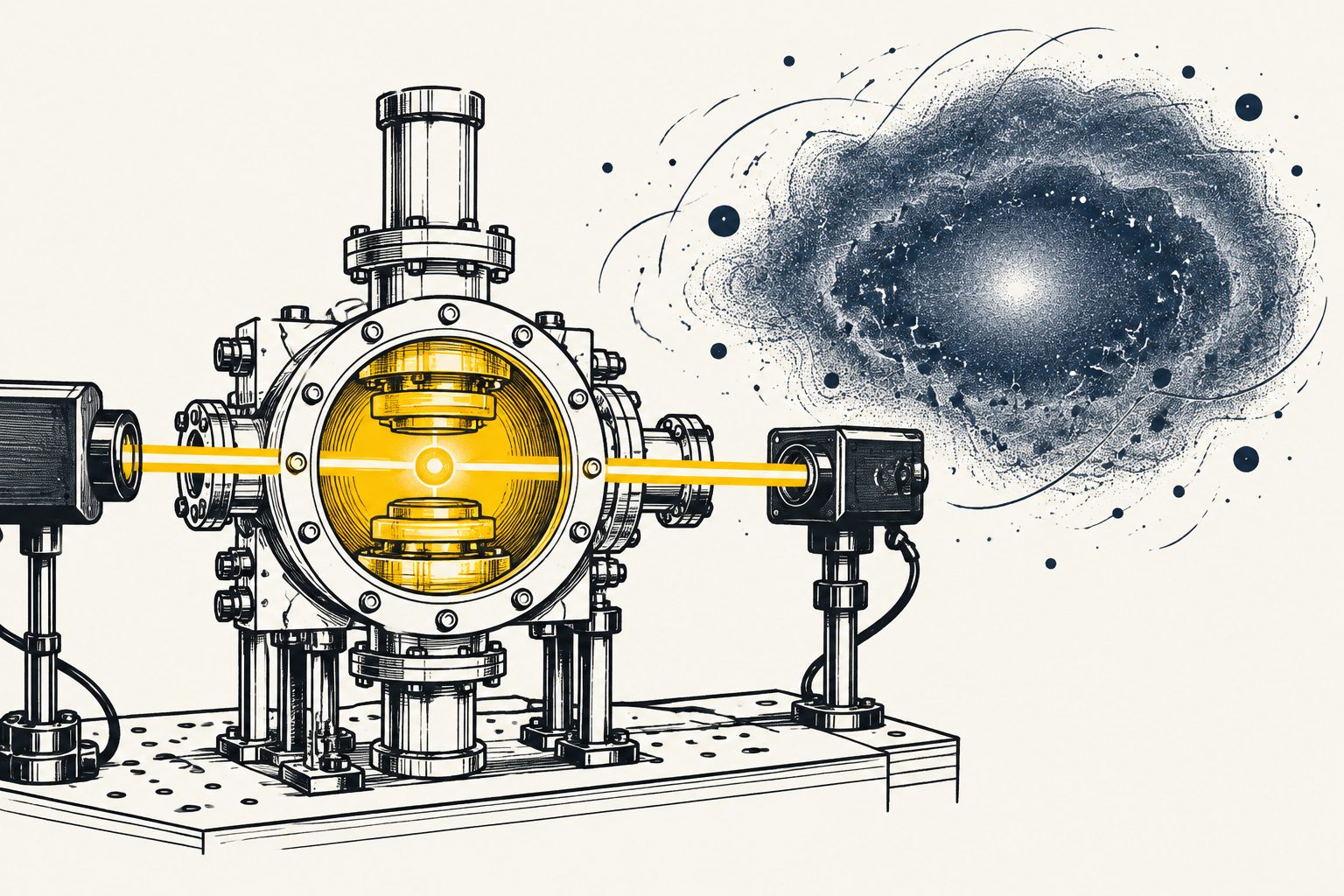
Editorial illustration — not from the study.
The team stabilized a continuous-wave laser to thorium-229’s 148-nanometre nuclear transition using rapid feedback from absorption spectroscopy. The thorium nuclei were embedded in a millimetre-sized calcium fluoride crystal kept at room temperature, and a subharmonic of the laser radiation was compared continuously with a single-ion ytterbium clock.
The nuclear clock reached a shot-noise-limited fractional frequency instability of 3 × 10⁻¹²/√(τ/s), approaching 10⁻¹⁵ after one day of operation. The researchers searched for periodic fluctuations and slow drifts in the nuclear transition energy over timescales from 20 seconds to one day, placing constraints on models of ultralight dark matter.
What the thorium clock measured
The researchers realized a thorium-229 optical nuclear clock by locking a laser to the isotope’s 148-nanometre nuclear transition. Its fractional frequency instability was 3 × 10⁻¹²/√(τ/s), where τ is the averaging time in seconds, and it approached 10⁻¹⁵ over one day of operation.
They used the clock to search for periodic fluctuations and slow changes in the transition energy. The resulting constraints on ultralight dark matter models compete with the best atomic-clock limits for dark matter coupling to photons and improve on previous measurements for coupling to the strong force. The abstract reports no detection of dark matter effects.
Why a nuclear clock matters
Nuclear transitions can respond differently to outside disturbances than transitions involving an atom’s electrons. The thorium-229 clock therefore provides another precision instrument for testing whether ultralight dark matter could alter the strengths of fundamental interactions over time.
The reported limits show that this clock can already contribute to dark matter searches, especially for possible coupling to the strong force. The authors also project that future devices could improve the clock’s instability by several orders of magnitude, although those improvements have not yet been demonstrated here.
Evidence and limits
This is a direct experimental realization and measurement of a thorium-229 nuclear clock, with its performance compared against a single-ion ytterbium clock. The dark matter result comes from searching the clock data for periodic fluctuations and slow drifts over timescales between 20 seconds and one day; it is a set of constraints on models, not a detection of dark matter.
The reported clock performance is the result achieved in this experiment. Larger future improvements are projections, and the abstract does not give details such as the duration of the full data set, systematic-error budget or how the limits vary across individual dark matter models.
A theoretical study proposes an experiment in which a mass placed in a quantum superposition could produce an effectively repulsive gravitational effect on another particle. The effect would arise from quantum interference and, if observed, would conflict with general relativity’s description of gravity as always attractive.
Researchers report that silicon spin qubits can perform precise operations in parallel, overcoming a major source of error during simultaneous control. In a five-qubit array, gate fidelities stayed above 99.99% for up to three qubits and above 99.9% when all five operated together.
A survey of MESSENGER measurements identified 116 candidate magnetic reconnection layers near Mercury’s magnetopause. The structures appear to recur under the planet’s typically low-Alfvén-Mach-number solar wind, but they cannot yet be confirmed as reconnection outflows.