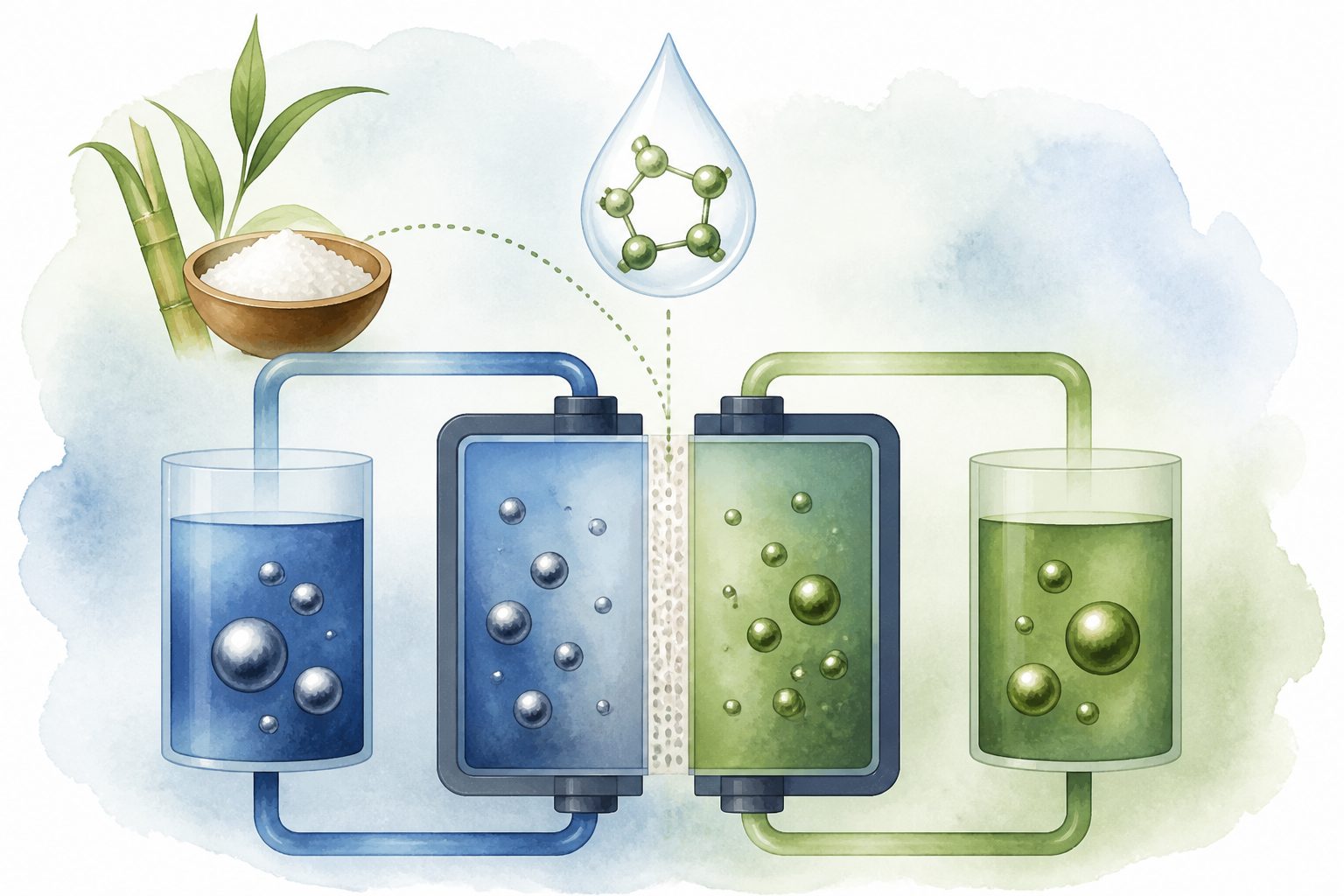
The additive isomalt reduced hydrogen formation and guided zinc deposits into a more compact, reversible layer.
Alkaline zinc–iron flow batteries are being studied for large-scale energy storage, but unwanted hydrogen formation and uneven zinc buildup can reduce their performance. Researchers report that isomalt changed the chemical environment around a porous carbon electrode and helped control how zinc was deposited and removed.
The additive also reduced water’s availability for hydrogen formation in the electrolyte. In tests, the modified battery cycled for over 500 cycles at 20 mA cm⁻², while a full cell reached an energy efficiency of 87.5%, higher than the battery using the unmodified electrolyte.
How isomalt changes zinc growth
The researchers found that isomalt changes the local hydrogen-bond network in the electrolyte and lowers water activity, which suppresses hydrogen evolution. At the carbon electrode, isomalt formed a hydroxyl-rich layer that made zincate transport more even and directed zinc growth toward a preferred crystal orientation.
These changes lowered the resistance to charge transfer and the activation barrier for the zinc electrode. An alkaline zinc–iron flow battery containing isomalt cycled stably for over 500 cycles at 20 mA cm⁻². In full-cell tests, the optimized battery reached an energy efficiency of 87.5%, outperforming the battery with the original electrolyte.
Evidence and open questions
The findings come from electrolyte, electrode and full-cell electrochemical tests reported in a journal article. The abstract reports stable cycling for over 500 cycles at 20 mA cm⁻² and an energy efficiency of 87.5% in full-cell tests.
The abstract does not provide details about the battery’s physical scale, performance over longer periods, operating conditions beyond the stated current density, or how the additive compares with a wider range of alternatives. It therefore supports the reported laboratory performance but does not by itself establish how the system would perform in large-scale or commercial operation.
// Source
Nano-Micro Letters · 2026 · DOI: 10.1007/s40820-026-02333-2
Authors: Hui Chen, Lukang Han, Shaohua Han, Weijie Fan, Xuhong Yin, Junqing Pan, Manal S. Ebaid, Yuxi Song, Fuyu Chen, Jiang Zhou
Institutions: Central South University, Beijing University of Chemical Technology, Northern Border University, Yancheng Institute of Technology