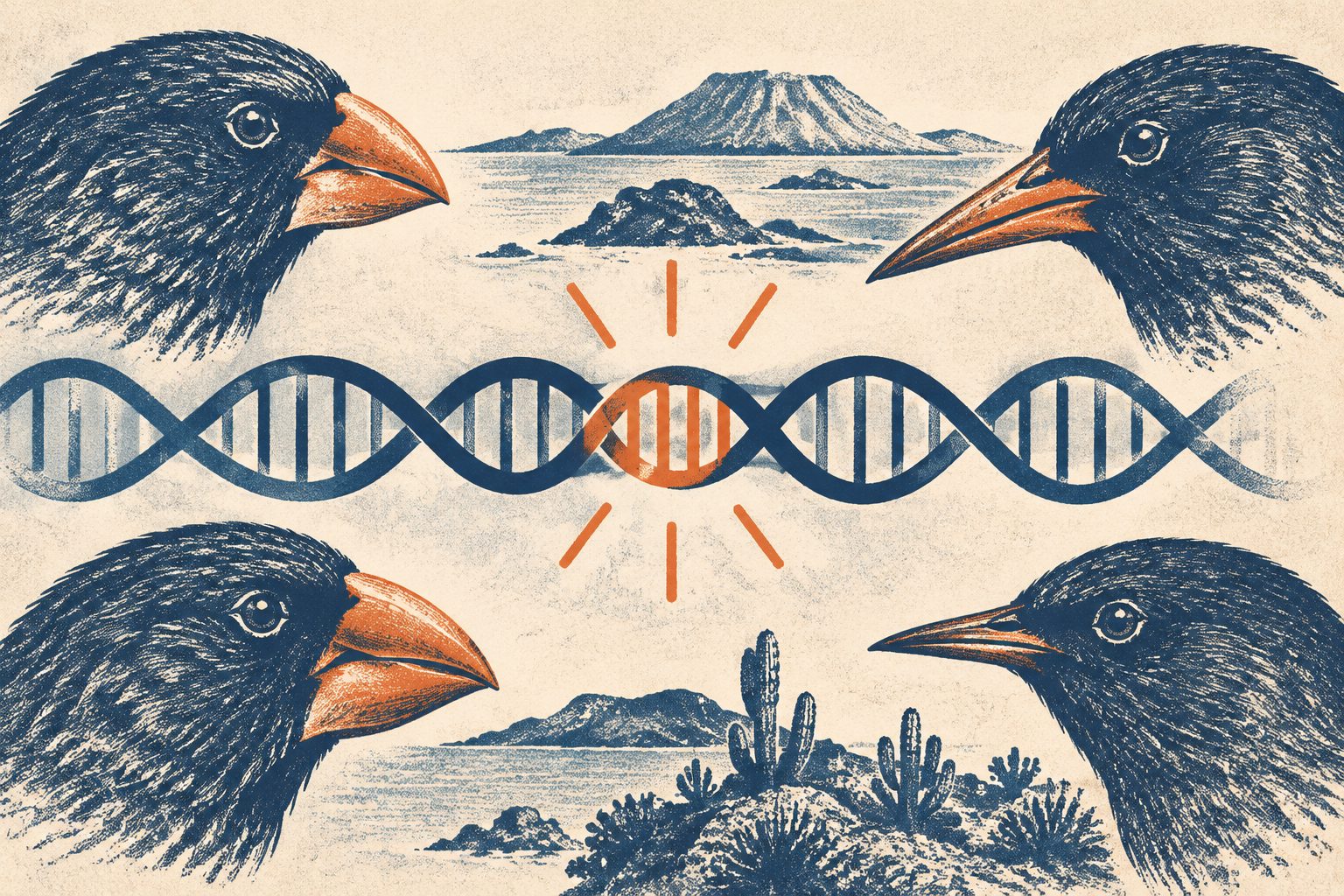
The finding links a supergene to beak and body size differences even as closely related finches continue to exchange genes.
Researchers combined whole-genome data with measurements of morphology in Camarhynchus tree finches, which diversified during the past 100,000 years. The birds show marked physical differences even though their genomes are otherwise only shallowly separated.
The team identified several highly differentiated genomic regions, including G03, a supergene associated with beak and body size. In two species living in the same area, most of the genetic difference between them was concentrated at G03, while different forms of the region appear to have diverged early in the group’s evolution.
The DNA behind different beaks
The researchers found several highly differentiated genetic regions in Camarhynchus tree finches, including G03, a supergene associated with beak and body size. They describe a pattern of genomic mosaicism: in two species living alongside each other, genetic differences across the rest of the autosomes were limited, while G03 was close to being fixed in different forms.
The study also found an unexpectedly wide range of G03 haplotypes, or inherited versions of the region. The small and large G03 alleles diverged early in the finches’ evolutionary radiation. The authors link this genetic difference to a shift between different physical forms and to ecological expansion among Darwin’s finches.
Evidence and caveats
The study is based on whole-genome comparisons, morphological data and analyses in a broader evolutionary context. Its results identify associations between the G03 region and beak and body size and show how genetic differentiation is distributed across the genome.
The abstract does not report the number of birds studied, the size of the morphological effects or the specific experiments used to test how G03 produces these traits. It therefore supports a strong link between the region and the observed differences, but does not provide those details needed to judge the effects’ size or how broadly they apply beyond these finches.
// Source
Nature Communications · 2026 · DOI: 10.1038/s41467-026-78507-8
Authors: Matteo Sebastianelli, Erik D. Enbody, Carl‐Johan Rubin, Carlos A. Valle, Lukas F. Keller, B. Rosemary Grant, Peter Raymond Grant, Leif Andersson
Institutions: Cornell University, Uppsala University, University of Zurich, Texas A&M University, Princeton University, Universidad San Francisco de Quito, Science for Life Laboratory, Galapagos Science Center