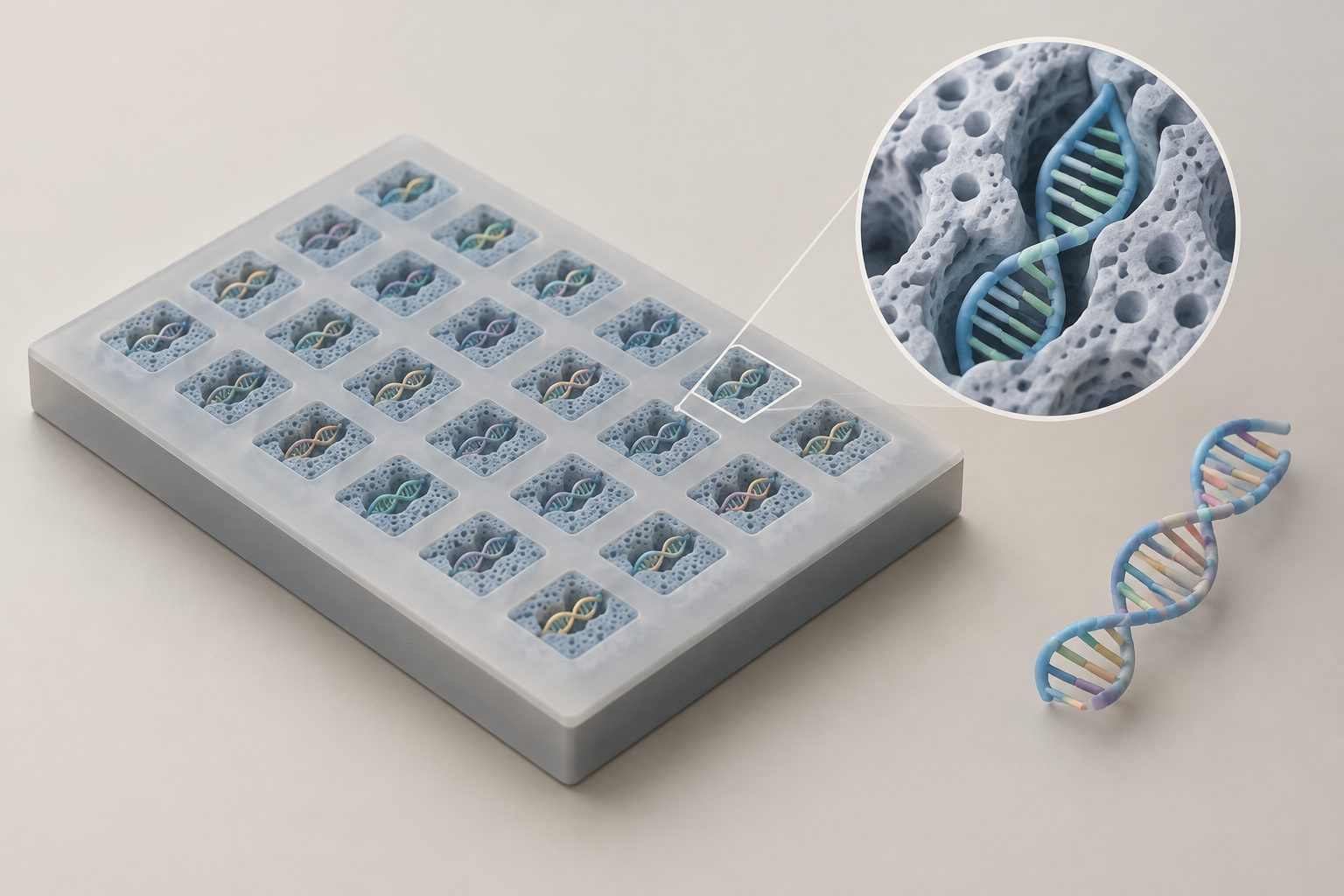
The on-chip system produced DNA with higher yields and recovered encoded information after correcting errors.
Electrochemically directed DNA synthesis can place many writing sites on a semiconductor-compatible chip, but dense arrays may produce less DNA at each site. The researchers added a porous silica film with an interconnected network of pores, increasing the effective surface area while maintaining control over the chemical reactions used to build DNA strands.
The platform produced more than 1821 pmol of DNA per square centimeter—more than 11 times the yield of a flat silica surface. It also synthesized 121-nucleotide strands in parallel and was used to encode, write and recover digital information after error correction.
Evidence and open questions
This is a journal article reporting a laboratory demonstration of a porous-silica on-chip DNA synthesis platform. The abstract reports yield measurements, comparisons with a planar silica surface, error statistics relative to other laboratory-built systems, and recovery of encoded information from 121-nucleotide strands. It does not provide details about the amount of digital information stored, the number of synthesis sites, storage duration, repeated read-and-write cycles, or performance at larger scale. The abstract also does not describe the exact error-correction method or give the individual error rates.
// Source
Microsystems & Nanoengineering · 2026 · DOI: 10.1038/s41378-026-01456-1
Authors: Shijia Yang, Dayin Wang, Qiaoli Liu, Xuedong Lan, Zequan Zhao, Weidong Wang, Kai Xia, Xiuli Gao, Yuan Luo, Jianlong Zhao
Institutions: Chinese Academy of Sciences, University of Chinese Academy of Sciences, Shanghai Institute of Microsystem and Information Technology, State Key Laboratory of Transducer Technology