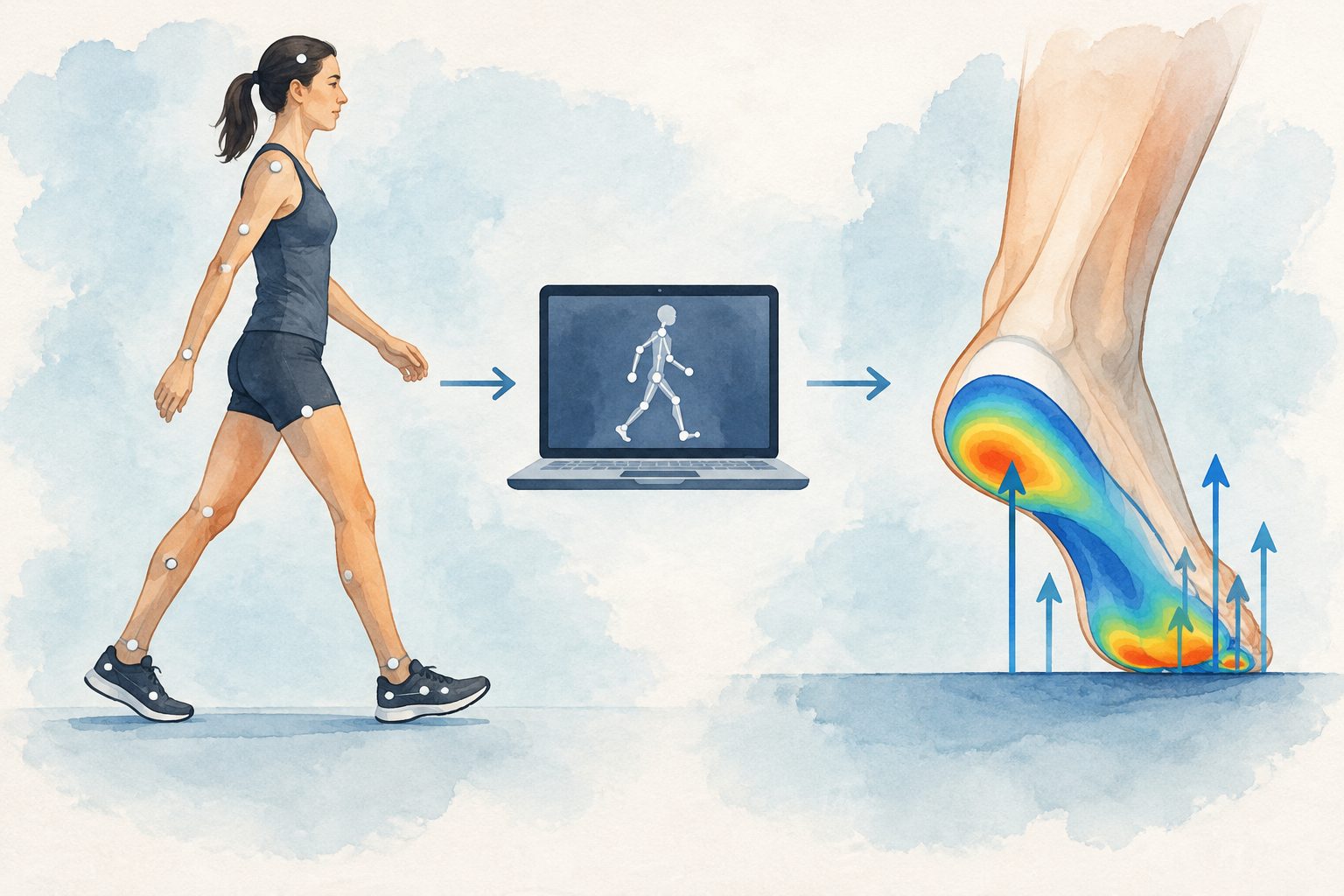
OpenGRF closely matched force-plate measurements for vertical forces and ankle moments during walking and stair use.
Ground reaction forces and moments—the pushes and turning effects between the feet and the ground—are important inputs for computer simulations of human movement. These quantities are usually measured with force plates, but OpenSim did not previously include a tool to estimate them directly from joint movements.
The researchers tested OpenGRF using marker-based motion data from seven healthy adults who walked on level ground and went up and down stairs. Across 126 trials, the tool produced its closest matches to force-plate recordings for vertical ground forces and ankle moments. Its estimates were less reliable for side-to-side forces, free moments and the centre of pressure, especially during stair tasks or when both feet were on the ground.
How well the estimates matched
OpenGRF estimated vertical ground reaction forces with high accuracy: normalized root-mean-square error was no more than 1.5%, and correlations with force-plate measurements were at least 0.94. The estimates were particularly accurate during level walking.
Accuracy for forward-and-backward forces was good, with errors of 4.4–6.1% and correlations of 0.81–0.91. Side-to-side forces were less reliable, especially on stairs, with errors as high as 11.2% and correlations as low as 0.48. Free moments—the twisting effects around the foot-ground contact—were the most difficult quantity to predict, with errors of up to 28%.
Ankle moments were predicted closely, with an error of about 1.7% and a correlation of about 0.98. The median error in the estimated centre of pressure was 21–23 millimetres, with the largest differences occurring during double support, when both feet were on the ground.
Why force estimates matter
Force plates provide important measurements for musculoskeletal simulations but are not part of every movement-recording setup. OpenGRF offers a way to estimate these forces, moments and the centre of pressure directly from joint movement data within OpenSim.
The results suggest that the tool can provide especially useful estimates of vertical forces and ankle moments for the walking and stair activities tested. Its uneven performance across different quantities also shows where force-plate measurements remain more dependable, particularly for side-to-side forces and free moments.
Evidence and caveats
This was a validation study using a scaled 37-degree-of-freedom model without muscles and marker-based recordings from seven healthy adults. Each participant completed six trials of level walking, stair ascent and stair descent, for 126 trials in total; the estimates were compared with force-plate recordings.
The participants were healthy, and the study covered only these activities. The tool was less accurate for medio-lateral forces, free moments and centre-of-pressure estimates in some parts of the tasks, so the findings do not show equally reliable performance for every ground reaction quantity or movement.
// Source
Journal of The Royal Society Interface · 2026 · DOI: 10.1098/rsif.2026.0264
Authors: Andrea Di Pietro, Francesca Di Puccio, Luca Modenese
Institutions: UNSW Sydney, University of Pisa