A light sensor switches from ultrafast sensing to brain-like processing
Changing the electrical bias lets one device respond in 614 nanoseconds or process signals over 8.28 seconds, across visible to mid-infrared light.
Editorial illustration — not from the study.
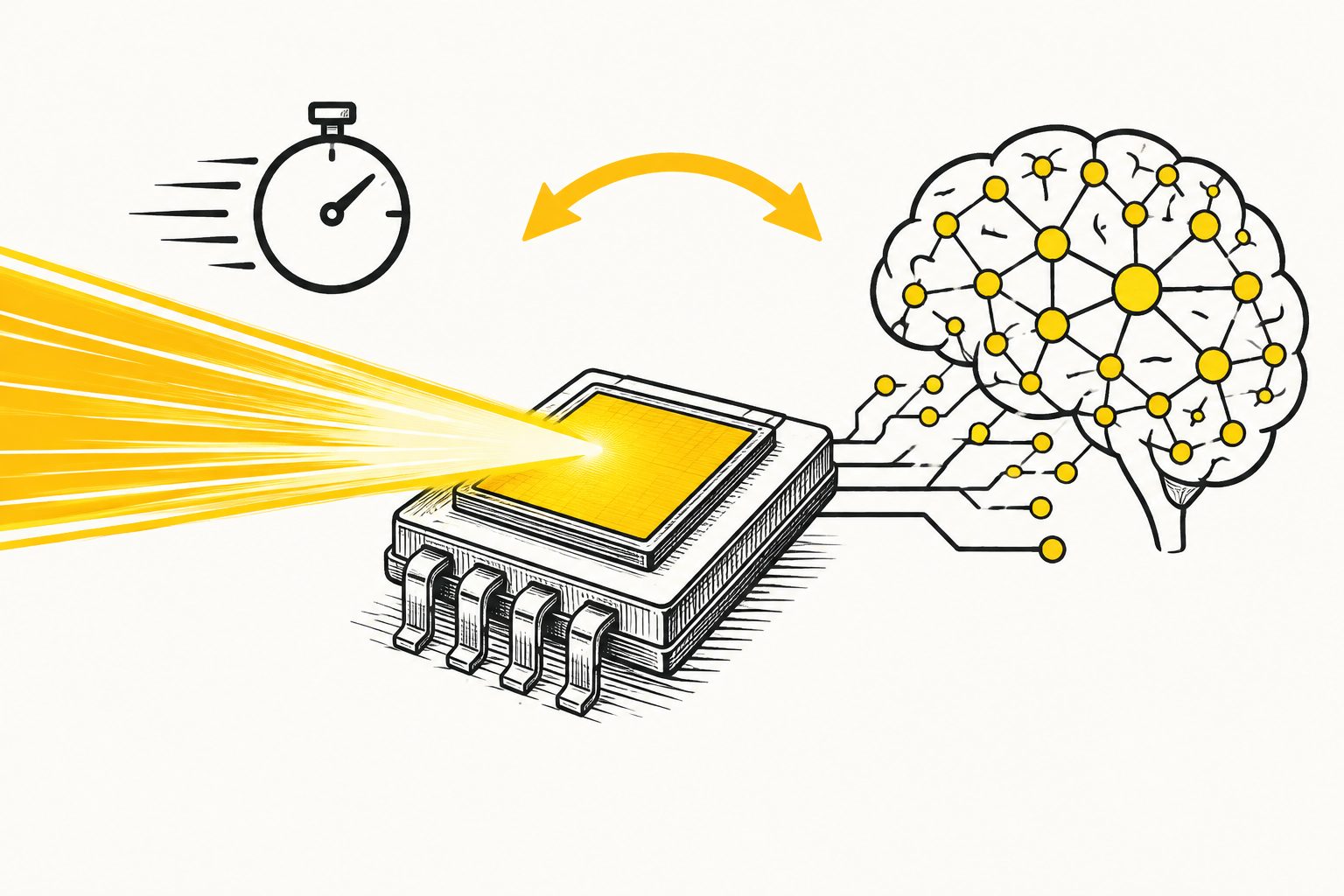
The bias-reconfigurable barrier photodetector changes how electrical charges move through the device when its voltage is adjusted. At low bias, charge moves quickly through the barrier, producing a fast response; at higher bias, slower heat- and defect-assisted processes extend the response to timescales used for synaptic computing.
The device detects light from the visible range through the mid-infrared and can act as a physical reservoir for in-sensor computing. The researchers report high accuracy in recognition tasks involving whether vehicles were accelerating or decelerating.
What the sensor can do
The photodetector's response time was continuously tunable from 614 nanoseconds to 8.28 seconds, a range of seven orders of magnitude. Electrical control of the barrier height changed the dominant charge-transport process from direct tunneling to slower thermal and trap-assisted processes.
At low bias, the device operated as a high-speed photodetector. At elevated bias, its response extended to synaptic timescales, allowing it to perform neuromorphic processing as a physical reservoir. It also showed a broadband response spanning visible to mid-infrared light and achieved high accuracy in vehicle acceleration and deceleration classification tasks.
Why one adjustable sensor matters
Most vision hardware is designed either to capture signals quickly or to process them, so combining both functions can require separate components. This device puts adjustable sensing and neuromorphic processing in one light-sensitive element, which the researchers say could support more hardware-efficient machine vision, multispectral sensing and edge computing.
Its broadband response and electrically controlled timescale could allow the same detector to be adapted to different sensing and processing tasks. The abstract supports these potential uses but does not establish performance in a deployed vision system.
Evidence and open questions
This is a journal research article reporting measurements from a bias-reconfigurable photodetector and demonstrations of recognition tasks. The abstract gives the response-time range and describes the device's operating modes, broadband response and classification results, but it does not provide the classification accuracy, dataset size, device dimensions, testing conditions or long-term stability.
The abstract also does not show how the device compares quantitatively with separate detectors and processors, or whether its performance remains consistent across larger and more varied real-world tasks. Those details are needed to assess its practical advantages and generalizability.
Researchers developed a Schirmer strip that simultaneously indicates glucose and pH through color changes, with smartphone image analysis helping assess the results. In tests using artificial tear fluid, the glucose signal appeared within 30 seconds and had a visual detection limit of 0.5 mM.
Researchers have used hydrogen plasma to process Nd-Fe-B magnet machining waste, separating it into metallic iron and a rare-earth oxide-rich fraction. The process also formed rare-earth hydrides, creating feedstocks that could be used in further magnet production without acid.
An article explores how nanomaterials could support water purification as pollution and water scarcity put pressure on clean supplies. It discusses materials that trap toxic metals and membranes designed to filter very small contaminants, while noting their possible uses and limitations.