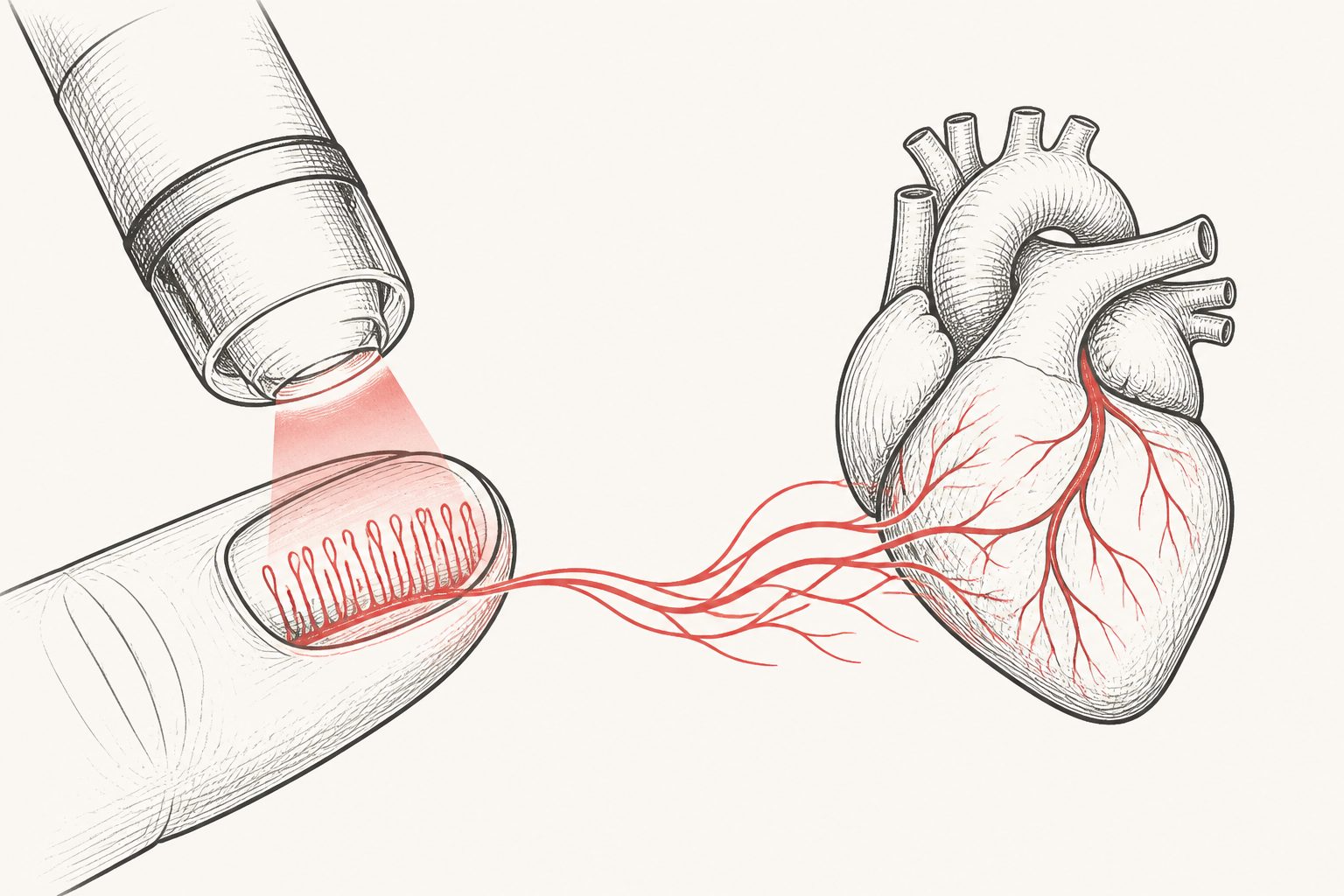
The devices combine lead sulfide quantum dots, a conducting polymer and vanadium oxide. Near-infrared light gradually increases conductance by moving electrons into defect states, while visible light decreases conductance through a different pathway. This lets the devices update their stored weights in a more linear and balanced way than many optoelectronic memristors described by the researchers.
Engineering & Technology2 weeks ago
A light-controlled memory array classified blood-cell images with 96.5% accuracy
The array used two colors of light to adjust its memory cells and consumed as little as 0.63 femtojoules per update.
What the light-controlled cells did
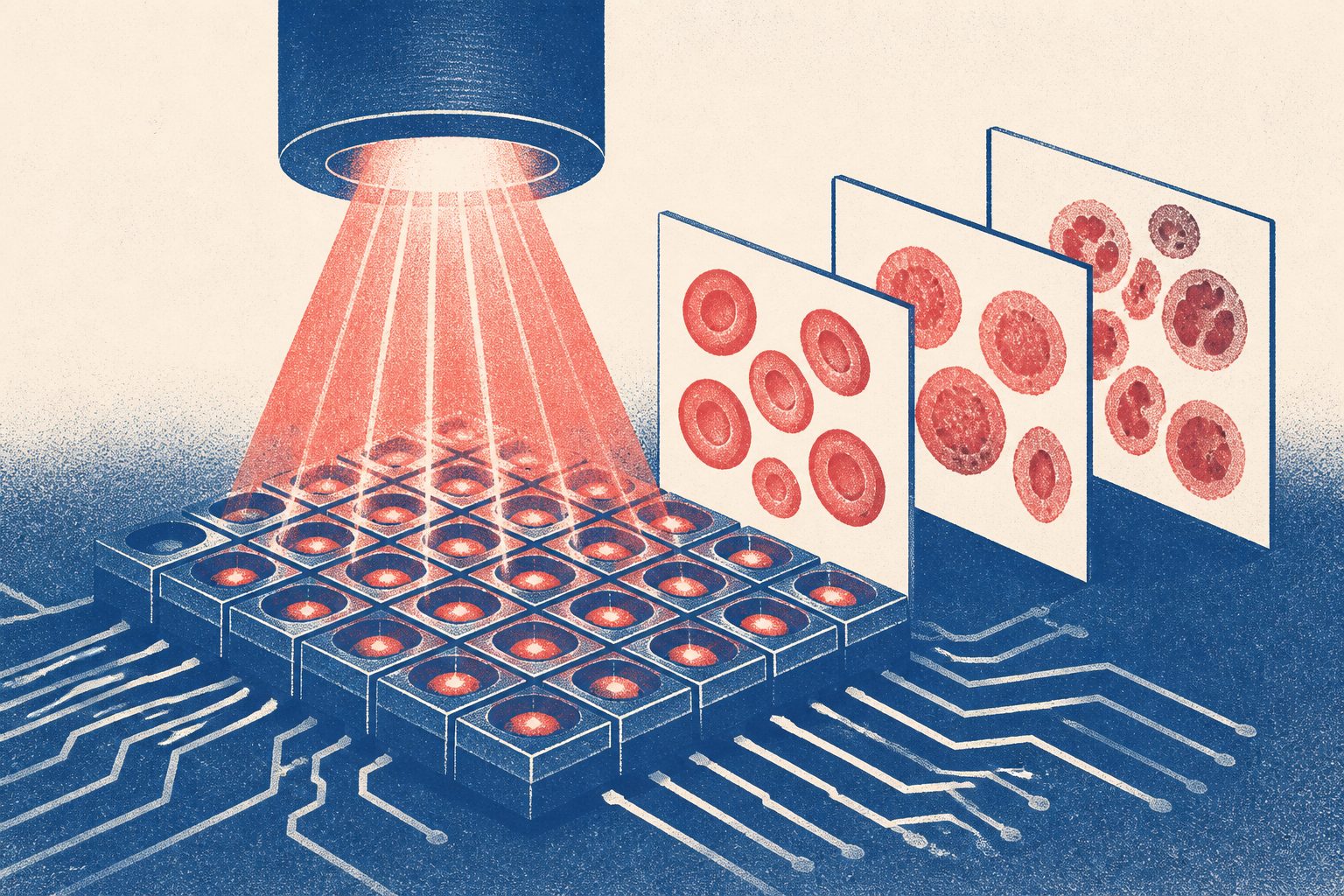
The researchers report a spectrally partitioned all-optical memristor whose conductance can be increased with near-infrared light and decreased with visible light. The updates had a reported linearity of 0.9994 and an effective 8-bit conductance resolution. The electrical energy used per optically induced synaptic event was calculated to be as low as 0.63 femtojoules under an ultralow probing bias. A 32 × 32 array classified BloodMNIST microscopic blood-cell images with 96.5% accuracy and showed strong noise robustness.
Why optical memory matters
Optical control could allow many memory cells to be updated in parallel without relying on electrical assistance for each change. The reported linear, symmetric updates address two issues that can reduce the efficiency and scalability of neuromorphic hardware. The low calculated energy use and image-classification demonstration support the researchers’ proposed route toward low-power, spectrally programmable systems, although they do not by themselves establish performance in deployed applications.
Evidence and open limits
The work is a journal article reporting material-level operation, measurements of conductance updates and a hardware image-classification demonstration in a 32 × 32 array. The energy figure is calculated under an ultralow probing bias, and the abstract does not provide the number of images used, comparisons with other systems, or details of the noise tests. The reported classification result concerns the BloodMNIST task; the abstract does not establish how the array would perform on other datasets or at larger scales.
// Source
Nano-Micro Letters · 2026 · DOI: 10.1007/s40820-026-02331-4
Authors: Junchao Zhang, Bai Sun, Songling Wang, Guangdong Zhou, Linfeng Sun, Zelin Cao, Kaikai Gao, Xiaojun Li, Xiaoliang Chen, Jinyou Shao
Institutions: Chinese Academy of Sciences, Xi'an Jiaotong University, Beijing Institute of Technology, Southwest University, Fujian Institute of Research on the Structure of Matter