A protein found in Chlamydia responds to heat by releasing a brake on stress-response genes, helping the bacteria form infectious cells.
Chlamydia lacks a dedicated heat-shock sigma factor, a common bacterial system for turning on heat-stress genes. Instead, the study found that heat increases production of HagF, a protein found across Chlamydia species.
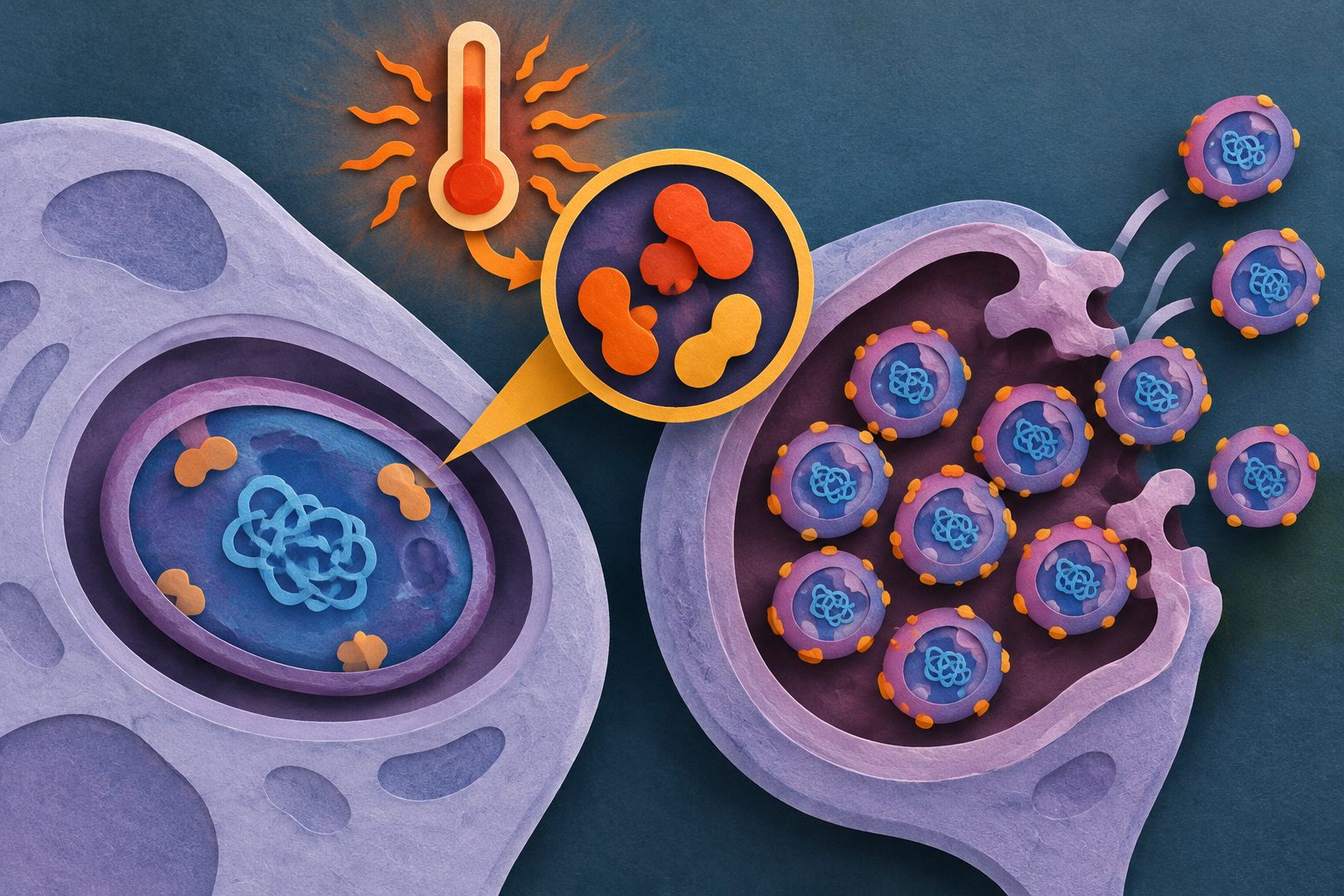
HagF binds to HrcA, a protein that normally represses genes encoding molecular chaperones—proteins that help other proteins function under stress. The binding prevents HrcA from forming the pair it needs to attach to DNA, lifting repression of the hrcA-grpE-dnaK gene group. This supports a developmental transition that allows Chlamydia to form infectious elementary bodies during heat stress.
How heat changes Chlamydia
The researchers found that HrcA represses the hagF gene under non-stressed conditions, while heat shock increases hagF expression. As HagF accumulates, it binds to HrcA and blocks HrcA from forming dimers, or two-protein pairs, that are needed for DNA binding. This reduces HrcA's repression of the hrcA-grpE-dnaK operon, a group of stress-response genes.
The resulting changes promote secondary differentiation in Chlamydia's developmental cycle and enable the formation of infectious elementary bodies under heat stress. The work identifies a heat-induced negative feedback loop involving HagF and HrcA, alongside the previously described positive feedback involving the chaperone GroESL.
// Source
PLoS Pathogens · 2026 · DOI: 10.1371/journal.ppat.1014749
Authors: Ye-Hong Huang, Yuxuan Wang, Danny Wan, Joseph D. Fondell, Xiang Fu Wu, Guangming Zhong, Huizhou Fan
Institutions: Central South University, The University of Texas at San Antonio Health Science Center, Rutgers, The State University of New Jersey, Xiangya Hospital Central South University