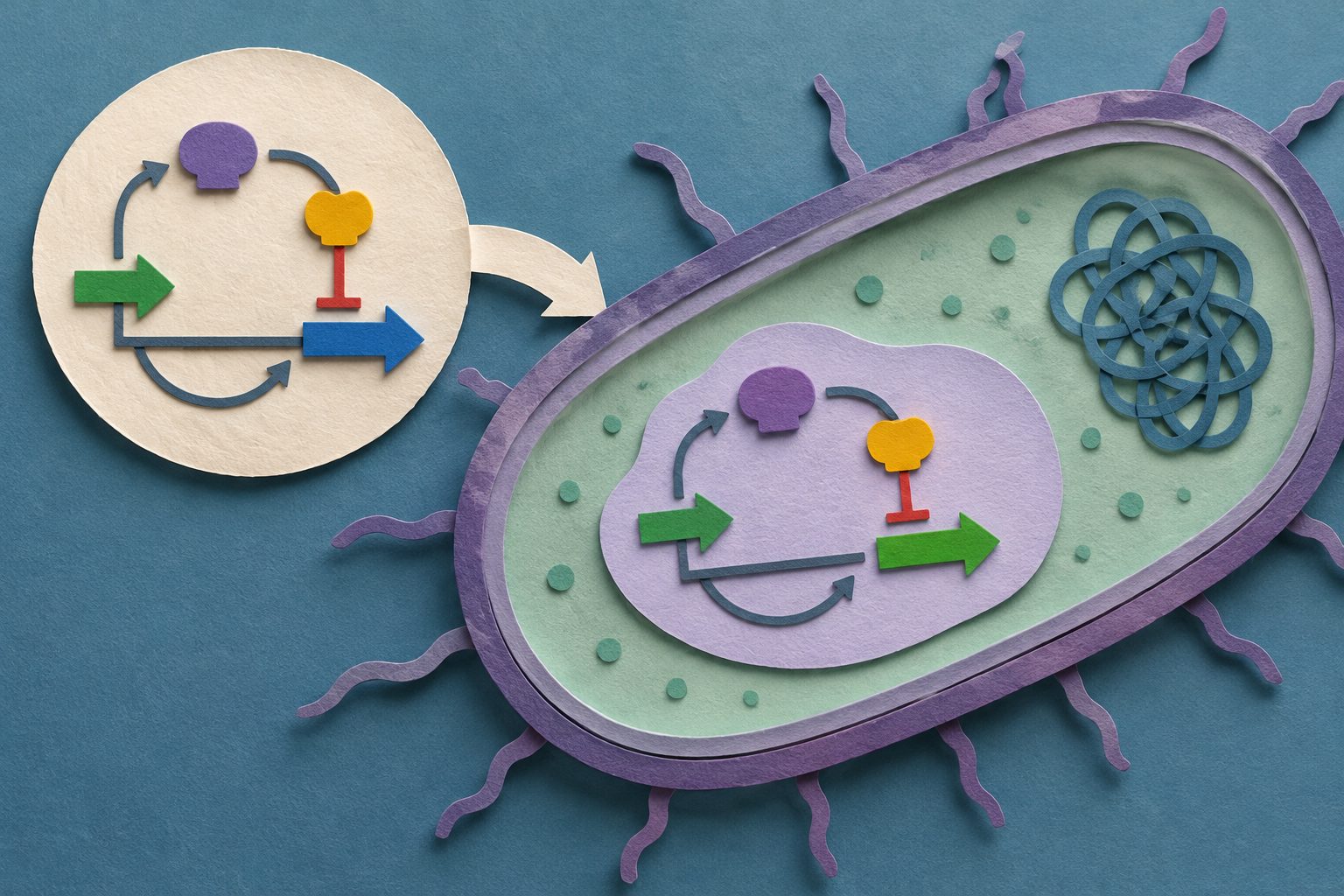
Researchers engineered 219 genetic circuits in bacteria, covering three regulatory cascades and a toggle switch. They changed the circuits’ physical arrangement by placing each whole circuit at different chromosome locations or by separating and distributing its modules.
Biology19 hours ago
A genetic circuit can change its behavior when moved inside a bacterium
Researchers found that changing a circuit’s position on the chromosome can alter its operation without changing its DNA sequence.
What circuit position changed
The circuits behaved differently depending on where they were positioned inside the bacterial cell. Analysis combined with a mathematical model showed that spatial positioning could optimize circuit performance and switch circuits between operating modes. As circuits became more complex, changing their position could produce new functions, even when the circuit’s DNA sequence was not altered.
Why location matters
Genetic circuit design often relies on changing DNA parts such as promoters, regulators or ribosome-binding sites. This study identifies physical location as another design option, which could help researchers tune circuits when suitable DNA components are unavailable and use a cell’s internal space in circuit design.
Evidence and limits
The evidence comes from engineered bacterial circuits, analysis of their behavior and a mathematical model. The study examined 219 circuits of four types, but the abstract does not establish whether the same effects apply to other organisms, circuit designs or practical bioproduction settings.
// Source
Nature Communications · 2026 · DOI: 10.1038/s41467-026-78916-9
Authors: Lorea Alejaldre, Jesús Miró-Bueno, Ángeles Hueso‐Gil, Lewis Grozinger, Hüseyin Taş, Sina Geißler, Ángel Goñi‐Moreno
Institutions: Universidad Politécnica de Madrid, Harvard University, Centro Nacional de Biotecnología, Instituto Nacional de Investigación y Tecnología Agraria y Alimentaria, Centre for Plant Biotechnology and Genomics