An integrated device stored time-based and five-path quantum states with fidelities above 99% and 96%, respectively.
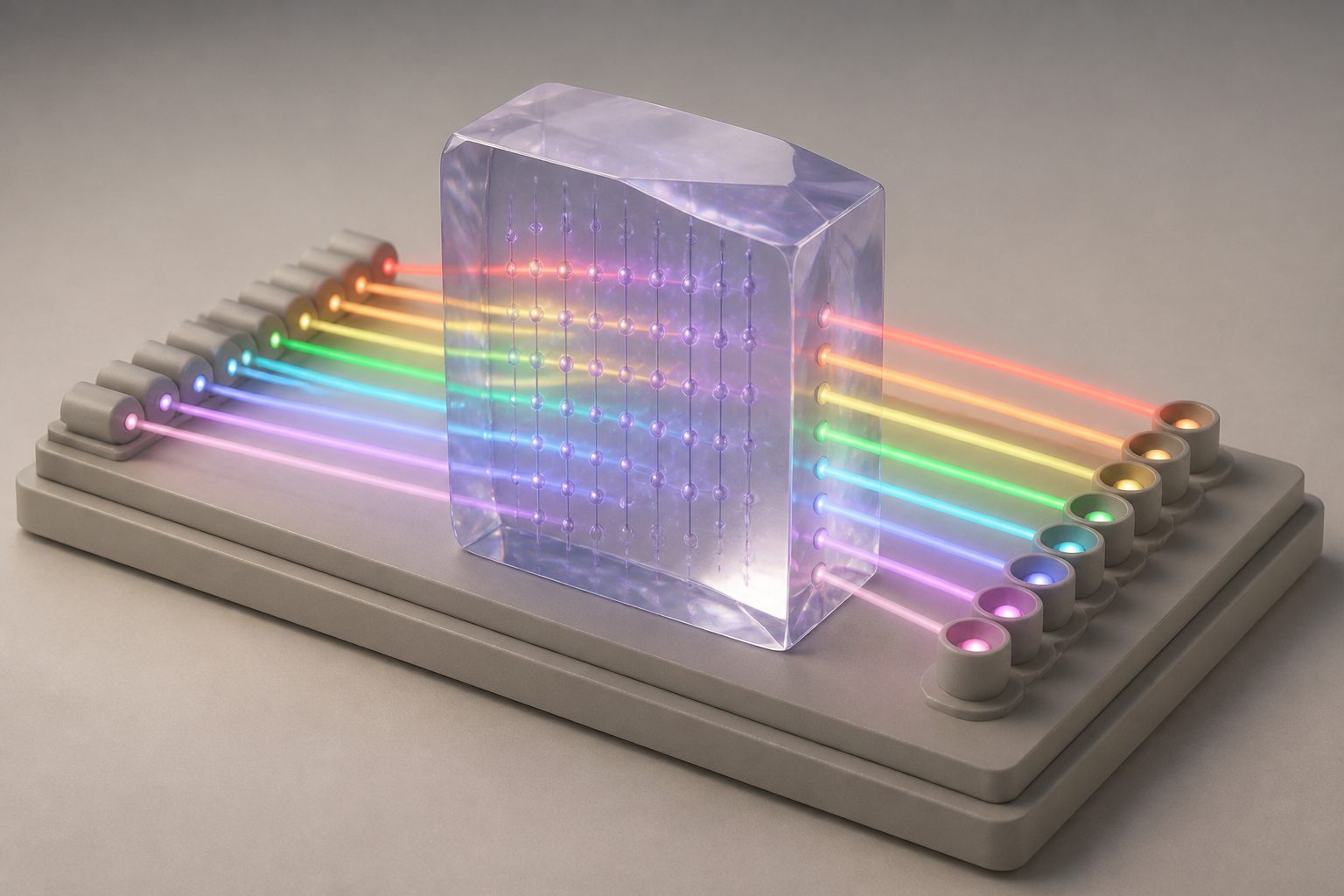
The device uses waveguides—structures that guide light—written into a europium-doped yttrium silicate crystal. Electrodes on the chip independently control when each of its 11 channels releases a stored quantum state, enabling random access to the memory rather than requiring all channels to be read in a fixed sequence.
In tests, the memory stored three time-bin qubits, which encode information in different arrival times, with fidelity exceeding 99%. It also stored quantum states using five possible light paths with fidelity above 96%.
Evidence and open limits
This is an experimental demonstration of a device, with performance assessed through the reported storage fidelities for time-bin and path-encoded states. The abstract does not provide details about storage duration, efficiency, loss, operating conditions, or how the device compares with other memories. It also does not establish how the system would perform when scaled beyond 11 channels or deployed in a complete quantum network.