A cold-made molecule extended worms’ lives and reduced harmful protein clumps
In worms, the molecule moved from muscle to other tissues, while adding it or tyrosine reduced disease-linked protein aggregation in human cells.
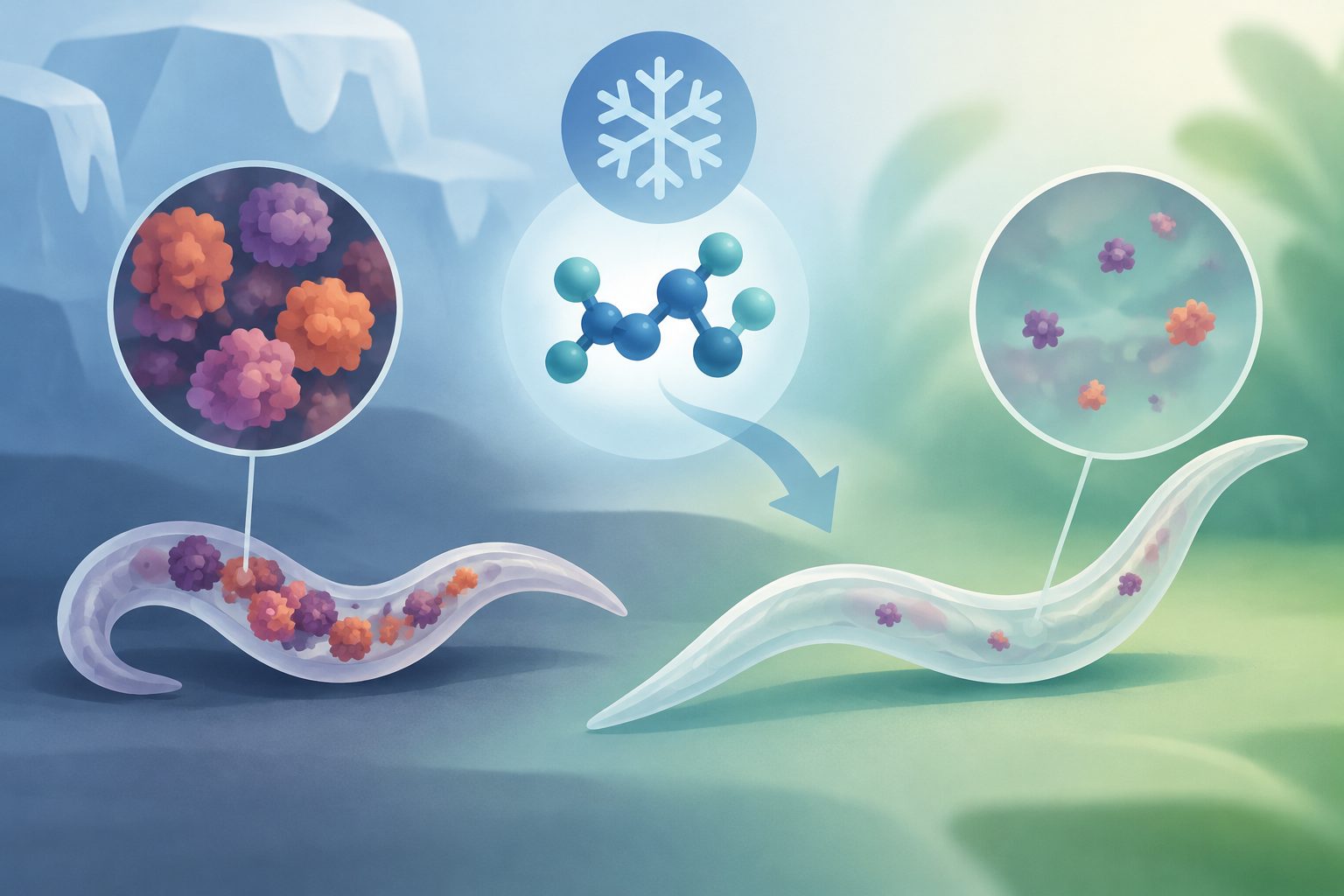
Editorial illustration — not from the study.
The researchers found that moderately cold temperatures increased production of dihydrobiopterin, or BH2, in worm muscle. BH2 travelled to tissues including the intestine and neurons, where it was converted into tetrahydrobiopterin, or BH4. BH4 helped an enzyme produce tyrosine, a process associated with longer life in the worms and protection against age-related protein aggregation and neuronal dysfunction.
Increasing BH2 production in muscle was enough to extend worm lifespan and reduce protein aggregation in distant tissues, even at normal or higher temperatures. In human cells, adding BH2 or tyrosine reduced aggregation of expanded polyglutamine proteins linked to Huntington’s disease and mutant TDP-43 and FUS proteins linked to amyotrophic lateral sclerosis.
How the pathway works
Cold increased activity of CAT-4, the worm version of the human enzyme GCH1, leading to greater production of BH2. Muscle released BH2, which travelled to the intestine and neurons and was converted there into BH4 by DHFR-1.
BH4 supported the enzyme PAH-1, which helps make tyrosine. This BH2–BH4 pathway extended lifespan in Caenorhabditis elegans and reduced disease-related protein aggregation and later neuronal dysfunction during ageing. Producing more BH2 specifically in muscle had similar effects even when worms were kept at normal or elevated temperatures.
In human cells, BH2 or tyrosine supplementation reduced aggregation of expanded polyglutamine proteins associated with Huntington’s disease, as well as mutant TDP-43 and FUS proteins associated with amyotrophic lateral sclerosis.
Why the finding matters
The findings identify a possible way for cold-related signals in muscle to affect protein maintenance and ageing in distant tissues. They also connect this pathway to human disease-associated proteins in cultured human cells, suggesting that the same metabolic processes may be relevant to protein aggregation beyond the worm model.
However, the study does not show that BH2 or tyrosine extends human lifespan or treats Huntington’s disease or amyotrophic lateral sclerosis. Its significance is currently in identifying a biological pathway and testing it in worms and human cells.
Evidence and caveats
The study combines genetic and metabolic experiments in Caenorhabditis elegans with experiments in human cells. In the worms, the researchers altered the production and handling of BH2, tracked its movement between tissues, and measured effects on lifespan, protein aggregation and neuronal dysfunction. In human cells, they tested whether adding BH2 or tyrosine changed aggregation of disease-linked proteins.
The abstract does not report the size of the lifespan effect or the concentrations used in the human-cell experiments. The lifespan and whole-organism findings come from a nematode, while the human evidence comes from cells grown in the laboratory. The results therefore do not establish effects in people or in patients with neurodegenerative disease.
A study of illicit alcohol in two Ugandan cities found that alcohol strength was inconsistent and sometimes under-declared, reaching 44.2%. Some spirits contained methanol above safe limits, while opaque beers showed bacterial contamination and many production and retail sites had poor sanitation.
Researchers found that bacterial surface-layer proteins can evolve through modular changes and gene transfer, producing different outer structures. In closely related bacteria with the same type of surface layer, only pathogens showed resistance to the antimicrobial molecules LL-37 and lysozyme.
Researchers traced how AlphaFold 3 turns evolutionary differences among related protein sequences into three-dimensional structure predictions. They found that evolutionary diversity matters more than simply adding more sequences, helping explain both the system’s strengths and some of its failures.