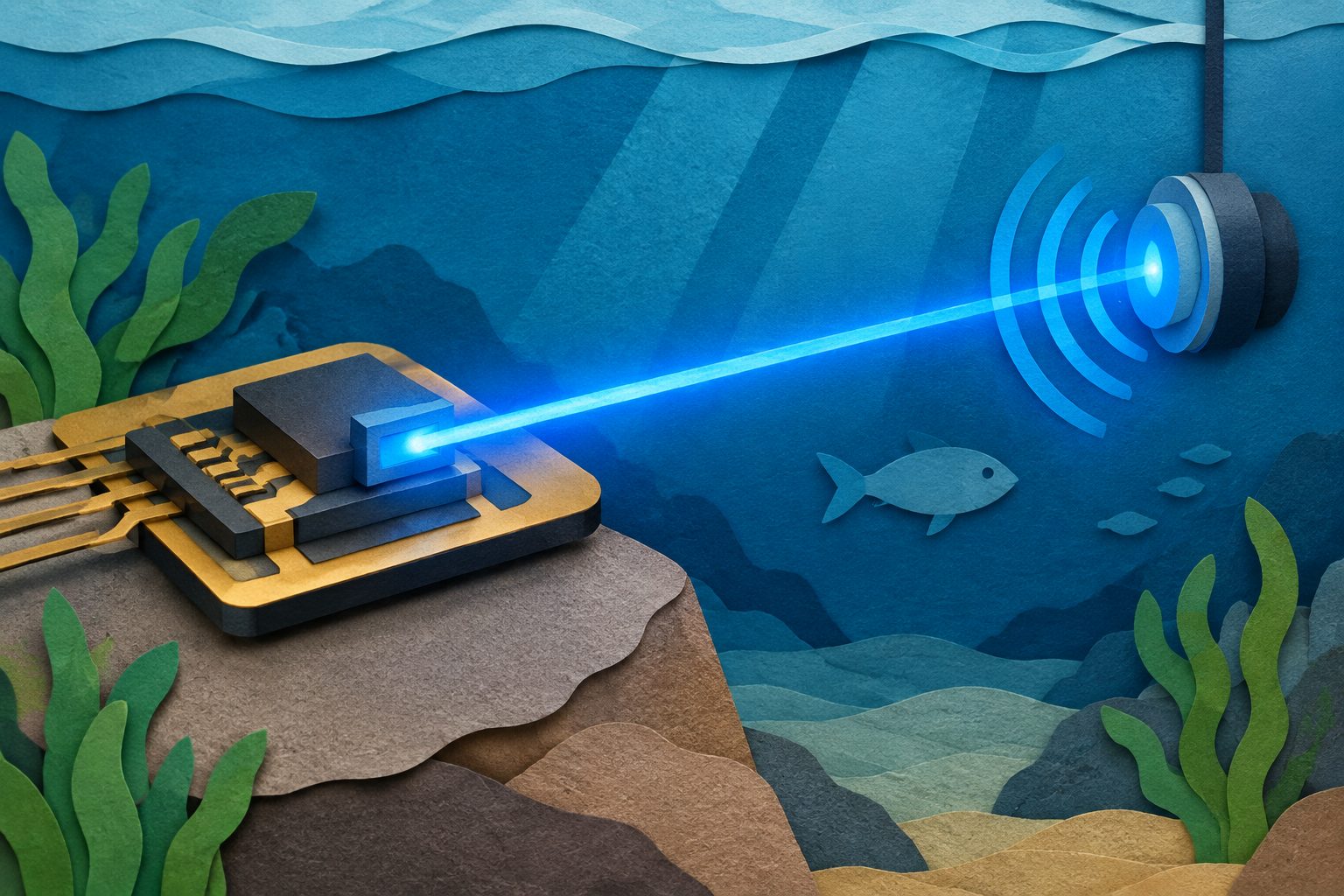
The device combines stable blue light with rapid frequency changes in a compact photonic circuit.
The laser combines a gallium nitride laser diode with a high-quality optical resonator made on a silicon nitride photonic platform. Piezoelectric actuators made from aluminium nitride change the circuit’s refractive index, allowing the laser’s frequency to be tuned quickly while maintaining low phase noise.
The device produced controlled frequency sweeps of up to 900 megahertz at repetition rates of up to 1 megahertz. The sweeps had less than 2% tuning nonlinearity, meaning the frequency changes stayed close to the intended pattern. The researchers used the laser in demonstrations of underwater communication and coherent aerosol sensing.
What the blue laser does
The integrated laser operated at 461 nanometres, in the blue part of the spectrum. It had a linewidth below 30 kilohertz, a measure of how narrowly concentrated its optical frequency is, and produced more than 1 milliwatt of output power.
The laser was built by combining a gallium nitride laser diode with a low-loss silicon nitride photonic circuit. Its aluminium nitride piezoelectric actuators enabled mode-hop-free frequency sweeps of up to 900 megahertz at repetition rates of up to 1 megahertz. The tuning nonlinearity was below 2%. The researchers demonstrated the device in underwater communication and coherent aerosol sensing experiments.
Why underwater light matters
Blue and ultraviolet lasers are useful for technologies including underwater and free-space optical communications, optical atomic clocks and quantum computing based on Rydberg atoms. These applications can benefit from light whose frequency is both stable and rapidly adjustable.
The work shows that these functions can be combined in a compact integrated device operating at a wavelength that has been difficult to achieve in photonic circuits. The underwater communication and aerosol-sensing demonstrations indicate possible uses, although the abstract does not provide enough detail to assess their performance in broader operating conditions.
Evidence and open questions
This is a peer-reviewed research article reporting a direct device demonstration. The researchers measured the laser’s linewidth, output power and frequency-tuning performance, then used it in underwater communication and coherent aerosol-sensing experiments.
The abstract does not report the communication distance, data rate, sensing range or other application-level performance measures. It also does not describe long-term reliability or how the device compares with other blue lasers in practical systems. Those details are needed to judge how broadly the demonstrations can be applied.
// Source
Nature Photonics · 2026 · DOI: 10.1038/s41566-026-02040-9
Authors: Anat Siddharth, Asger Brimnes Gardner, Xinru Ji, Shivaprasad Umesh Hulyal, Mikael Reichler, Alaina Attanasio, Johann Riemensberger, Sunil Ashok Bhave, Nicolas Volet, Simone Bianconi, Tobias Jan Kippenberg
Institutions: Aarhus University, Purdue University West Lafayette, École Polytechnique Fédérale de Lausanne