Muonium is a short-lived bound state made of a positively charged anti-muon and an electron. Because it contains a second-generation particle and does not involve the strong interaction, it could test whether different forms of matter fall in the same way under gravity. Earlier muonium sources were too diffuse for such experiments.
Physics & Space3 days ago
A bright beam of muonium could put gravity to a new test
The newly developed beam may allow researchers to measure how this short-lived matter–antimatter atom falls and to study the muon more precisely.

What the new beam does
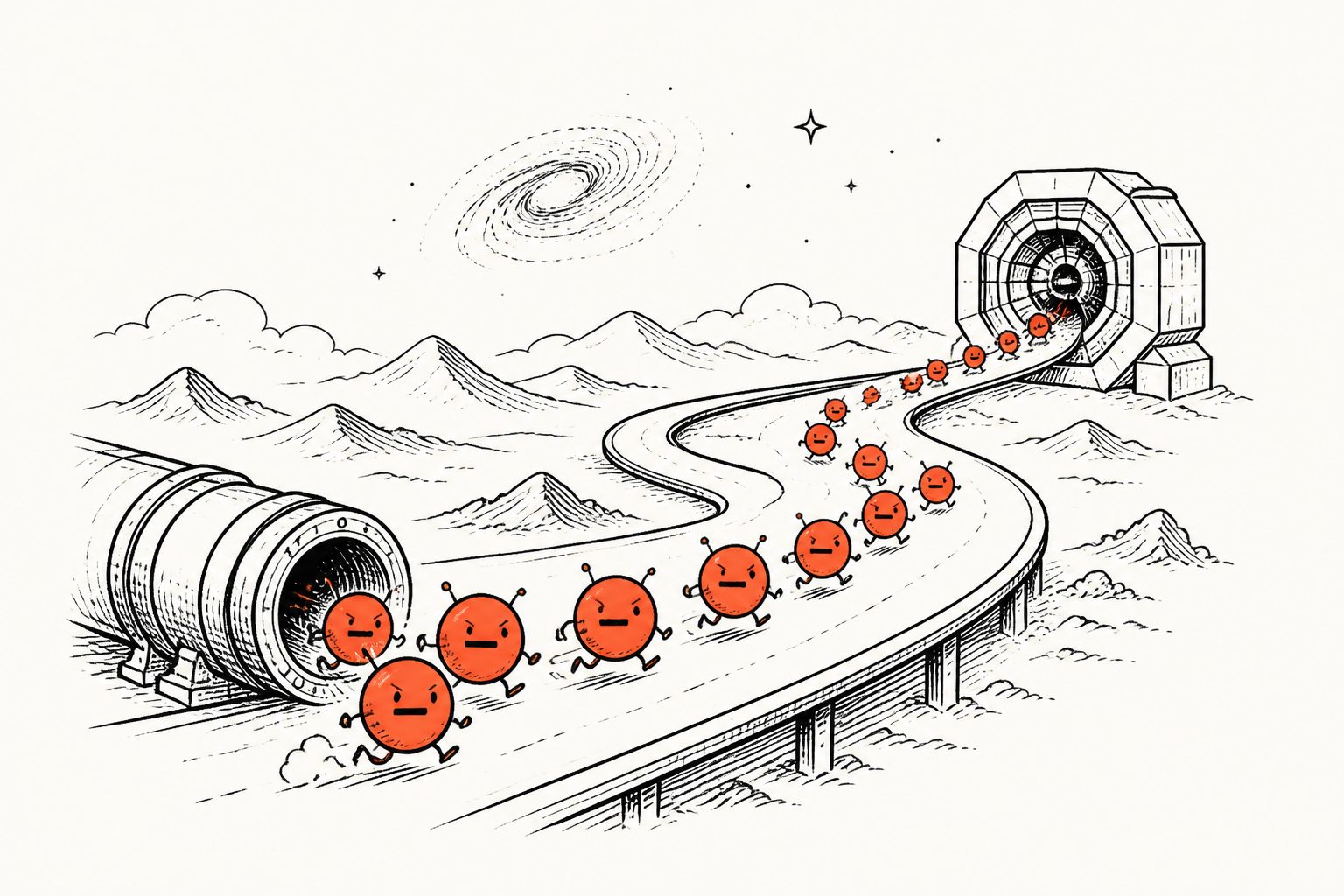
The researchers generated a high-brightness muonium beam from a thin layer of superfluid helium. Its mean forward speed and narrow range of speeds indicate that it is a superthermal beam, and its yield is similar to that of the most intense diffuse muonium sources. The beam is expected to enable muonium interferometry and a measurement of its gravitational acceleration at the percent level. Its brightness could also allow measurements of the muonium 1S–2S transition with sub-kilohertz precision, supporting a more precise determination of the muon mass and tests of bound-state quantum electrodynamics.
Why the beam matters
The beam could make it feasible to test the universality of free fall with muonium, extending gravity tests to a bound state containing a second-generation Standard Model particle and no strong interaction. It could also provide a new route to precise measurements of the muon mass and to stringent tests of the theory describing quantum effects in bound systems.
Evidence and limits
This journal article reports the generation and measured beam properties of a laboratory muonium source. The abstract does not report a gravity measurement, muonium interferometry, or 1S–2S spectroscopy; those are experiments the beam is expected to enable. The muon’s short lifetime remains an inherent challenge, and the abstract gives no further details about the beam’s absolute intensity, experimental setup or the eventual precision of these proposed measurements.
// Source
Nature Physics · 2026 · DOI: 10.1038/s41567-026-03433-x
Authors: J. Zhang, Aldo Antognini, M. Bartkowiak, D. Goeldi, K. Kirch, A. Knecht, D. Taqqu, R. Waddy, Frederik Waûters, P. Wegmann, A. Sótér
Institutions: Johannes Gutenberg University Mainz, ETH Zurich, Paul Scherrer Institute