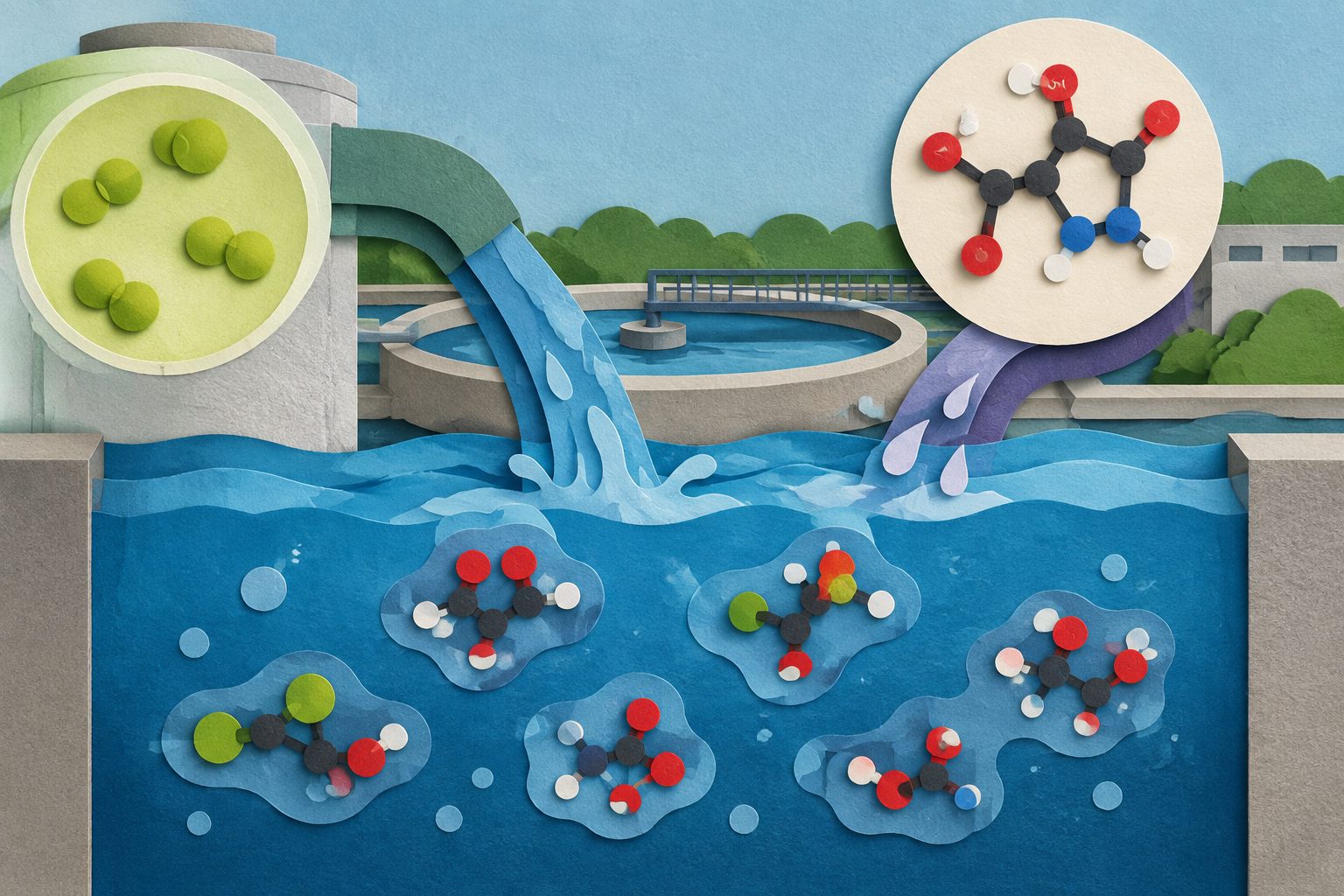
Laboratory experiments traced how the common amino acid is converted into dichloroacetic acid and other potentially harmful compounds during chlorination.
The study examined what happens when hypochlorous acid, the active form of chlorine in water, reacts with aspartic acid. The reaction quickly produced chlorinated forms of the amino acid, then passed through an intermediate that continued changing over several hours.
The main pathway formed cyanoacetic acid, then dichloroacetonitrile and ultimately dichloroacetic acid. A secondary pathway produced chloral hydrate and trichloroacetic acid, while most of the amino acid’s nitrogen ended up as nitrate.
The reaction’s product paths
The reaction began with rapid formation of N-chloroaspartic acid, followed by N,N-dichloroaspartic acid. The researchers’ kinetic analysis indicated that dichlorine monoxide helped drive the second chlorination step under neutral conditions. The dichloro compound then broke down into the intermediate 3-chloroimino-propanoic acid.
That intermediate followed multiple pathways. The dominant route produced cyanoacetic acid, which was converted into dichloroacetonitrile and then dichloroacetic acid, the main carbon-containing product. A smaller route formed chloral hydrate and then trichloroacetic acid. Increasing the amount of hypochlorous acid shifted the products toward more trichloroacetic acid. Nitrate was the major nitrogen-containing final product.
Why the chemistry matters
The findings show how an amino acid found in natural waters and algal biomass can contribute to haloacetic acids and other disinfection by-products during chlorination. They also show that products can continue forming through secondary reactions after the initial chlorination step, and that the amount of oxidant can affect which compounds are produced.
Mapping these reaction paths may help explain how aspartic acid contributes to by-product formation during water chlorination. The study does not assess the health effects of the products or determine how much of them forms in treated drinking water.
Evidence and scope
The researchers used stopped-flow spectrophotometry to follow the fastest reactions, time-resolved proton nuclear magnetic resonance spectroscopy to track changing compounds, and ion chromatography to identify final products. They combined these measurements in a kinetic model that accounted for the observed reaction behavior.
The experiments examined a controlled reaction between aspartic acid and hypochlorous acid under neutral conditions. The results therefore map the chemistry of this specific system; they do not by themselves show how the reaction behaves in full-scale treatment plants or in waters containing other organic substances and ions. The study also does not measure toxic effects or establish exposure risks for people.
// Source
ACS Omega · 2026 · DOI: 10.1021/acsomega.6c06133
Authors: Dávid Angyal, Fruzsina Simon, István Fábián, Maria T. Szabó
Institutions: University of Debrecen