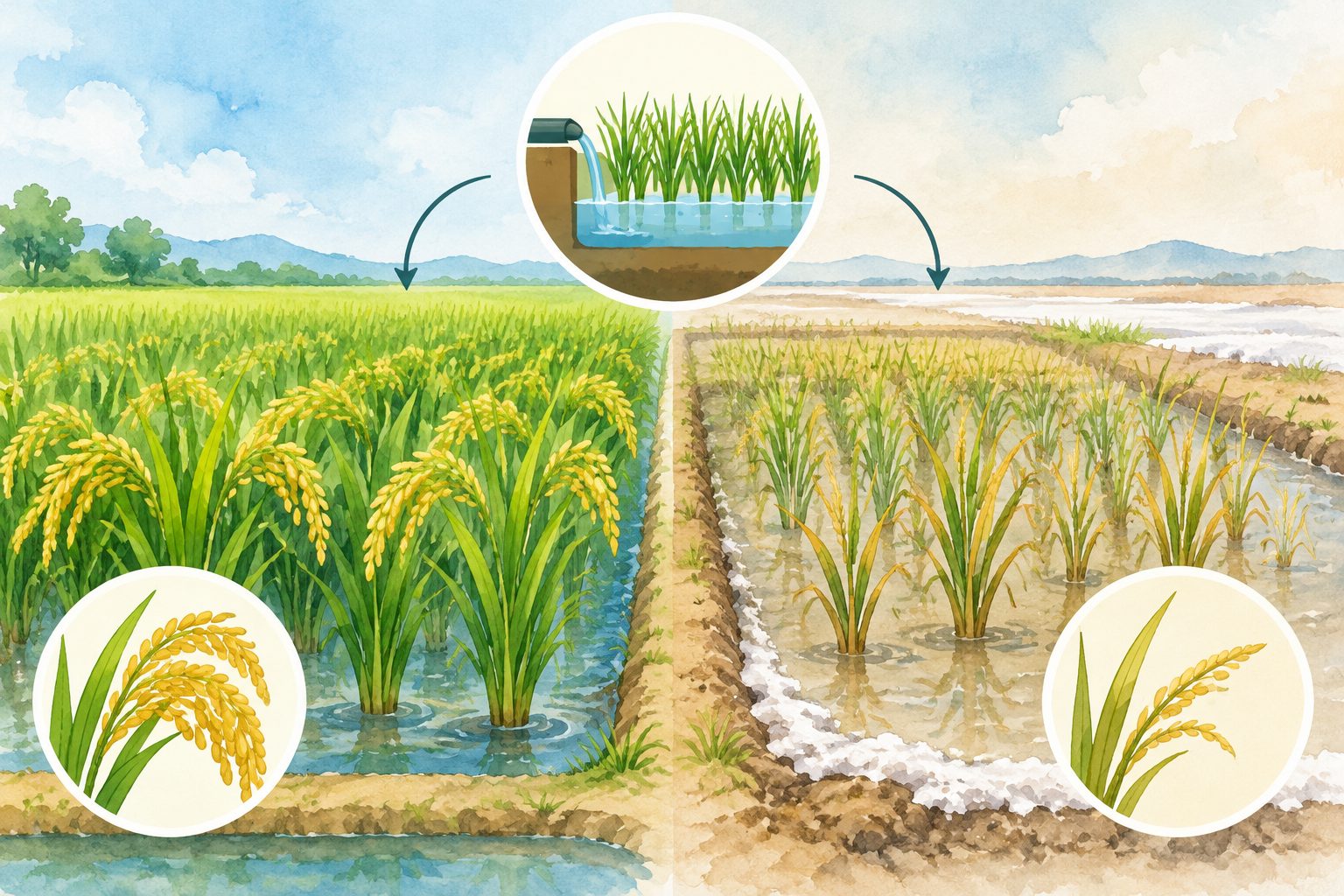
Two seasons of field trials in coastal Bangladesh found that alternate wetting and drying depended strongly on local soil salinity.
Researchers tested three irrigation approaches—continuous flooding, keeping soil saturated, and alternate wetting and drying—in five locations each in Barishal and Khulna during the 2021–22 and 2022–23 rice seasons. All trials used the salt-tolerant rice variety BRRI dhan67.
In Barishal, the irrigation methods produced similar yields, but alternate wetting and drying raised irrigation water productivity compared with continuous flooding. In Khulna, it also used irrigation water more productively, but soil salinity rose more under this approach and average grain yield was lower.
How salinity changed the results
In Barishal, irrigation treatment did not significantly change rice yield. Alternate wetting and drying increased irrigation water productivity compared with continuous flooding by about 30% in 2021–22 and 21% in 2022–23, reaching 0.75 and 0.69 kilograms of rice per cubic metre of irrigation water, compared with 0.58 and 0.57 kilograms under continuous flooding.
In Khulna, soil salinity increased during crop growth and was higher under alternate wetting and drying and soil-saturation irrigation than under continuous flooding. Average grain yield under alternate wetting and drying was about 14% lower than under continuous flooding, although irrigation water productivity was 21–29% higher. Soil salinity differences between irrigation treatments were relatively small in the low-salinity Barishal sites.
Evidence and limits
The study was based on on-farm field experiments conducted over two seasons at five locations in each of two Bangladeshi regions. Researchers compared continuous flooding, soil saturation and alternate wetting and drying, with three replicated plots at each location, and measured irrigation water, soil salinity and rice yield. The trials used one rice variety, BRRI dhan67, and the results came from low- and medium-salinity settings.
The researchers say more testing is needed across a wider range of locations, seasons, irrigation-water qualities and rice varieties. The findings therefore do not establish that the same yield and salinity effects will occur in all coastal environments.
// Source
Discover Agriculture · 2026 · DOI: 10.1007/s44279-026-00804-z
Authors: Priya Lal Chandra Paul, Debjit Roy, Mohammad Shamsudduha, Md Belal Hossain, Md Mahbubul Alam, Rakiba Shultana, Afrin Jahan Mila, Jaed Hasnat
Institutions: University College London, Bangladesh Agricultural Research Institute, Bangladesh Rice Research Institute, Islamic University of Technology