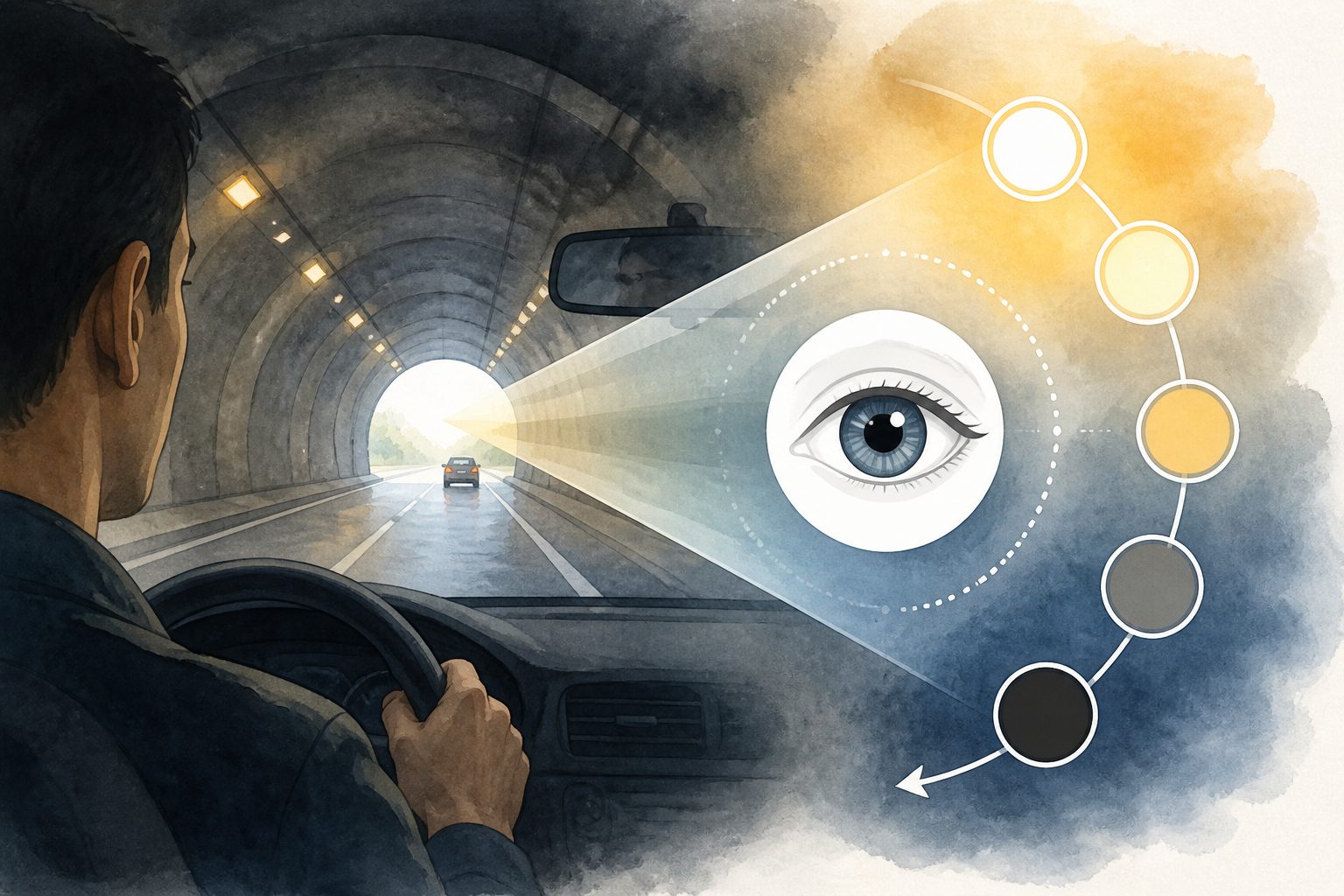
Eye-tracking in four road tunnels found visibility to be the biggest factor in pupil response, followed by light color and surface brightness.
Researchers report real-vehicle experiments in four road tunnels, collecting multiple aspects of the lighting environment and road geometry while also measuring drivers’ pupil diameter with an eye-tracking system. Their goal was to connect tunnel visual conditions to a measurable psychophysiological signal—pupil diameter—that can reflect how the visual scene and mental workload are affecting drivers.
Using an AI model to predict pupil diameter, the team reports improved prediction performance with a specific approach to tuning the model, and they used SHAP analysis to identify which conditions mattered most. They found visibility to be the largest influence on pupil response, with correlated color temperature and road surface illuminance next, and geometric parameters afterward. They also proposed a visibility-driven compensation model to describe the non-linear relationship between visibility and pupil diameter.
Visibility’s role in pupils
In real-vehicle experiments in four road tunnels, the researchers measured drivers’ pupil diameter and collected environmental variables including visibility, road surface and sidewall illuminance, lighting uniformity, correlated color temperature, tunnel distance, curvature radius, and external time. An AI model (GWO-XGBoost) predicted pupil diameter with test-set performance of R² = 0.914 and MAPE of 7.15%, evaluated using 5-fold cross-validation with MSE, RMSE, MAE, and R². SHAP-based interpretation indicated visibility was the major influence factor on pupil response, followed by color temperature, road surface illuminance, and then geometric parameters. Based on these results, the team suggested a visibility-driven compensation (VDC) model that describes the non-linear relationship between visibility and pupil diameter with a high level of fit.
Field data and modeling limits
This work is based on real-vehicle field experiments in four tunnels, with drivers’ pupil diameter measured by eye tracking and multiple tunnel/environment variables recorded. The predictive model was evaluated with 5-fold cross-validation using standard error metrics, and SHAP analysis was used for feature contribution interpretation. Limitations include that the abstract does not specify the number of drivers, how many runs per tunnel, or the range of lighting conditions beyond the variables listed, and it does not directly test whether using the proposed compensation approach improves driver behavior or safety outcomes.