Ulva algae lipids hit resistant bacteria—but also harm mammalian cells
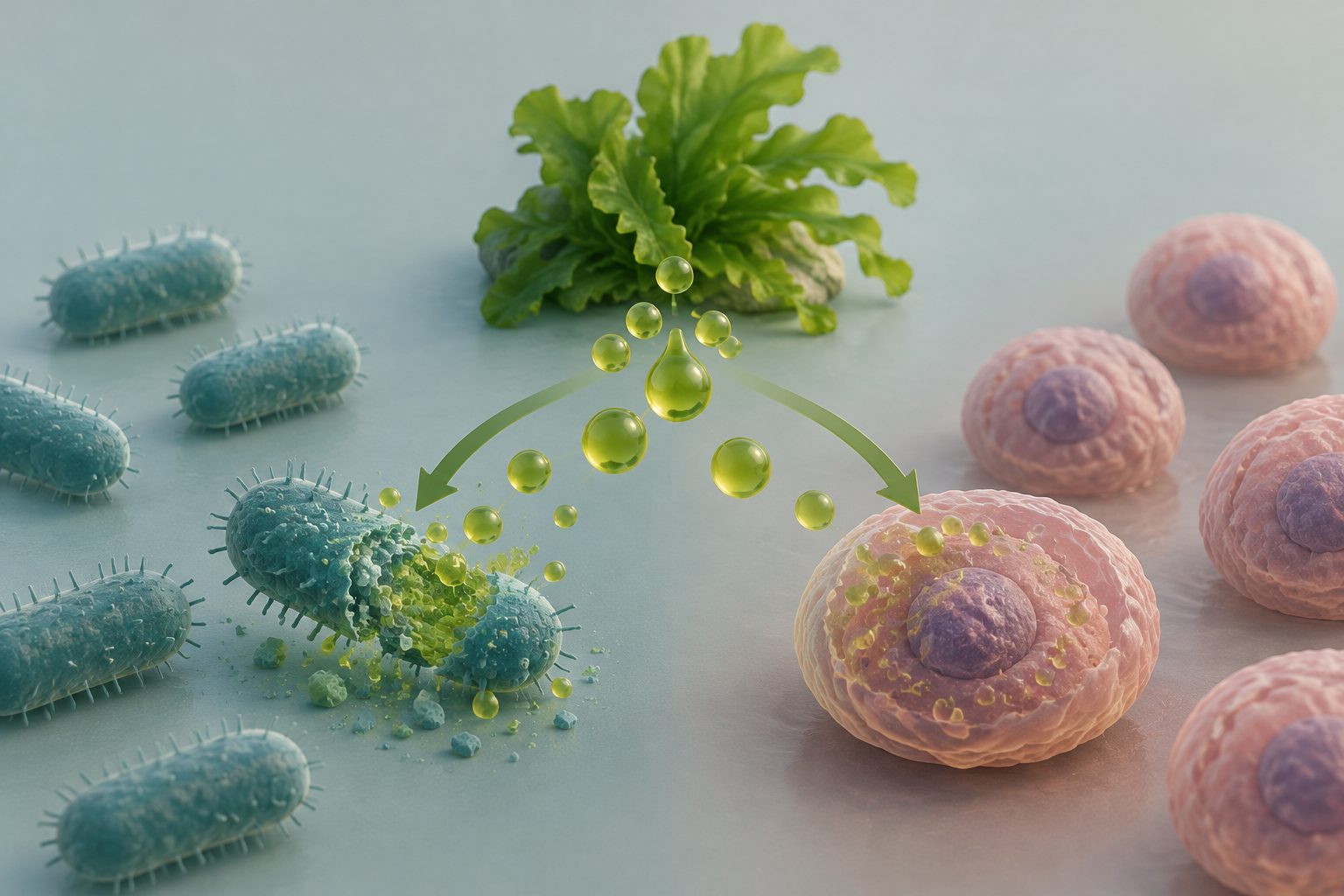
The crude extract showed moderate activity against drug-resistant bacteria, but its toxic effects occurred near the same concentrations.
Editorial illustration — not from the study.
Researchers chemically analyzed lipids extracted from dried Ulva ohnoi biomass and tested the extract against multidrug-resistant isolates of six bacterial groups, including Acinetobacter baumannii, Escherichia coli, Klebsiella pneumoniae, Pseudomonas aeruginosa, Staphylococcus aureus and coagulase-negative Staphylococci. Palmitic acid made up 63.62% of the fatty acids, while oleic acid accounted for 21.01%. The extract showed its strongest minimum inhibitory concentrations against S. aureus and coagulase-negative Staphylococci.
The extract also showed toxicity in mouse and bovine fibroblast cells at concentrations close to its antibacterial levels. Although it was better tolerated by red blood cells, its low selectivity indices indicate that the crude extract is not yet suitable as a therapeutic agent. The researchers describe it as a starting material for purification and further testing, rather than a treatment candidate.
What the algae extract did
The lipid extract inhibited growth of S. aureus and coagulase-negative Staphylococci at 1.33 mg/mL, and of A. baumannii and E. coli at 2 mg/mL. These results indicate moderate antibacterial activity for an unfractionated crude extract. Minimum bactericidal concentrations ranged from 1 to 8 mg/mL and were interpreted as showing mainly bacteriostatic activity, meaning the extract restrained bacterial growth more than it killed the bacteria.
The extract was dominated by palmitic acid, at 63.62% of its fatty acids, followed by oleic acid at 21.01%. Its half-maximal toxicity concentrations in L929 mouse fibroblasts and MDBK bovine kidney fibroblasts ranged from 0.25 to 1.95 mg/mL—close to the concentrations that inhibited some bacteria. Red blood cells tolerated higher concentrations, with a hemolysis half-maximal concentration of 4.705 mg/mL. Overall, selectivity indices were below 10, the threshold the researchers used for an adequate therapeutic margin. Thermal testing found 88% mass loss during heating and no detectable crystalline or other ordered domains in the tested temperature range.
Why the narrow safety margin matters
The findings show that lipids from U. ohnoi have measurable activity against multidrug-resistant bacterial isolates, including bacteria for which new antibacterial agents are being sought. But the same crude extract affected mammalian fibroblast cells at concentrations close to its antibacterial levels. That narrow separation between activity and cell toxicity means the extract, in its current form, does not have an adequate therapeutic window.
The results support further bioassay-guided purification, in which individual components or fractions are tested to identify whether antibacterial activity can be separated from toxicity. The study therefore extends evidence for antibacterial potential in Ulva lipids without establishing that this extract can be used clinically.
Evidence and caveats
This was a laboratory screening study using a crude lipid extract and multidrug-resistant bacterial isolates, along with cultured mammalian cells and red-blood-cell hemolysis tests. The researchers characterized the extract with chemical and thermal methods and measured bacterial inhibition, bacterial killing, and cell toxicity.
The study did not include standard antibiotics tested in parallel, so the extract cannot be directly compared with established treatments. It also did not measure time-dependent bacterial killing or whether repeated exposure could promote resistance. The extract's intense color interfered with some color-based cell-viability tests at higher concentrations, although the researchers used cell-free controls and several assays to reduce this problem. The low selectivity indices, the use of an unfractionated extract, and the absence of clinical testing mean that the results do not establish therapeutic safety or effectiveness.
A study of illicit alcohol in two Ugandan cities found that alcohol strength was inconsistent and sometimes under-declared, reaching 44.2%. Some spirits contained methanol above safe limits, while opaque beers showed bacterial contamination and many production and retail sites had poor sanitation.
Researchers found that bacterial surface-layer proteins can evolve through modular changes and gene transfer, producing different outer structures. In closely related bacteria with the same type of surface layer, only pathogens showed resistance to the antimicrobial molecules LL-37 and lysozyme.
Researchers traced how AlphaFold 3 turns evolutionary differences among related protein sequences into three-dimensional structure predictions. They found that evolutionary diversity matters more than simply adding more sequences, helping explain both the system’s strengths and some of its failures.