Tiny mineral sprays release phosphorus slowly, but crops absorb them differently
Tests in phosphorus-deficient barley found that the spray released phosphorus over several days, while uptake depended on the crop and the formulation.
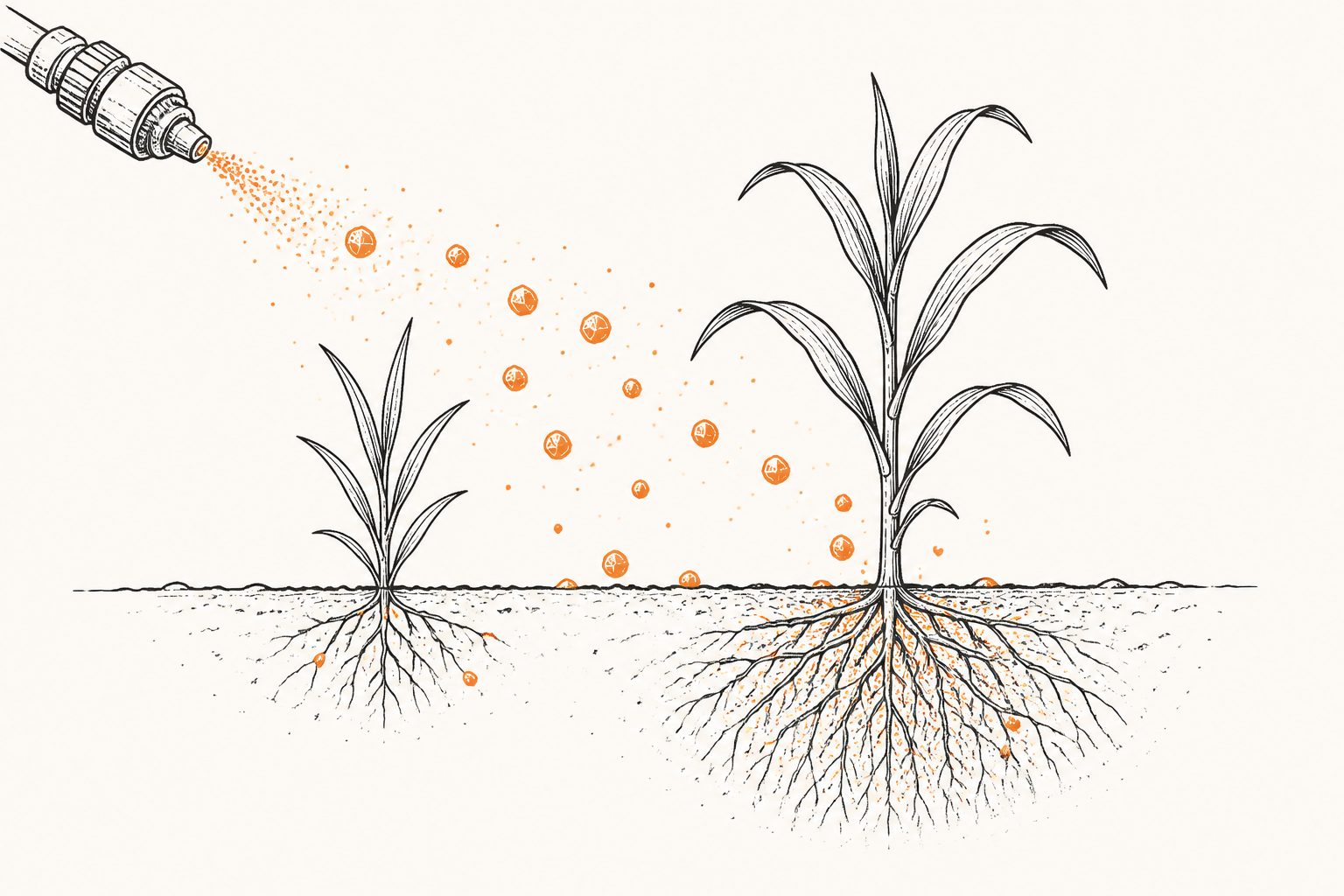
Editorial illustration — not from the study.
Researchers produced chemically labelled nano-hydroxyapatite particles using a low-cost wet process and applied them to leaves. In barley, the particles gradually dissolved after entering through pores on the leaf surface, releasing phosphorus locally and supporting its movement within the plant without causing leaf scorching in the experiments.
Uptake depended strongly on the spray formulation and air humidity, and it differed between crops. Potato took up more phosphorus after a single application, while barley needed repeated treatments, suggesting that the approach may not work the same way across plants.
How the spray behaved
The researchers produced elongated nano-hydroxyapatite particles with a median length of 33.6 nanometers and width of 5.3 nanometers. The particles remained well dispersed in liquid, could be redispersed after concentration and dissolved more readily at some pH levels than others.
In infiltration experiments, the particles dissolved gradually on leaves, with the highest phosphate release occurring one to three days after treatment. Imaging showed that droplets entered through stomata, the small pores on leaf surfaces, and moved through the apoplast, the space outside plant cells. The particles dissolved there and released phosphorus without entering the leaf’s mesophyll cells.
In phosphorus-deficient barley, the treatment enabled local and systemic phosphorus recovery and did not cause leaf scorching in the reported experiments. Uptake was strongly affected by surface tension of the formulation and air humidity. Potato showed high uptake after one application, whereas barley had lower uptake and required repeated treatments.
Why crop differences matter
Agriculture often loses much of the phosphorus applied to crops, creating efficiency and long-term environmental concerns. A leaf spray that releases phosphorus gradually could offer another way to supply deficient plants, rather than relying only on conventional phosphate salts.
The results also show that nano-hydroxyapatite is not a uniform solution across crops. Its performance depended on the plant species, the spray’s physical properties and humidity, so practical use would require formulations and application schedules suited to particular crops.
Evidence and caveats
The study combines particle characterization, leaf infiltration experiments, bioimaging and plant comparisons in phosphorus-deficient barley and potato. These results directly describe how the tested particles behaved in the reported experiments and how uptake differed between the two crops.
The abstract does not report field trials, long-term effects, crop yields or environmental outcomes. It also shows that uptake varied with species and formulation conditions, so the findings cannot be assumed to apply equally to other crops or spray recipes. The comparison indicates potential as a phosphorus fertilizer, but does not establish that it outperforms conventional fertilizers in agricultural production.
// Source
Journal of Nanobiotechnology · 2026 · DOI: 10.1186/s12951-026-04896-z
Researchers developed a system that analyzes live data from grid sensors and other devices to predict faults in a simulated power network. In tests using a 33-bus IEEE network with injected faults, it achieved up to 96.4% accuracy while making predictions in less than a second.
Researchers developed a Schirmer strip that simultaneously indicates glucose and pH through color changes, with smartphone image analysis helping assess the results. In tests using artificial tear fluid, the glucose signal appeared within 30 seconds and had a visual detection limit of 0.5 mM.
Researchers have used hydrogen plasma to process Nd-Fe-B magnet machining waste, separating it into metallic iron and a rare-earth oxide-rich fraction. The process also formed rare-earth hydrides, creating feedstocks that could be used in further magnet production without acid.