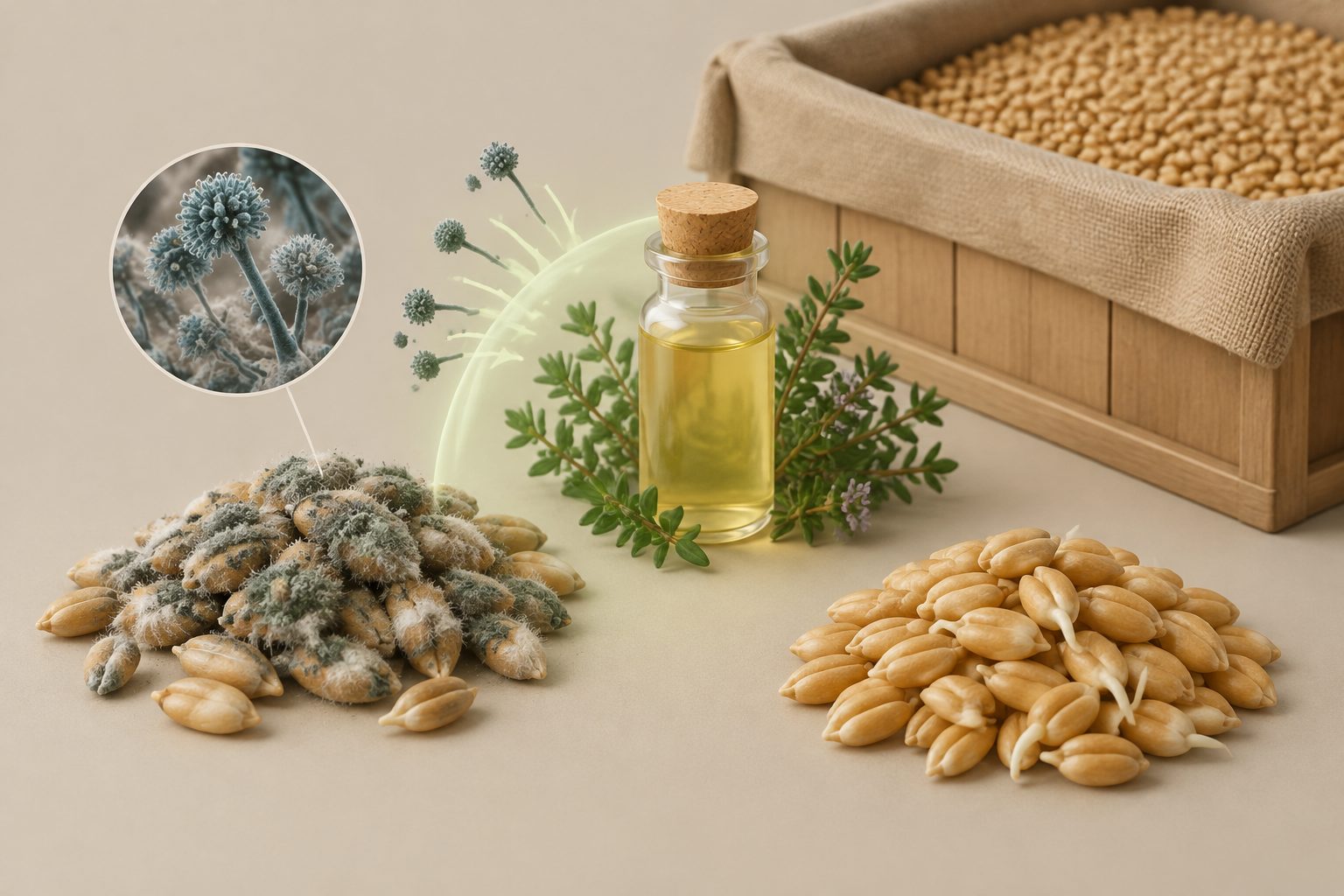
In laboratory and grain-storage tests, the thyme compound blocked Aspergillus versicolor while treated wheat retained full germination at one concentration.
Researchers tested thymol against A. versicolor using computer-based protein docking, agar-plate experiments and treated wheat grains. The fungus was isolated from contaminated wheat stored in Morocco’s Fez-Meknes region.
In agar, thymol’s minimum inhibitory concentration was about 0.5 milligrams per milliliter, while its minimum fungicidal concentration was twice that amount. The inhibitory concentration stopped mycelial growth and destroyed 95% of spores after 24 hours. On wheat grains, 1 milligram per milliliter completely inhibited fungal proliferation during eight weeks of storage.
How thymol affected the fungus
Computer simulations indicated that thymol interacted with two fungal proteins, cutinase and chitin synthase, through hydrogen bonds and other molecular contacts. The docking results showed binding energies of -6.0 kilocalories per mole for cutinase and -5.9 kilocalories per mole for chitin synthase; these results suggest possible interactions with targets involved in fungal invasion and cell-wall structure, but they do not by themselves demonstrate how the fungus is affected.
In agar tests, thymol’s minimum inhibitory concentration was about 0.5 milligrams per milliliter, and the minimum fungicidal concentration was twice that amount. The inhibitory concentration completely stopped mycelial growth and resulted in 95% destruction of fungal spores after 24 hours. When wheat grains were treated with 1 milligram per milliliter of thymol, the study reported complete inhibition of A. versicolor growth and protection during eight weeks of storage. Wheat treated with the minimum inhibitory concentration had a 100% germination rate.
Why stored wheat matters
A. versicolor can spoil stored wheat and is associated with sterigmatocystin, a carcinogenic mycotoxin. The results indicate that thymol could be explored as a plant-based option for controlling this storage fungus while maintaining wheat seed germination under the tested conditions.
The study supports further development of thymol as a post-harvest fungicide, but it does not establish that thymol prevents sterigmatocystin production or that the treatment will work in commercial storage or on other grains.
Evidence and open questions
The evidence combines molecular docking, laboratory agar tests and a wheat-grain storage experiment. The fungus used was isolated from contaminated wheat in the Fez-Meknes region, and the grain treatment was followed for eight weeks. The findings therefore show activity under the study’s tested conditions, rather than effectiveness across storage environments, wheat varieties or fungal populations.
The excerpts do not report measurements of sterigmatocystin, so the study does not show whether thymol lowers toxin levels. The docking results predict protein interactions rather than proving that either protein is the mechanism responsible for the observed antifungal effect. The provided material also does not give enough detail to assess how broadly the results apply beyond the tested isolate and experimental setup.
// Source
Journal of Global Innovations in Agricultural Sciences · 2026 · DOI: 10.22194/jgias/26.2028
Authors: Assia Houiat, Samira Oukhouia
Institutions: Sidi Mohamed Ben Abdellah University