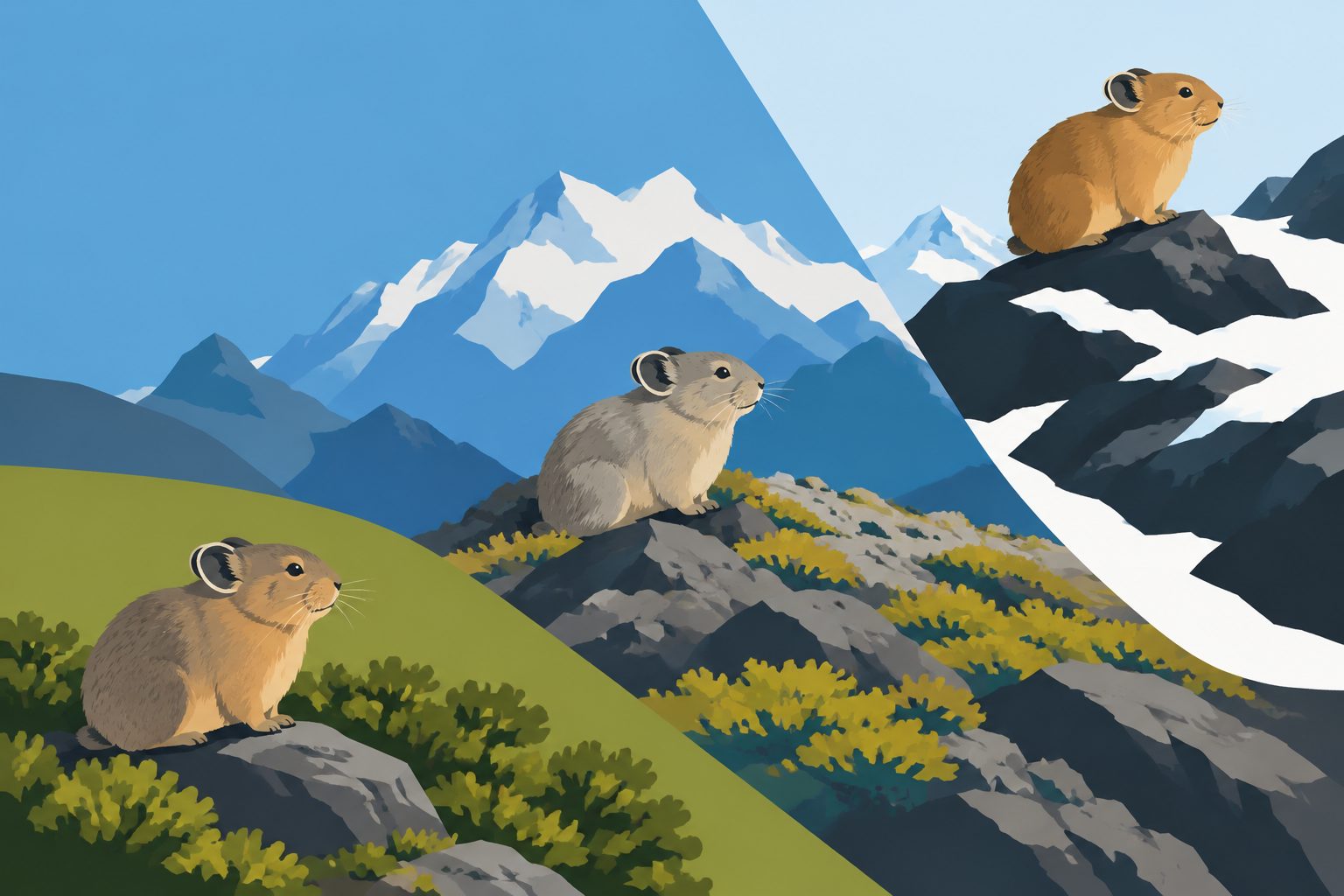
Two burrowing species favor different vegetation zones, while a rock-dwelling species uses rocky ground across the elevation range.
Researchers examined the habitat associations of three high-altitude pikas in the Trans-Himalayas: the burrowing Ochotona nubrica and Ochotona ladacensis, and the rock-dwelling Ochotona macrotis. They compared broad regional patterns with more localized habitat use across elevational bands and areas where the species overlap.
O. nubrica was associated with tall vegetation and shrub-rich pastures between 2800 and 4500 metres. O. ladacensis was concentrated at higher elevations, from 4200 to 6000 metres, in short alpine scrub and steppes. O. macrotis was associated with rocky microhabitats across 2800 to 6000 metres, and at lower elevations in summer it used greener areas.
How the pikas split habitats
The study found distinct fine-scale habitat associations among the three pika species. The social, burrowing O. nubrica preferred pastures with tall stands and high shrub cover, while the social, burrowing O. ladacensis was a high-elevation specialist associated with stunted alpine scrub and steppes. The asocial, rock-dwelling O. macrotis preferred places with extensive rock cover across the elevational range and was associated with greener microhabitats at lower elevations in summer.
The pattern changed with the scale of analysis. Some species appeared to be generalists when all sampled locations across their regional range were considered, but the same species appeared more specialized within particular elevational zones. Directional comparisons of niche overlap also indicated that habitat separation varied between species pairs and spatial scales.
Why small habitats matter
The findings help explain how closely related pikas can occur in the same broad mountain region while using different small-scale habitats. That distinction matters for conservation planning because protecting a species' broad elevation range may not preserve the particular vegetation, rocky ground or other local features it uses where species overlap.
The authors also place the results in the context of climate change and changing land use, which threaten cold-adapted Himalayan specialists. Mapping habitat associations at both regional and local scales can therefore provide more detailed information for planning in areas where these pikas coexist.
Evidence and caveats
Researchers recorded signs of pika activity at more than 300 sites in Ladakh between 2017 and 2022, then sampled 83 presence plots and 63 random plots across elevation ranges and zones of overlap or separation. They combined remotely sensed climate, topography and vegetation data with field measurements of local vegetation and physical habitat using paired quadrats.
This was an observational study of habitat associations, not an experiment. The authors note that microhabitat partitioning can be difficult to distinguish from other influences, such as physical environmental filtering, and the study does not by itself prove that competition caused the observed habitat choices. The evidence comes from sampled sites in the Trans-Himalayas of Ladakh, so the results should not automatically be generalized to all pika populations or mountain regions.