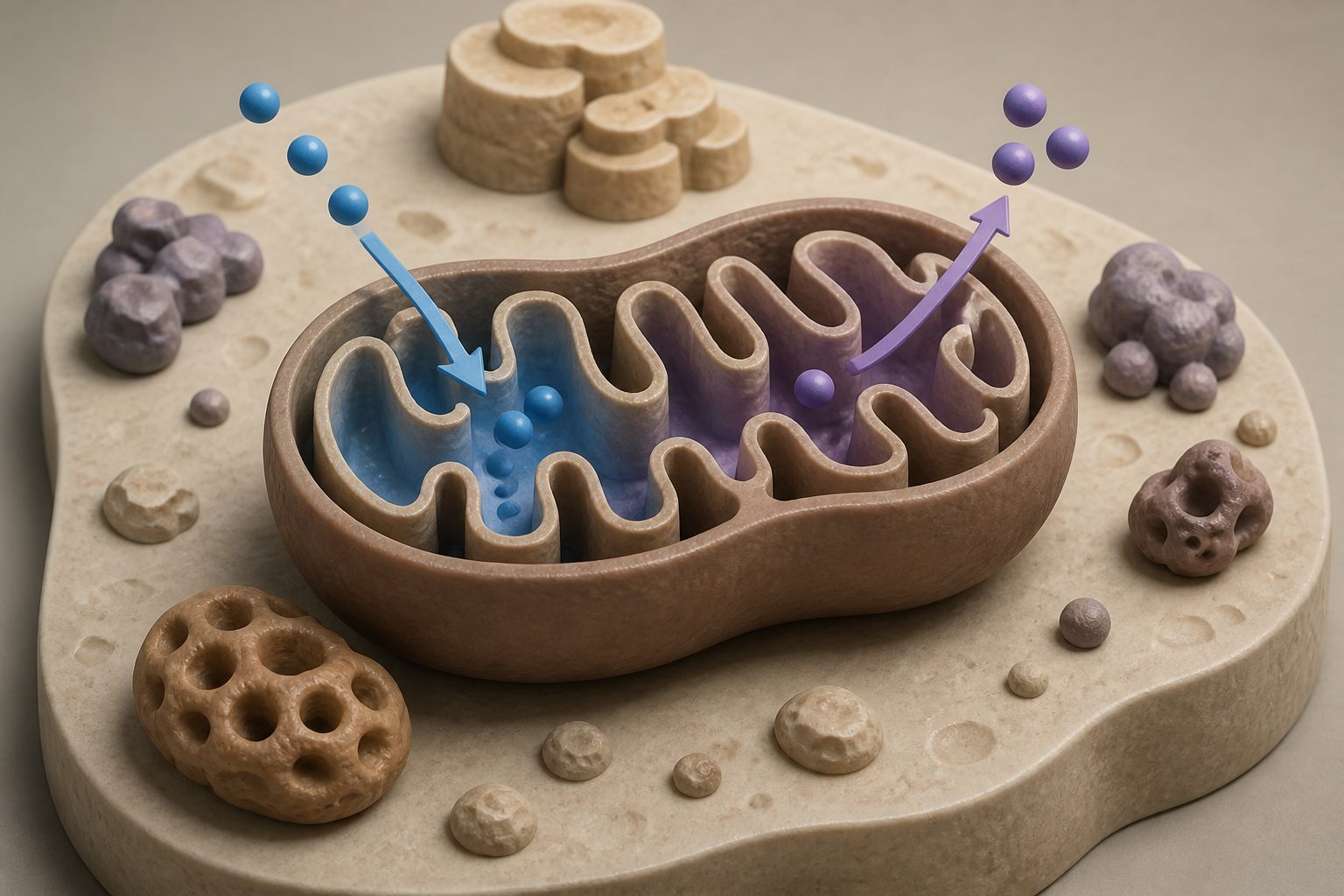
A comparison of mitochondrial proteins across eukaryotes suggests the ancestor of modern complex cells had both ways to make energy.
Researchers compared experimentally defined mitochondrial protein sets from eight organisms, identifying 8,619 distinct proteins grouped into 3,199 families. They used these data to retrain an AI-based protein classifier and predict mitochondrial protein sets for about 200 eukaryotes, including organisms whose mitochondria have undergone major evolutionary changes.
The researchers then reconstructed the mitochondrial protein set of the last eukaryotic common ancestor, or LECA—the ancestor shared by living eukaryotes. Their reconstruction indicates that LECA had a complex mitochondrion capable of both aerobic metabolism, which uses oxygen, and anaerobic metabolism, which does not.
How mitochondria changed
Across eight organisms, the researchers identified 8,619 distinct mitochondrial proteins in 3,199 protein families. Forty-three percent of these proteins lacked Pfam domains, which are recognizable protein regions used to classify proteins. The comparison also identified 33 protein families found in eukaryotic pathogens but absent in humans, making them candidate targets for future studies of protozoan infectious diseases.
Using the experimentally defined data, the researchers retrained a classifier based on a protein language model and used it to predict mitochondrial protein sets in about 200 eukaryotes. These predictions showed different evolutionary patterns, including expansions of particular gene families and extensive reductions that appear to be leading toward complete mitochondrial loss. The reconstructed LECA mitochondrion was complex and had the capacity for both aerobic and anaerobic metabolism.
Why early mitochondria matter
The findings provide a comparative view of how mitochondria have changed across eukaryotes, from retaining many functions to losing much of their protein machinery. They also suggest that the ancestor of modern complex eukaryotes had a mitochondrion able to use both oxygen-dependent and oxygen-independent forms of metabolism, informing ideas about the organelle's early evolution.
The pathogen-specific protein families could also help guide research into treatments for protozoan infectious diseases, although the study identifies them only as candidate targets and does not test their medical effectiveness.
// Source
Cell · 2026 · DOI: 10.1016/j.cell.2026.08.029
Authors: Michael Z. Chen, Jonathan A. Stefely, Eric G. Bardon, Ruslan Aphasizhev, Inna Aphasizheva, Cora N. Betsinger, Steven A. Carr, Luke H. Chao, Felicia G. Deng, Manoj T. Duraisingh, Michelle Y. Fry, Manish Goyal, Tiana M. Issa, Minsoo Kim, Cameron Genxuan Lian, Yi-Ting Liao, Bridget E Luce, Syed Yusuf Mian, Khanh Nguyen, Aditya S. Paul, Keith D. Rivera, John C. Samuelson, Md Solayman, Namrata D. Udeshi, Andres Vacas, Sarah E. Calvo, Vamsi Krishna Mootha
Institutions: Harvard University, Boston University, Broad Institute, Massachusetts General Hospital, Howard Hughes Medical Institute