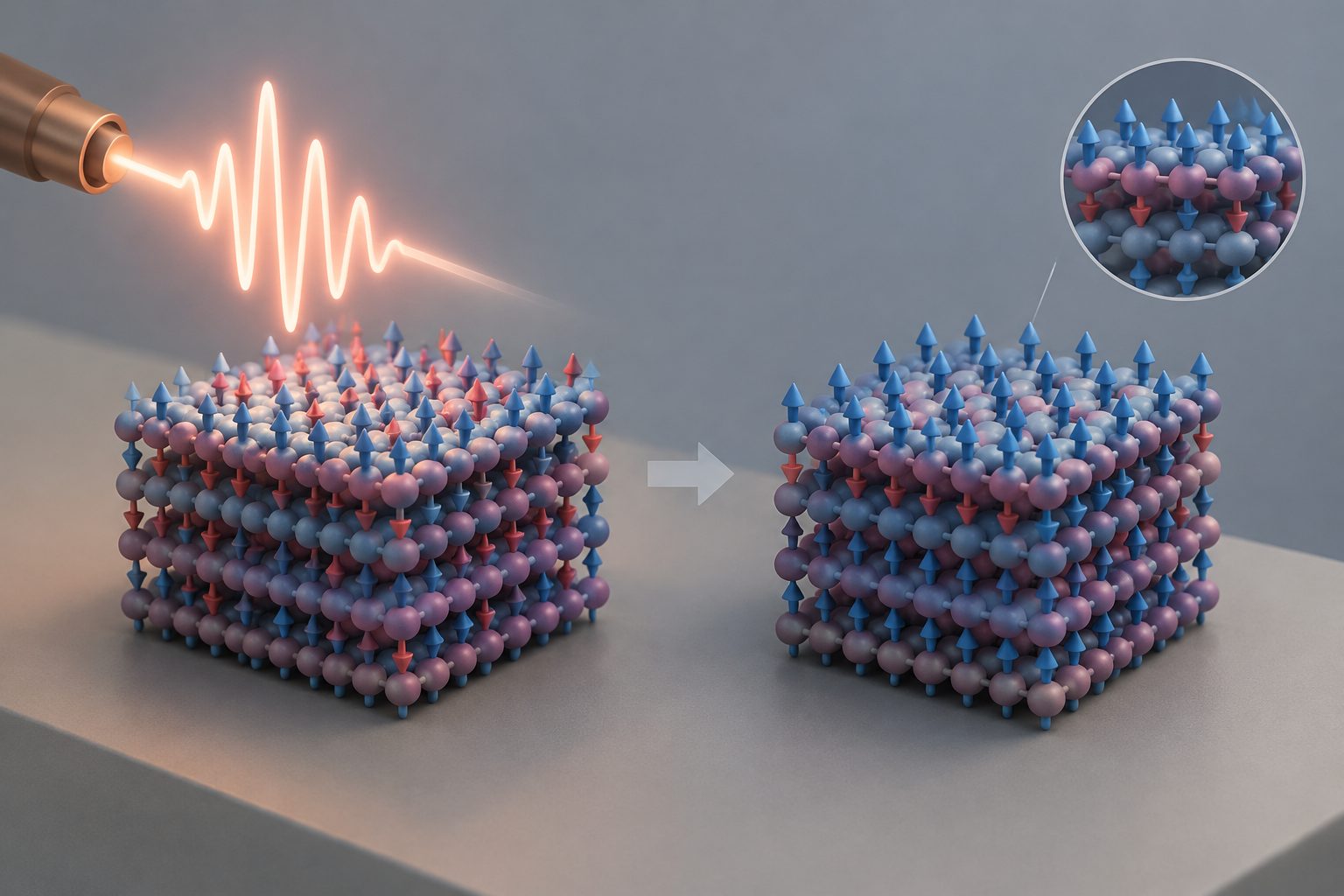
Experiments on manganese phosphorus trisulfide found long-lived vibrations and a response consistent with a possible change in its magnetic state.
Researchers used time-resolved measurements of light emitted at twice the incoming frequency to track how MnPS3 responded to strong terahertz fields. They observed large, long-lived oscillations in the antiferromagnetic phase, driven by atomic motions amounting to a few percent of the material’s equilibrium bond lengths.
The changing light patterns indicated that the fields dynamically broke a mirror symmetry. Two vibrational modes, at 1.7 and 4.5 terahertz, contributed to the response; the lower-frequency mode had not been seen in equilibrium measurements. Comparisons with simulations linked the behavior partly to field-driven charge rearrangement and found it consistent with a metastable, lower-symmetry state and a possible antiferromagnetic-to-ferrimagnetic transition.
How the material changed
Strong terahertz fields produced pronounced, long-lived oscillations in MnPS3 while it was in its antiferromagnetic phase. The oscillation amplitudes were comparable to the material’s equilibrium signal, and the associated phonons involved atomic displacements at the percent level relative to equilibrium bond lengths.
Rotational-anisotropy measurements showed that the material’s mirror symmetry changed dynamically. The response was modulated by vibrational modes at 1.7 and 4.5 terahertz, with the 1.7-terahertz mode described as a hidden mode because it was not observed in equilibrium spectroscopy. The researchers attribute part of the effect to terahertz-driven charge rearrangement that lowers local crystal symmetry and couples to the vibrations.
The response had a complex dependence on the polarization of the terahertz field and lasted long enough to be consistent with a metastable state of reduced symmetry. Simulations supported an interpretation involving a potential transition from antiferromagnetism to ferrimagnetism.
// Source
Nature Communications · 2026 · DOI: 10.1038/s41467-026-78519-4
Authors: Sheikh Rubaiat Ul Haque, Martin J. Cross, Sangeeta Rajpurohit, Jonah B. Haber, Christopher J. Ciccarino, Isabelle J. Sealey, V. A. Kulichenko, Monique Tie, Huaiyu Hugo Wang, Sharon S. Philip, Choongwon Seo, J. D. Koralek, Luis Balicas, Mykhaylo Ozerov, Dmitry S. Smirnov, Liang Zheng Tan, Felipe H. da Jornada, Tadashi Ogitsu, Matthias C. Hoffmann, Tony F. Heinz, Aaron M. Lindenberg
Institutions: Florida State University, Stanford University, Baylor University, National High Magnetic Field Laboratory, Lawrence Berkeley National Laboratory, SLAC National Accelerator Laboratory, Lawrence Livermore National Laboratory, Linac Coherent Light Source, Molecular Foundry