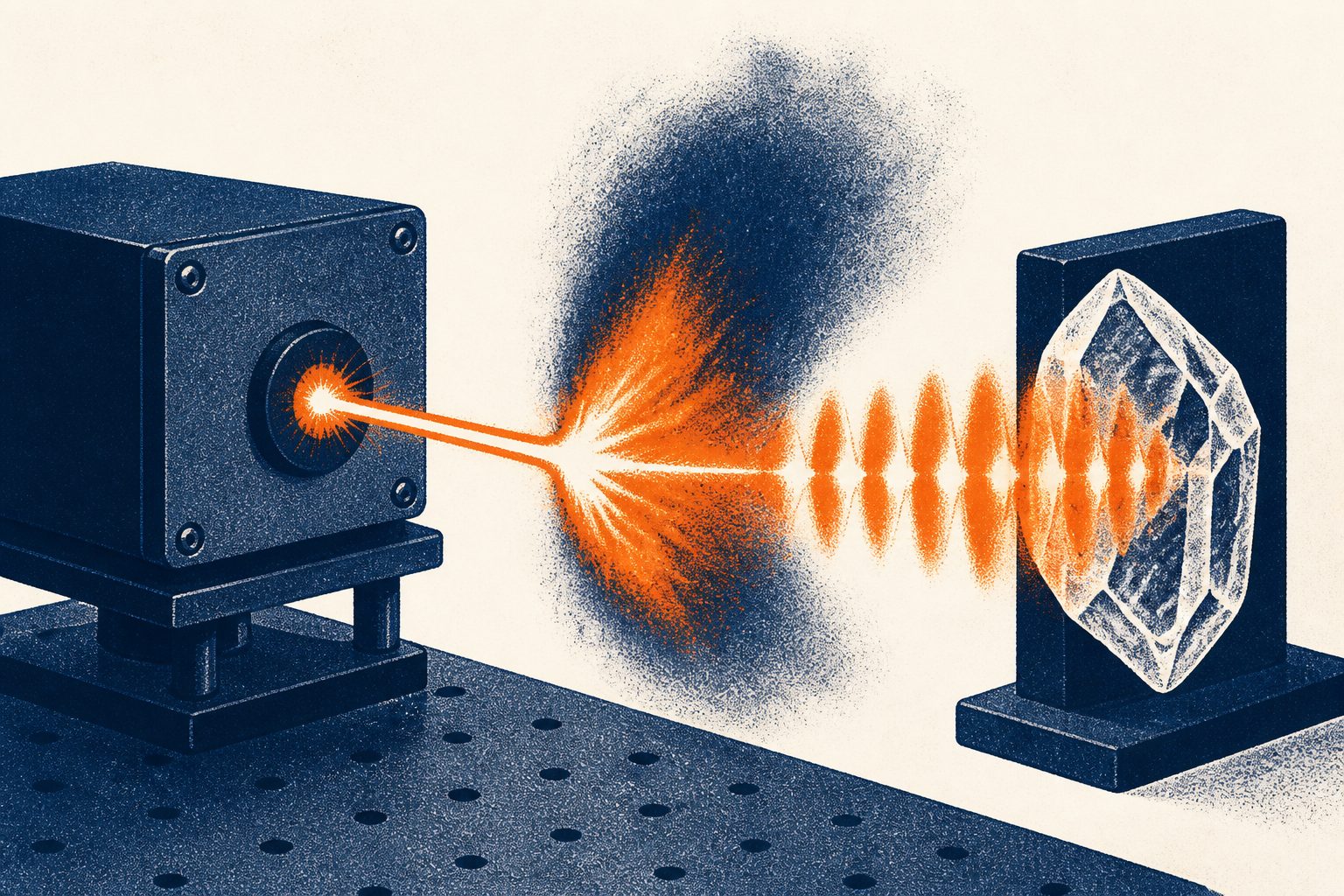
The source can shift its X-ray energies to match the absorption signatures of selected materials.
Researchers report a tabletop technique for producing bright, narrow-band X-ray harmonics whose photon energies can be shifted continuously. The source covers the extreme-ultraviolet to soft-X-ray range and can be adjusted to align with selected absorption edges, where materials absorb X-rays strongly.
The approach combines visible lasers with carefully controlled spectra and simultaneous optimization of the laser spectrum, waveguide and gas conditions. The researchers say the resulting pulses retain coherence, narrow bandwidth and high brightness, and are expected to form trains of pulses shorter than 300 attoseconds.
What the source produces
The researchers developed a tabletop method for generating high-order harmonics in the extreme-ultraviolet to soft-X-ray range. By jointly tuning infrared spectral broadening, second-harmonic phase matching, waveguide dispersion, the gas species and the gas density, they report continuous shifts of the harmonic peaks toward higher or lower photon energies.
The harmonics can be aligned with selected absorption edges, which are energy-specific signatures useful for studying materials. The source is reported to preserve coherence, narrow bandwidth and high brightness. The researchers expect the X-rays to emerge as trains of sub-300-attosecond pulses. They identify resonant imaging of magnetic nanostructures, resonant X-ray absorption spectroscopy and tunable sources for possible nuclear-clock development as potential applications.
// Source
Communications Physics · 2026 · DOI: 10.1038/s42005-026-02791-5
Authors: Dimitar Popmintchev, Aref Imani, Joris Roman, Siyang Wang, Jieyu Yan, Sirius Song, Ryan Clairmont, Zhihan Wu, Elizaveta Gangrskaia, Edgar Kaksis, Alessandra Bellissimo, Tobias Flöry, Bruno E. Schmidt, A. Pugžlys, Andrius Baltuška, Paolo A. Carpeggiani, Tenio Popmintchev
Institutions: University of California San Diego, TU Wien, Center for NanoScience