A redesigned hard-carbon surface steered chemical reactions toward a more stable protective layer in laboratory tests.
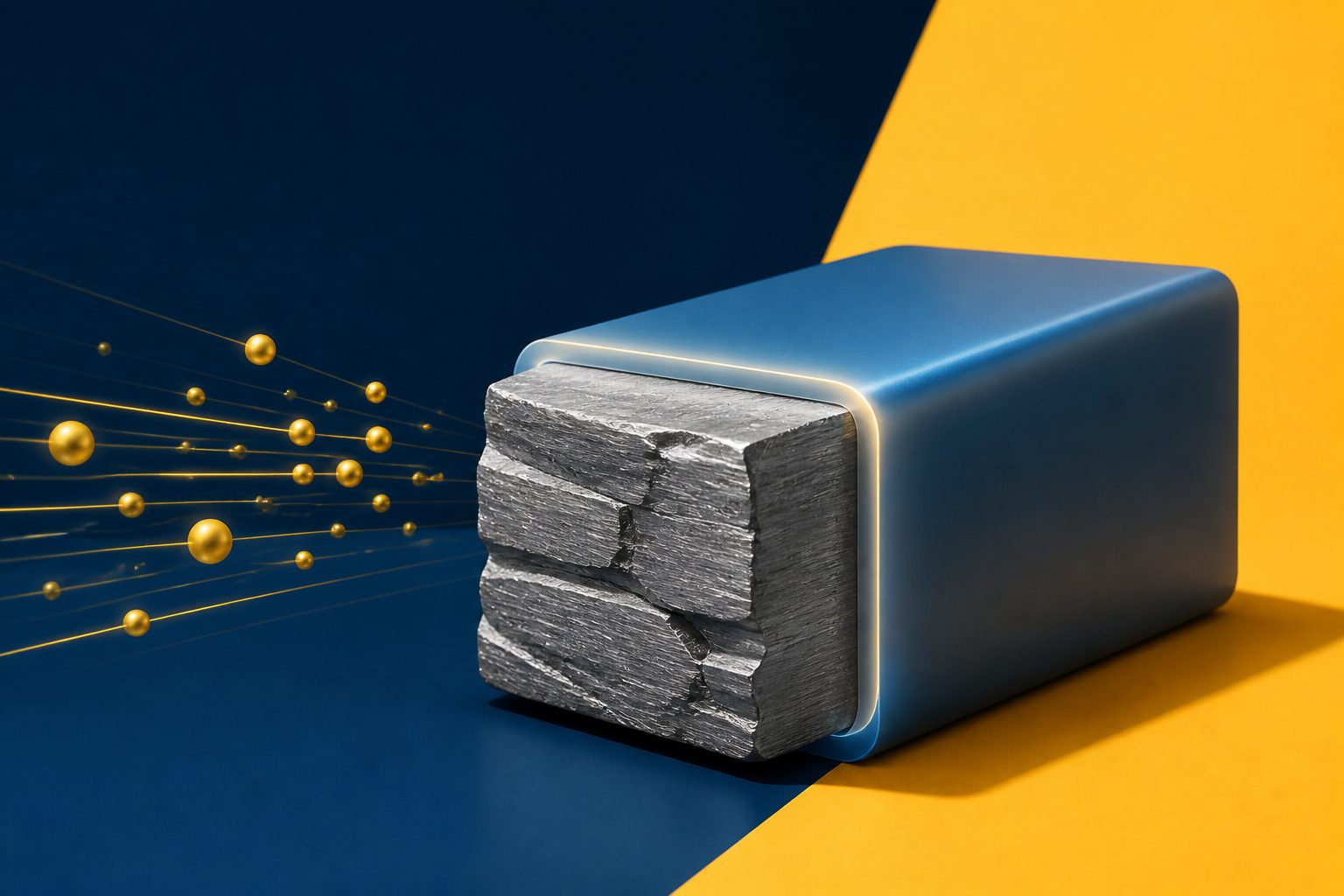
Researchers altered the surface of hard carbon, a material used as the negative electrode in sodium-ion batteries, by pairing pyridinic nitrogen with carbonyl groups. These chemical groups attracted certain electrolyte ingredients and pushed solvent molecules away, encouraging the formation of a thin, inorganic-rich protective layer at the electrode surface.
The optimized anode reached 91.9% Coulombic efficiency and a reversible capacity of 368.2 milliampere-hours per gram. It retained 96.5% of its capacity after 5,000 cycles. A pouch cell using a sodium iron phosphate cathode reached an energy density of 239.1 watt-hours per kilogram and operated stably for 500 cycles.
How the carbon surface works
The engineered hard-carbon surface created a chemical environment in which pyridinic nitrogen selectively anchored PF₆⁻ ions, while carbonyl groups repelled solvent molecules. The resulting concentration gradient directed more anions toward the electrode interface and shifted electrolyte breakdown away from solvent-dominated reactions.
The researchers report that this design lowered the barrier for PF₆⁻ breakdown by more than 70% and produced a thin protective layer rich in sodium fluoride and sodium oxide. The optimized anode achieved 91.9% Coulombic efficiency, a reversible capacity of 368.2 milliampere-hours per gram, and 96.5% capacity retention after 5,000 cycles. A pouch cell made with an NFPP cathode reached 239.1 watt-hours per kilogram and operated for 500 cycles.
Why longer cycling matters
Unstable protective layers at the hard-carbon surface can reduce the initial efficiency and cycle life of sodium-ion batteries. The results show a way to control the chemical reactions that form this layer rather than relying only on the electrolyte to form it spontaneously.
The long cycle test for the anode and the 500-cycle pouch-cell result indicate that the approach can work beyond a small electrode test. However, the abstract describes this as demonstrating practical potential; it does not establish how the design would perform under all operating conditions or in commercial cells.
Tests and open questions
This is a journal research article reporting laboratory tests of an engineered hard-carbon anode and a pouch cell. The abstract includes electrochemical performance, analysis of the surface layer, and a proposed explanation for how the paired surface groups alter electrolyte reactions.
The abstract does not provide details such as the test current, temperature, loading, full-cell operating conditions, comparison materials, or manufacturing scale. It therefore supports the reported performance in these tests but does not by itself show that the same results will hold in commercial sodium-ion batteries or over longer operation.
// Source
Nano-Micro Letters · 2026 · DOI: 10.1007/s40820-026-02339-w
Authors: Peiyao Wang, Shendong Xu, Siya Wang, Xiaoyu Cui, Jin Bai, Yuping Sun, Xuebin Zhu, Bangchuan Zhao, Shulei Chou, Xingqiao Wu
Institutions: Chinese Academy of Sciences, Wenzhou University, University of Science and Technology of China, Institute of Solid State Physics