Study links rare hormone-producing tumors with higher liver and heart risks
A large records-based analysis found more liver complications and some cardiovascular events among adults with these tumors than among adults with essential hypertension.
Moderate evidenceHuman studyInterpret with caution
Medical disclaimer: This article summarizes research findings and is for informational purposes only. It is not medical advice.
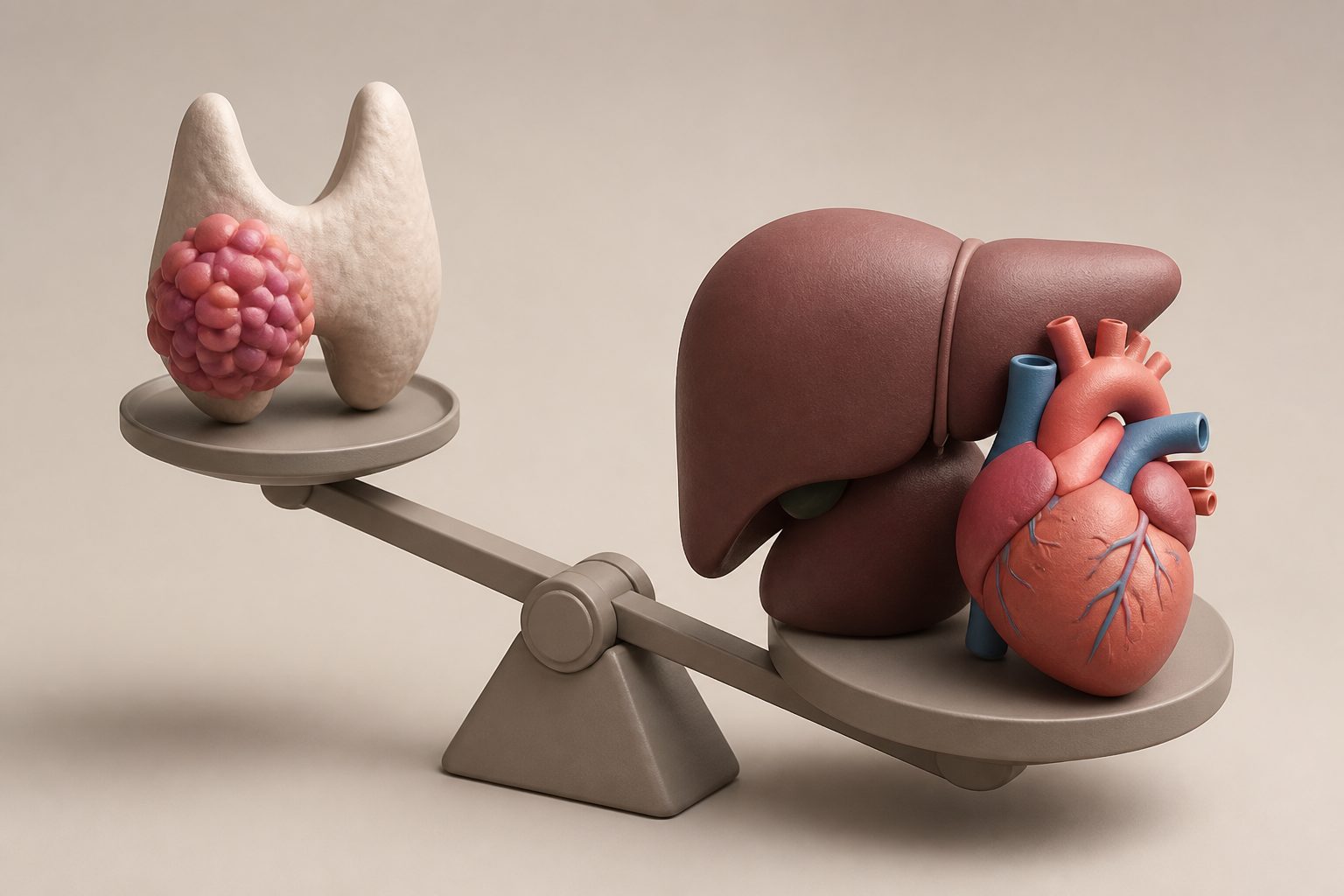
Editorial illustration — not from the study.
The researchers used data from the TriNetX health-record network to compare adults with pheochromocytoma or paraganglioma with adults who had essential hypertension. After matching the groups on demographic, metabolic and blood-pressure-related factors, 45,595 people were included in each group in the analysis described in the abstract. The study followed participants from diagnosis and examined newly recorded metabolic dysfunction-associated steatotic liver disease, serious liver outcomes, cardiovascular events, type 2 diabetes and death.
The tumor group had a 48% higher relative rate of newly recorded fatty liver disease and a 59% higher relative rate of major adverse liver outcomes. Hepatic decompensation was 73% higher, and hepatocellular carcinoma occurred at more than twice the relative rate. Major cardiovascular events were modestly higher, while the difference in new type 2 diabetes was not statistically significant. The researchers also reported higher mortality, but the excerpts do not provide a mortality estimate.
The question examined
This retrospective observational cohort study examined whether chronic sympathetic activation associated with pheochromocytoma and paraganglioma was linked with liver, cardiovascular and metabolic outcomes in humans. The researchers used anonymized inpatient and outpatient electronic records from the global TriNetX network. Adults with these tumors were compared with adults with essential hypertension, using propensity-score matching for demographic, metabolic and blood-pressure-related factors. The abstract describes five years of follow-up, while the discussion reports a mean follow-up of approximately four years. The abstract reports 45,595 participants in each matched group; the excerpts also report 47,171 people with the tumors before matching.
What researchers observed
Compared with the matched essential-hypertension group, adults with pheochromocytoma or paraganglioma had a higher rate of newly recorded metabolic dysfunction-associated steatotic liver disease: hazard ratio 1.48, with a 95% confidence interval of 1.38 to 1.58. Major adverse liver outcomes were also more common, with a hazard ratio of 1.59; hepatic decompensation had a hazard ratio of 1.73, and hepatocellular carcinoma had a hazard ratio of 2.18. Major adverse cardiovascular events were modestly higher, with a hazard ratio of 1.13. The difference in new type 2 diabetes was not statistically significant, with a hazard ratio of 1.02 and a confidence interval that included no difference. The study also reported higher all-cause mortality, but no mortality estimate is provided in the excerpts. Subgroups described as having pheochromocytoma or receiving alpha-adrenergic blockade had the greatest reported cardiometabolic risk; this comparison does not show that the medication caused or prevented any outcome.
Who this is relevant to
These findings may be most relevant to adults diagnosed with pheochromocytoma or paraganglioma who resemble the people represented in the TriNetX records, and to researchers studying possible links between sympathetic activity and liver disease. They should not be assumed to apply to the general population, to all people with fatty liver disease, or to people with other causes of high blood pressure. The study does not show that these tumors directly caused liver disease, cardiovascular events or death, and it does not evaluate an individual's personal risk.
Why it matters
The findings suggest that adults with pheochromocytoma or paraganglioma may have higher rates of liver disease and some related health outcomes than similar adults with essential hypertension. They add human observational evidence to a proposed connection between prolonged sympathetic activity and liver disease. However, the results do not establish that excess catecholamines caused the outcomes, and they may not apply to people without these tumors or to people with different health profiles.
Limitations & evidence assessment
The study was observational and based on electronic health records, so unmeasured differences between groups may have influenced the results. Data completeness varied between institutions; some information in free-text records could not be used, and the timing of laboratory and body-measurement data was not always clear. The tumors are genetically and clinically diverse, but genotype information, imaging data and precise cumulative catecholamine exposure were unavailable, limiting assessment of dose-response relationships. People with these tumors may have received more imaging and testing, which could have increased detection of fatty liver disease; detailed liver measurements were also unavailable. The excerpts give differing descriptions of follow-up duration, and the mortality result lacks a numerical estimate.
Why this evidence level: Cohort study on humans; observational but structurally stronger than cross-sectional designs.
Evidence levels are editorial estimates derived from study metadata — they are not clinical appraisals.
// Source
European Journal of Endocrinology · 2026 · DOI: 10.1093/ejendo/lvag176
A systematic review examined 12 studies of molecular tests for urinary tract infections in adults, including two randomized trials with 830 participants. The review found that PCR-based tests were more sensitive than standard urine cultures and were linked with short-term symptom improvement in both trials, but the tests were less specific and the overall clinical evidence remains limited.
This human-focused review examines chronic subdural hematoma, a blood collection around the brain that is more common in older adults. It describes evidence for middle meningeal artery embolization, a procedure intended to reduce blood flow to the membrane that can help sustain the hematoma. The review presents the procedure as a possible addition to, or alternative for, surgery in selected high-risk patients—not as a universal replacement.
Researchers studied 2,632 women from a Finnish birth cohort to examine whether being classified as climacteric at age 46 was associated with anxiety, depression symptoms, and psychiatric medication purchases. Climacteric women had higher reported levels of some anxiety and depression symptoms than preclimacteric women, although this observational study cannot show that menopausal changes caused those symptoms.