Review examines a blood-vessel procedure for chronic brain bleeding
The evidence suggests possible benefits for selected patients, but does not support replacing surgery for everyone.
Moderate evidenceReviewSome caution advised
Medical disclaimer: This article summarizes research findings and is for informational purposes only. It is not medical advice.
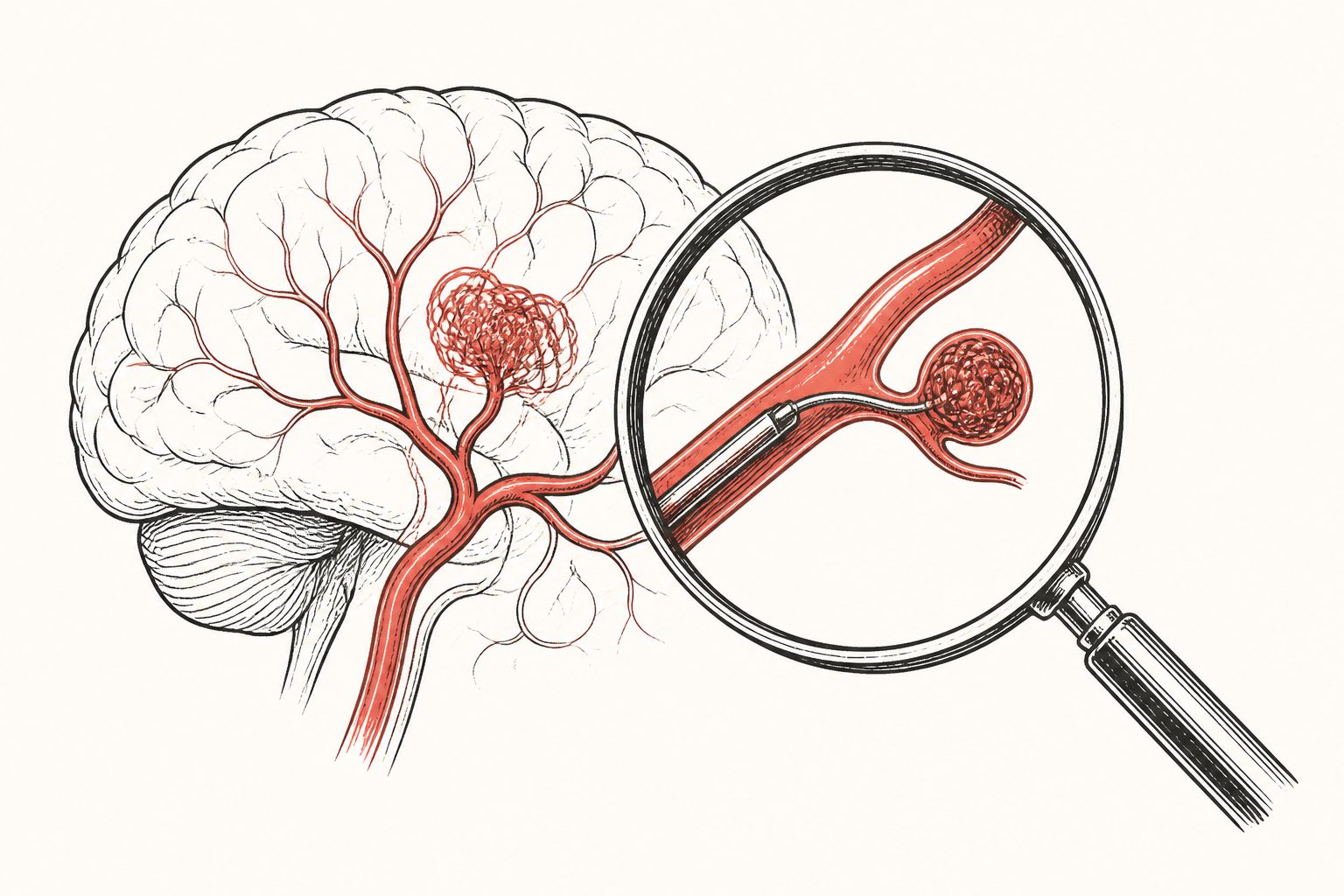
Editorial illustration — not from the study.
The review explains that chronic subdural hematoma may involve ongoing inflammation, fragile new blood vessels, repeated small bleeding, and abnormal breakdown of clots. This model differs from the older view that the condition is simply a static collection of blood caused by an injury.
It summarizes several human randomized trials of middle meningeal artery embolization. Some trials reported fewer recurrences or treatment failures, while another did not find a statistically clear reduction in recurrence. The authors say that longer follow-up, more consistent techniques, and better ways to identify suitable patients are still needed.
What the review examined
This journal article is a review of human research on chronic subdural hematoma. It discusses how the condition develops, factors linked with poorer outcomes or recurrence, standard conservative and surgical care, and evidence for middle meningeal artery embolization. The review summarizes three major randomized trials involving 400, 722, and 310 participants, as well as additional randomized studies and a pooled analysis of three pivotal trials involving 1,432 participants. The article does not report a new patient trial of its own, and the methods used to search for and select studies are not provided in the supplied information.
What the evidence shows
The review describes chronic subdural hematoma as an active process involving inflammation, abnormal blood-vessel growth, leakage, repeated small bleeding, and increased clot breakdown within a surrounding membrane. It reports that recurrence after surgery still occurs in roughly 10% to 30% of patients, based on the evidence it summarizes.
Across the reviewed randomized trials, results were mixed. In one trial, recurrence or progression requiring repeat surgery occurred in 4.1% of patients receiving embolization plus surgery compared with 11.3% receiving surgery alone. In another, symptomatic recurrence or progression occurred in 6.7% with embolization and 9.9% with usual care, but the difference was not statistically clear. A third trial reported treatment failure in 16% with embolization plus standard care compared with 36% with standard care alone. The pooled analysis of the three pivotal trials suggested a lower risk of recurrence or progression with adjunctive embolization, but the overall difference did not reach statistical significance. These findings describe associations and trial results from the reviewed studies; they do not establish that embolization is appropriate for every patient.
Who this may apply to
The findings concern human adults with chronic subdural hematoma, particularly the types of patients represented in the reviewed clinical trials. They may not apply to people with different forms of bleeding, different medical risks, or treatment settings unlike those trials. The review does not show that middle meningeal artery embolization should replace surgery for all patients, and it does not establish which individual patients are most likely to benefit.
Why it matters
Chronic subdural hematoma is increasingly important in aging populations because its occurrence rises with age and it can be associated with disability and death. The review may help explain why treatments aimed at the surrounding blood vessels are being studied in addition to procedures that drain the hematoma itself. Its conclusions are most relevant to clinicians and researchers considering how treatment choices might be tailored to particular human patients, but the review does not establish one universally suitable approach.
Limitations & evidence assessment
This article is a review rather than a new clinical trial, and the supplied information does not describe a formal search strategy or other methods for selecting the evidence. The randomized studies differed in their participants, use of surgery, embolization materials, outcome measures, and follow-up periods, which makes direct comparison difficult. Some evidence involved relatively short-term outcomes, and the review states that longer-term results and standardized techniques are still needed. The pooled result from three pivotal trials did not show a statistically clear overall reduction, and the supplied excerpt does not provide complete results for every study it mentions.
Why this evidence level: Randomized trial; sample size could not be determined from metadata.
Evidence levels are editorial estimates derived from study metadata — they are not clinical appraisals.
A systematic review examined 12 studies of molecular tests for urinary tract infections in adults, including two randomized trials with 830 participants. The review found that PCR-based tests were more sensitive than standard urine cultures and were linked with short-term symptom improvement in both trials, but the tests were less specific and the overall clinical evidence remains limited.
Researchers studied adults with pheochromocytoma or paraganglioma, rare tumors that can produce excess stress-related hormones, using anonymized electronic health records. Compared with matched adults who had essential hypertension, those with these tumors had higher rates of fatty liver disease, serious liver complications and some cardiovascular outcomes over several years. Because this was an observational study, it shows associations rather than proving that the tumors caused these outcomes.
Researchers studied 2,632 women from a Finnish birth cohort to examine whether being classified as climacteric at age 46 was associated with anxiety, depression symptoms, and psychiatric medication purchases. Climacteric women had higher reported levels of some anxiety and depression symptoms than preclimacteric women, although this observational study cannot show that menopausal changes caused those symptoms.