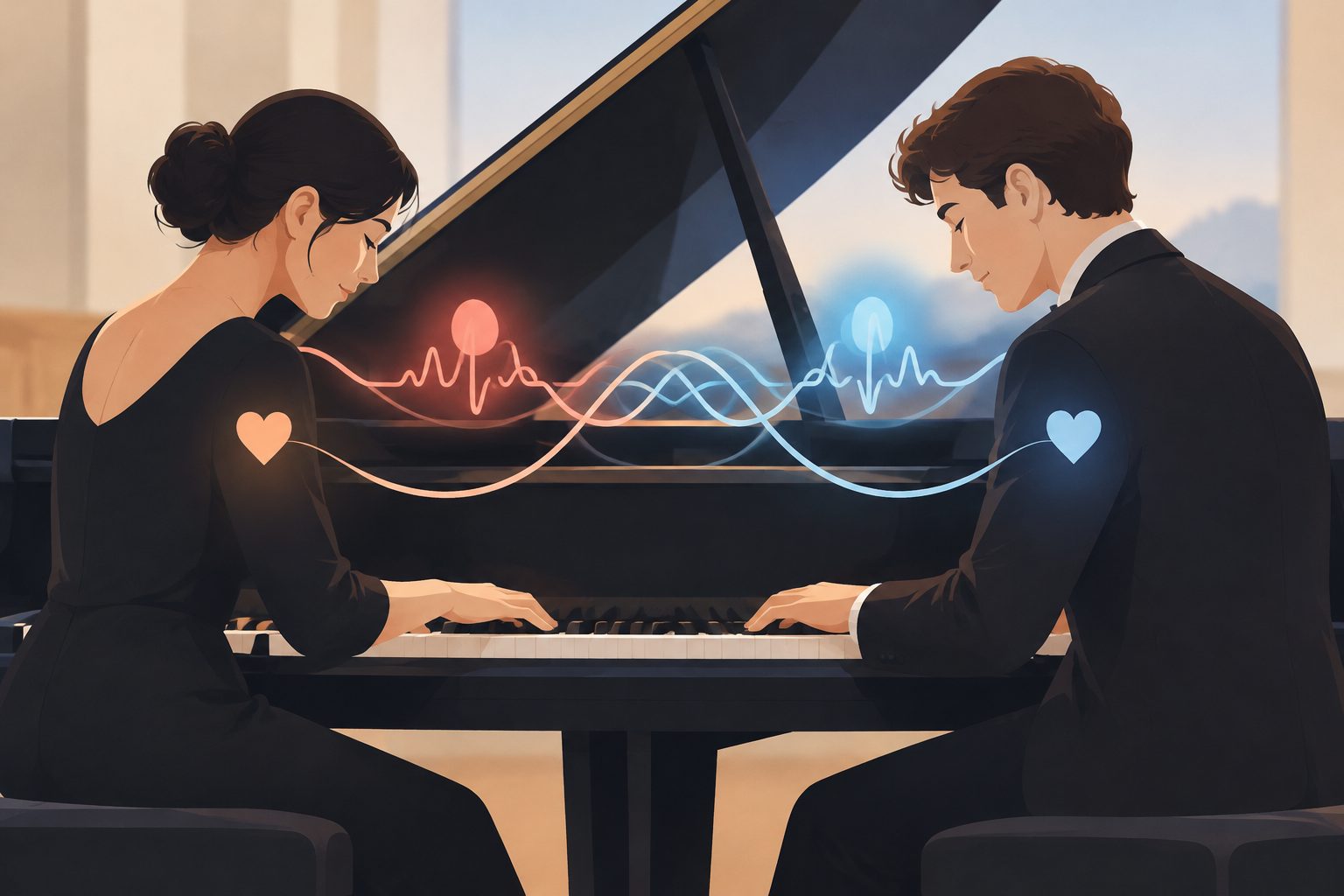
The closer their heart activity tracked one another, the greater experts judged the ensemble’s cohesion, although the study cannot show which caused which.
The researchers recorded heart rate and electrodermal activity—a measure related to changes in skin conductance—from 60 pianists as they performed four pieces designed to vary in emotional intensity and positivity. In every condition, the partners’ physiological signals were more synchronized than signals from matched surrogate pairs, with the strongest synchrony during pieces combining high arousal with positive emotion.
Negative-emotion pieces received lower expressiveness ratings. Heart-rate synchrony was associated with higher expert-rated ensemble cohesion, while skin-conductance synchrony was not significantly associated with expressiveness. The researchers found no consistent one-way leader–follower pattern, and neither collaboration duration nor trait empathy was a significant predictor in this sample.
How the pianists matched
All 30 piano duos showed heart-rate and electrodermal synchrony above the study’s surrogate baselines across all four emotional conditions. Synchrony was strongest for high-arousal, positive-emotion pieces. Pieces with negative emotional valence were rated as less expressive, regardless of arousal level.
Heart-rate synchrony was associated with expert-rated ensemble cohesion. Electrodermal synchrony was not significantly associated with expressiveness, so the proposed distinction between the two physiological signals received only partial support. The study found no systematic unidirectional leader–follower structure. Collaboration duration and trait empathy were not significant predictors, although the researchers say the study had limited power for some of these analyses.
Why ensemble synchrony matters
The findings provide objective evidence that autonomic activity—the body’s automatic physiological responses—can become synchronized between musicians performing together. They also suggest that heart-rate synchrony may track one aspect of collaborative performance: how cohesive an ensemble sounds to expert judges.
The results do not show that physiological synchrony causes better playing, or that it reflects emotional transfer between partners. Instead, they identify a measurable association that may help distinguish different aspects of coordination during ensemble performance.
Evidence and caveats
The study involved 30 established piano duos, or 60 participants, in a repeated-measures experiment in which each pair performed pieces from four emotional conditions. The researchers compared within-pair signals with cross-pair surrogate data and used statistical models to relate synchrony to expert ratings.
Several limitations affect interpretation. The participants were recruited from conservatory settings, so the results may not apply to other musicians or ensembles. Piano playing involves substantial movement, which can reduce the accuracy of heart-rate variability measures, and the study did not include a dedicated resting baseline for comparison. Electrodermal sensors were placed on fingers used in playing, which may have affected comfort or tactile feedback. Because the design was cross-sectional, it cannot determine whether synchrony precedes, accompanies or follows high-quality performance. The limited number of pairs also makes the nonsignificant findings about empathy and directionality inconclusive.
// Source
Frontiers in Psychology · 2026 · DOI: 10.3389/fpsyg.2026.1850198
Authors: Chang Li
Institutions: Jimei University