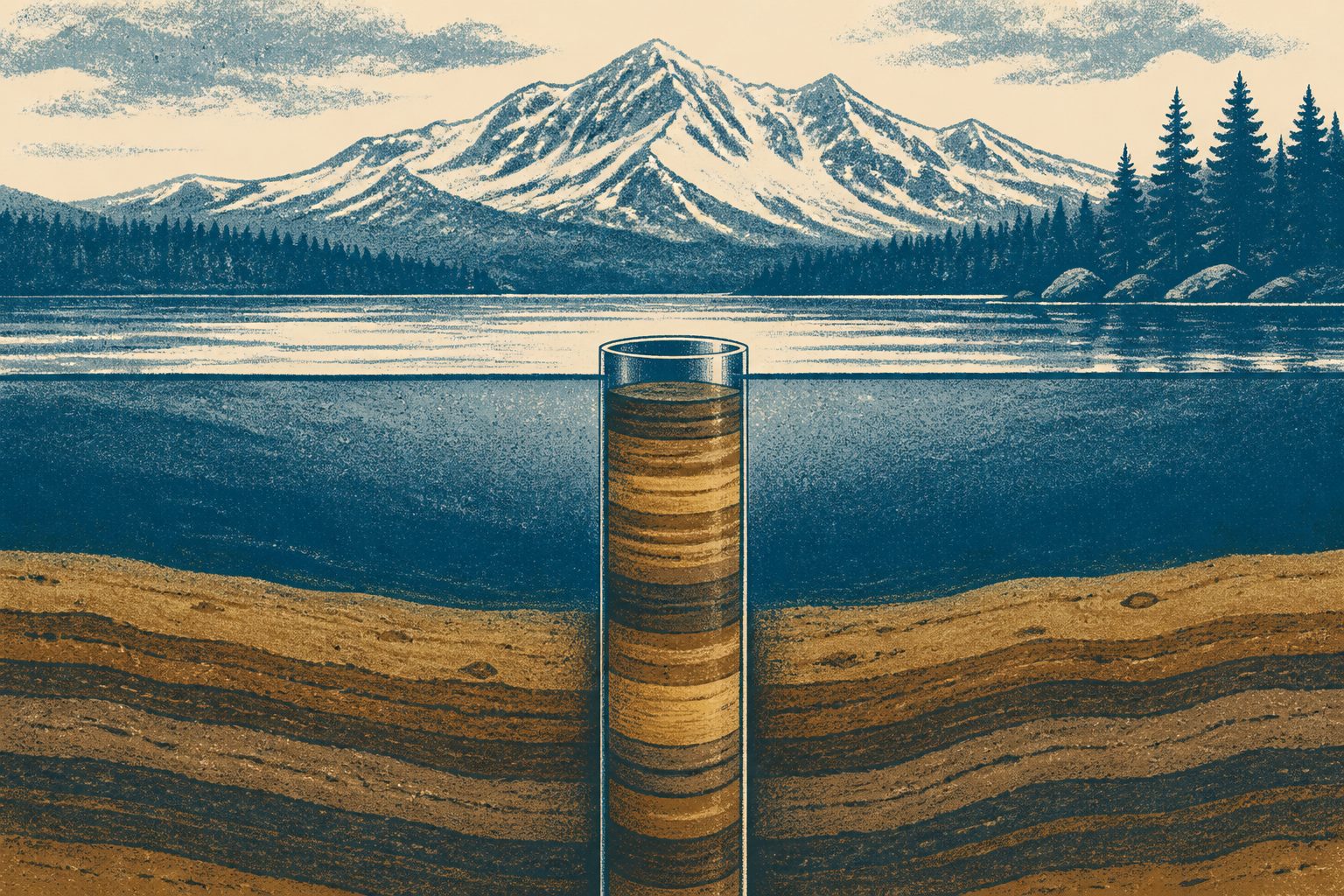
Sediment cores from two lakes preserve traces of climate events dating back thousands of years.
The study examined continuous sediment cores from the two lakes using radiocarbon dating, particle-size measurements, mineral analysis, chemical data and magnetic properties. Most of the sediment consisted of silt-sized material carried into the lakes from surrounding Quaternary deposits and older exposed rocks.
By combining these measurements, the researchers identified sediment changes that correspond with several known or inferred climate events. These included the Bølling warming about 14,700 calibrated years ago, cooling about 8,200 years ago, regional drying about 2,000 years ago and Bond Event 1 about 1,500 years ago, along with additional dry periods.
What the sediments show
The lake sediments were dominated by allothigenic silt — mineral material brought into the lakes from outside their basins — a pattern typical of freshwater lakes. The main sources were Quaternary deposits formed by weathering, slope movement and stream activity, as well as exposed rocks older than the Quaternary. Maps of the deposits indicate that slope flows and stream channels helped transport this material into the lakes.
The combined sediment evidence was used to correlate changes with the Bølling warming, at about 14,700 calibrated years before present; the cooling event about 8,200 years ago; aridization, or increasing dryness, in the Southern Urals about 2,000 years ago; and Bond Event 1 about 1,500 years ago. The researchers also identified possible dry events at about 11,430, 6,100, 4,250, 3,537 and 1,065 calibrated years before present.
Why these lakes matter
The two lakes lie near a climatic divide, where changes in moisture can be difficult to interpret consistently. Identifying which sediment features reflect material entering the lakes and which correspond with climate stages provides a basis for reconstructing how Southern Ural conditions changed during the Late Quaternary.
The findings also show that lake sediments can preserve evidence of both regional moisture changes and climate events recognized beyond the region. This helps place the Southern Urals’ past warming, cooling and drying episodes in a broader climate context.
Evidence and limits
The study is a geological reconstruction based on continuous lake-sediment cores, radiocarbon ages, particle-size distributions, mineral composition, inorganic geochemistry and magnetic measurements. The researchers used these indicators to infer sediment sources and to correlate sediment changes with regional and global climate stages.
The abstract covers two lakes and does not provide the number of core samples, dating uncertainties or the strength of each correlation. The identified climate events are therefore reconstructions from sediment proxies rather than direct measurements of past temperature or rainfall.
// Source
Journal of Mining Institute · 2026
Open access versionPublished 2026-08-31 Authors: А. Р. Юсупова, Н. Г. Нургалиева
Institutions: Kazan Federal University