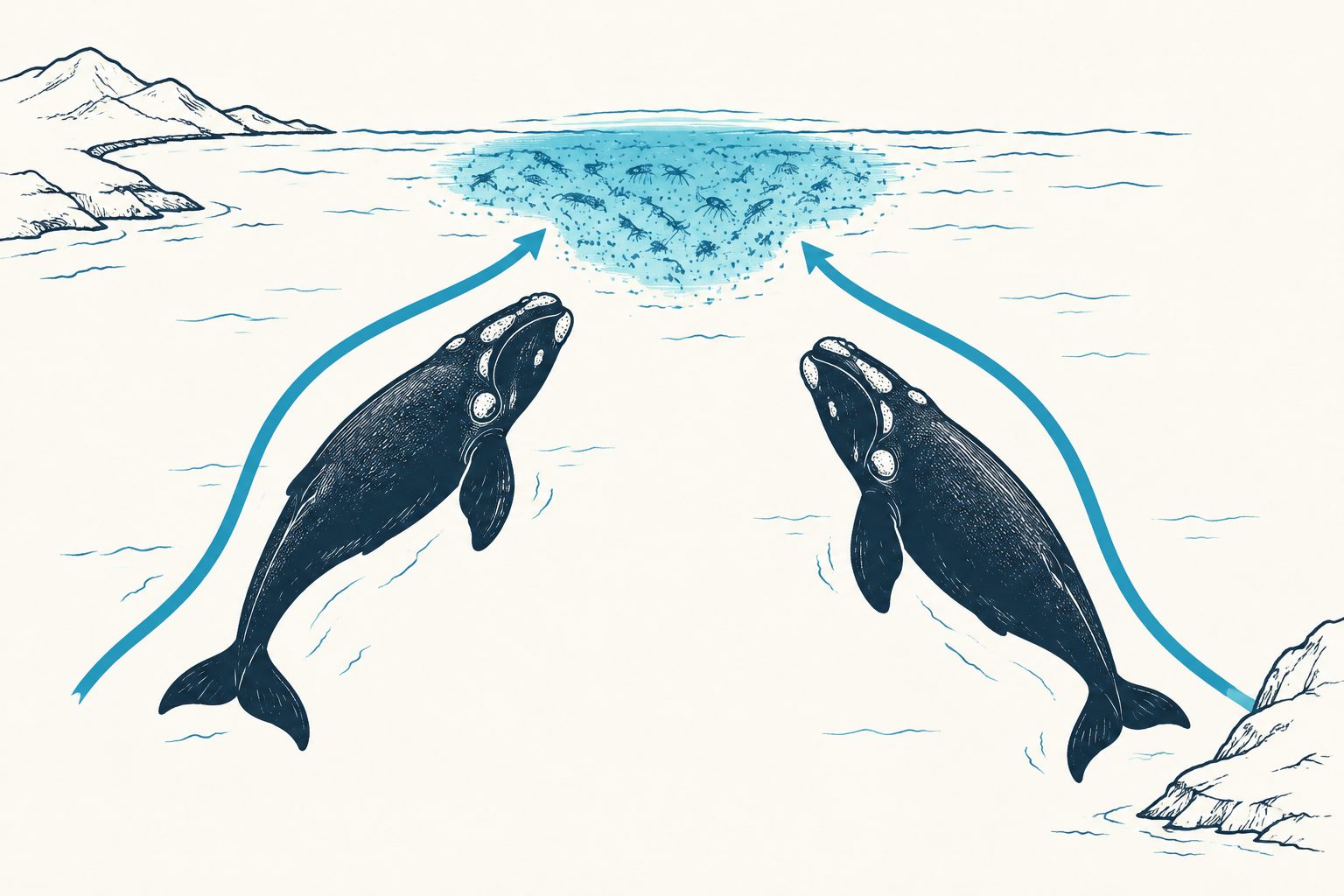
Whales leaving early were more likely to take a longer route, but arrived at similar times to those taking a direct path.
Researchers tracked 21 southern right whales as they migrated from wintering grounds to summer feeding grounds. Some took a direct route westward, while others traveled farther north before reaching the same feeding areas.
Departure time was the only measured factor linked to route choice: whales that left earlier were more likely to take the longer route. Although these whales spent more days migrating, they arrived at the feeding grounds at similar times to whales on the direct route. The researchers suggest the different routes may reflect a trade-off between minimizing travel time and minimizing energy use.
Two routes, similar arrival times
The whales followed two distinct migration routes. One was a direct westward path; the other was longer and passed through higher latitudes. Among the factors examined, departure timing from the wintering grounds was the only significant predictor of route choice. Sex, age class, body length and body condition were not significant predictors.
Whales that departed earlier were more likely to use the longer route and spent more days migrating. Despite this, both groups reached shared summer feeding grounds at similar times. The researchers hypothesize that the routes represent different strategies: one may minimize travel time, while the other may reduce energy costs. They also suggest that ocean currents, seafloor depth and magnetic-field gradients could provide navigation cues.
// Source
Proceedings of the Royal Society B Biological Sciences · 2026 · DOI: 10.1098/rspb.2026.0029
Authors: Leena Riekkola, Xuelei Zhang, Alice Della Penna, Virginia L. Andrews-Goff, Gabriela Duran, Rochelle Constantine, Simon Childerhouse, Fredrik Christiansen, Rosalind Cole, Kimberly T. Goetz, Robert Harcourt, David Lundquist, Catherine E. Meyer, Mike Ogle, Esther Stuck, Alexandre Novaes Zerbini, Emma L. Carroll
Institutions: University of Pretoria, Macquarie University, Department of Conservation, Aarhus University, University of Auckland, Mammal Research Institute, Australian Antarctic Division, Universidade Federal de Juiz de Fora, Istituto di Scienze Marine del Consiglio Nazionale delle Ricerche, NOAA National Marine Fisheries Service Alaska Fisheries Science Center, Marine Ecology and Telemetry Research, Blue Planet (Norway), Centro Universitário Academia, Auckland Institute of Studies