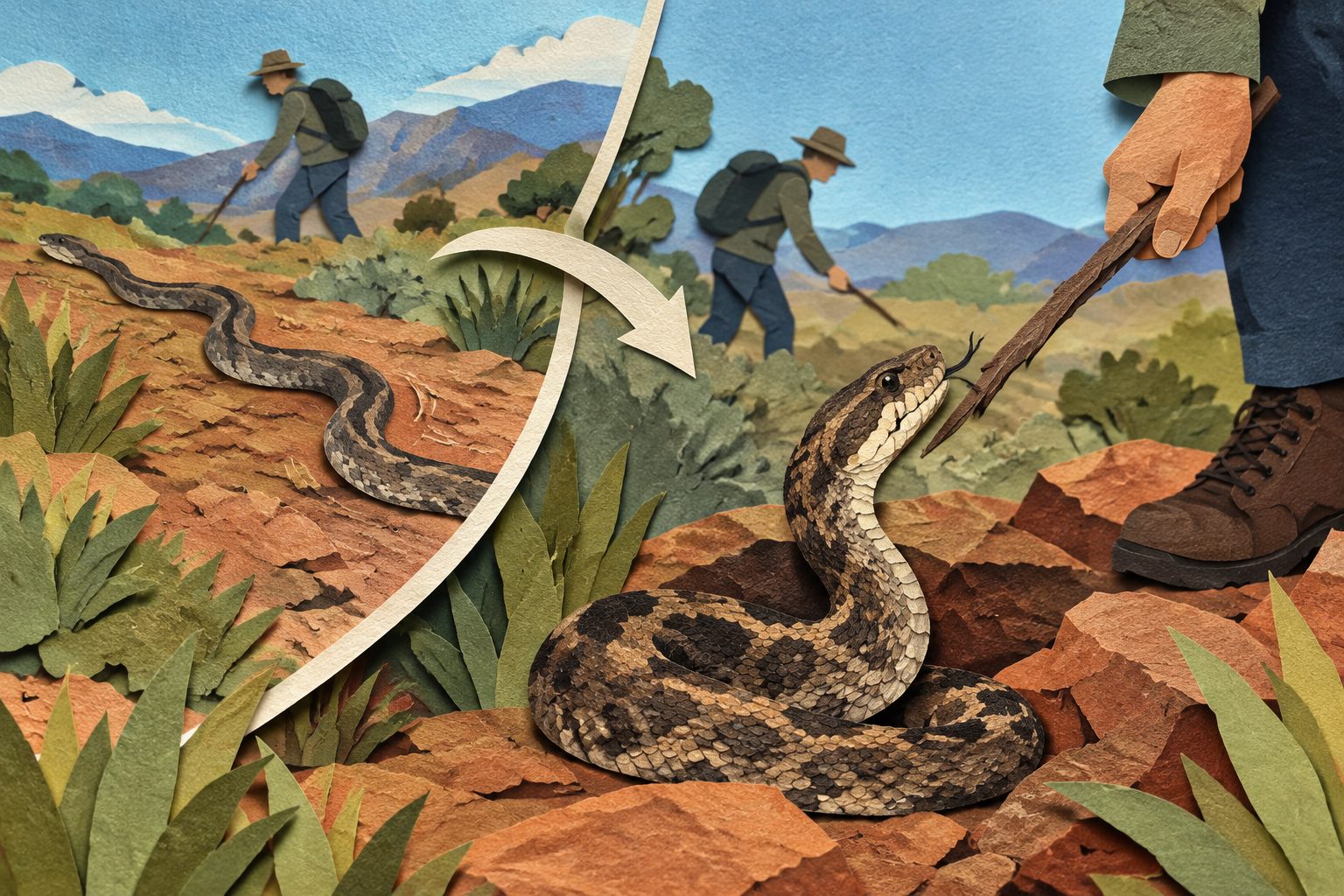
In tests with a fake human hand, three species struck or bit when they could not escape, while Mozambique spitting cobras spat instead.
Researchers tested recently captured wild puff adders, black mambas, snouted cobras and Mozambique spitting cobras in South Africa using a fake arm and hand. They recorded behaviour during two sequential trials and examined whether body size or sex predicted striking.
Black mambas, snouted cobras and puff adders struck at the model, while Mozambique spitting cobras did not strike or bite it. The spitting cobras instead showed their primary defensive response, spitting. Defensive behaviour was generally more common in the second trial, after the snakes had continued to experience the simulated threat.
How the snakes responded
Of 14 black mambas tested, 10 struck at the hand and eight of those bit it. Three of seven snouted cobras struck, with two biting, while four of six puff adders struck and three bit the hand. None of the 21 Mozambique spitting cobras struck or bit the model.
The three striking species generally waited until the simulated threat was closer than 50 centimetres before striking. Their strikes lasted less than 0.4 seconds, and puff adders had the highest acceleration over short distances, indicating strong performance at close range. Body size and sex were not significant predictors of striking behaviour. The researchers could not evaluate models for biting across species because those models did not converge. Defensive behaviour was generally higher in the second trial, and snakes were less likely to bite when they had the option to flee.
Evidence and caveats
The study used behavioural experiments with recently captured wild snakes from within about 50 kilometres of Hoedspruit in Limpopo Province, South Africa. Each snake was housed individually for no longer than two weeks and tested with a fake arm in two trials. The sample sizes were small and differed by species: 14 black mambas, seven snouted cobras, six puff adders and 21 Mozambique spitting cobras.
These laboratory trials used an artificial threat and may not represent every encounter between people and snakes. The snakes came from one South African region, so the results may not apply to all populations. Striking varied substantially among individuals, and the study found no significant effects of body size or sex. The researchers also could not assess biting models across species because of statistical non-convergence.
// Source
Behavioral Ecology and Sociobiology · 2026 · DOI: 10.1007/s00265-026-03810-9
Authors: Hiral Naik, Graham John Alexander
Institutions: University of the Witwatersrand