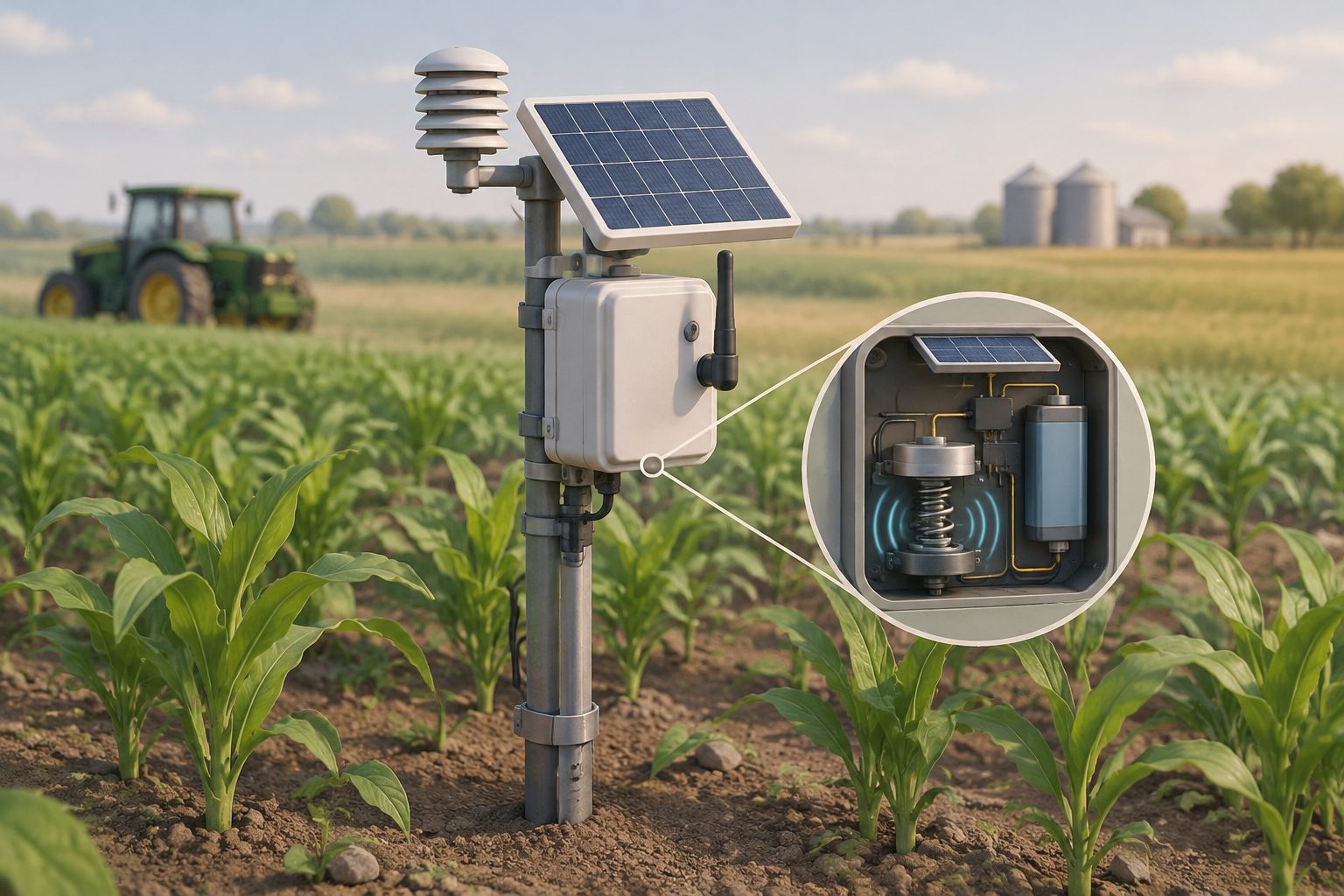
A system combining a small solar panel with vibration-powered devices ran agricultural wireless sensors for more than 12 hours without light.
The researchers combined a monocrystalline solar panel with piezoelectric devices, which turn mechanical movement or vibration into electricity. A power-management circuit was used to draw energy efficiently, and the harvested power was stored in a supercapacitor and lithium-ion battery system.
A sensor platform was tested indoors and then deployed in a greenhouse and an open field. Compared with solar-only systems, the hybrid setup increased reported energy capture by 30–45%. The sensors maintained more than 98% uptime during a continuous 30-day deployment and operated for more than 12 hours without light.
Tests and open questions
The evidence comes from the system’s design, indoor calibration and deployments in a greenhouse and an open field, including a 30-day continuous test. The reported results compare solar-only, piezoelectric-only and hybrid configurations. The excerpts do not give the number of sensor nodes, detailed weather conditions, or the precise test duration for each setting. The work also does not report longer-term, multi-season trials or tests across larger sensor arrays; those are identified as future work. Some provided text is unrelated to the energy harvester, so the findings here are limited to the stated harvesting and sensor-deployment results.
// Source
Progress in Electronics and Communication Engineering · 2026 · DOI: 10.31838/ece/03.02.06
Authors: N. K. Havalam, Ragaba Mean Bosco
Institutions: Rwanda Biomedical Center