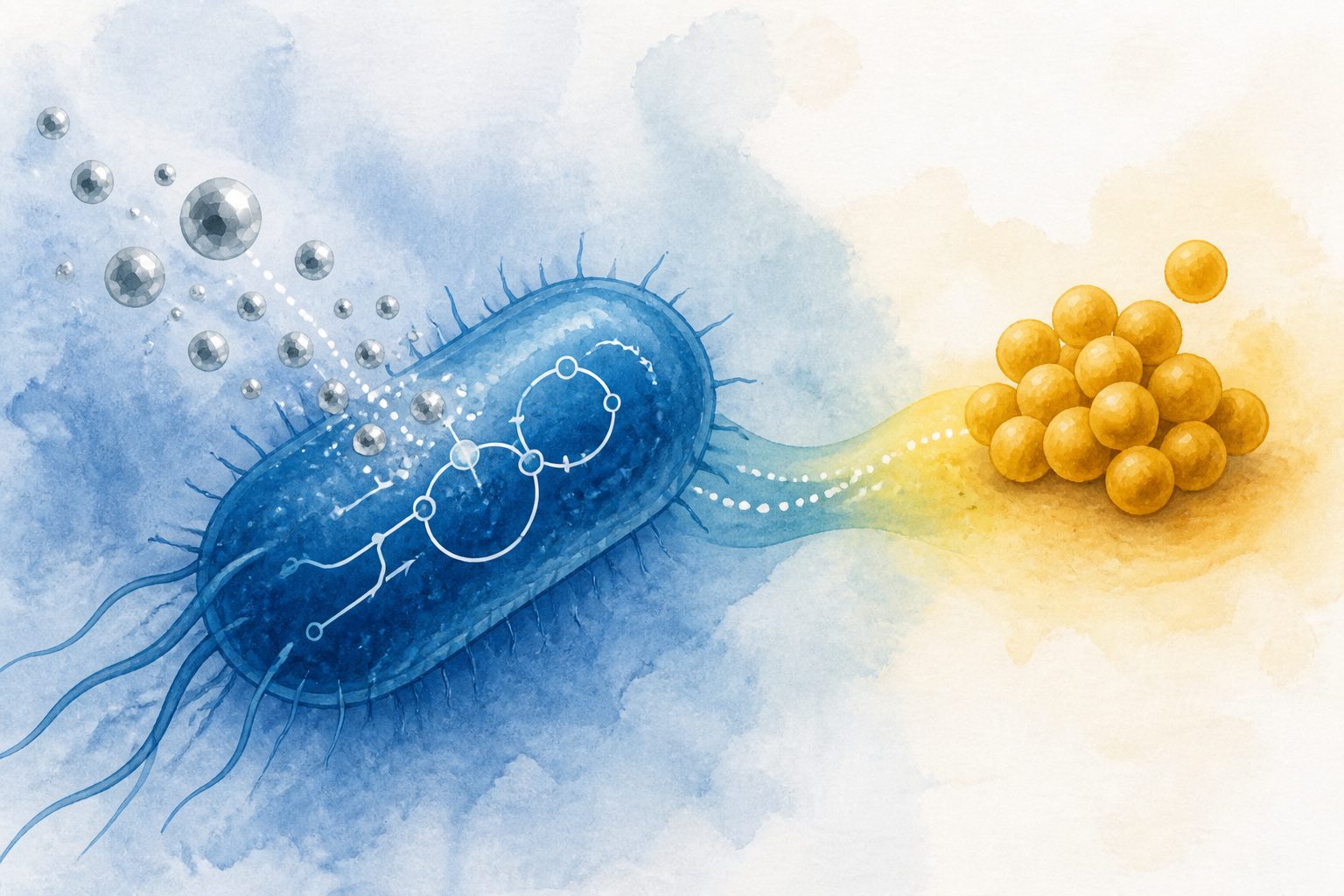
In laboratory competition, the particles prompted E. coli to release nutrients that improved Staphylococcus aureus survival.
Researchers repeatedly exposed mixed cultures of E. coli and S. aureus to 0.5 milligrams per liter of silver nanoparticles for nine days. The treatment increased the S. aureus-to-E. coli ratio threefold, while untreated cultures were generally dominated by E. coli, sometimes strongly enough to exclude S. aureus.
The researchers linked the shift to E. coli’s use of ethanolamine, a nutrient, in cellular structures called Eut bacterial microcompartments. This process led to acetate and ammonium building up outside the cells. Tests indicated that nitrogen, rather than carbon, was the main growth-supporting resource passed between the bacteria. Removing the eutBC genes eliminated the coexistence pattern in nanoparticle-exposed cultures. A similar survival benefit for S. aureus occurred in simulated nutrient-rich water.
How the bacteria’s balance shifted
Repeated exposure to 0.5 mg/L silver nanoparticles for nine days increased the S. aureus/E. coli ratio threefold. Without the treatment, E. coli dominated the mixed cultures; in 25% of lineages, S. aureus was competitively excluded and the E. coli/S. aureus ratio exceeded 10^5.
During competition, E. coli activated ethanolamine use in Eut bacterial microcompartments and released acetate and ammonium. Physiological tests identified nitrogen as the main growth-promoting resource in this exchange. Deleting eutBC abolished the nanoparticle-associated coexistence pattern and produced an outcome similar to untreated cultures. In simulated eutrophic water, the nanoparticles also increased S. aureus survival through the E. coli Eut pathway. Exposure to a mass-matched amount of silver ions did not activate ethanolamine use or promote more balanced coexistence.
Evidence and caveats
The study combines competition experiments, physiological assays, genetic deletion of the eutBC pathway and tests in simulated nutrient-rich water. The loss of the coexistence effect after eutBC deletion supports a direct role for that pathway, while the silver-ion comparison indicates that the effect was not reproduced by an equivalent amount of dissolved silver ions.
The evidence comes from a defined two-species laboratory model and simulated water, not from a natural wastewater or water-treatment environment. The abstract does not establish whether the same mechanism operates in more diverse microbial communities or under all environmental conditions.