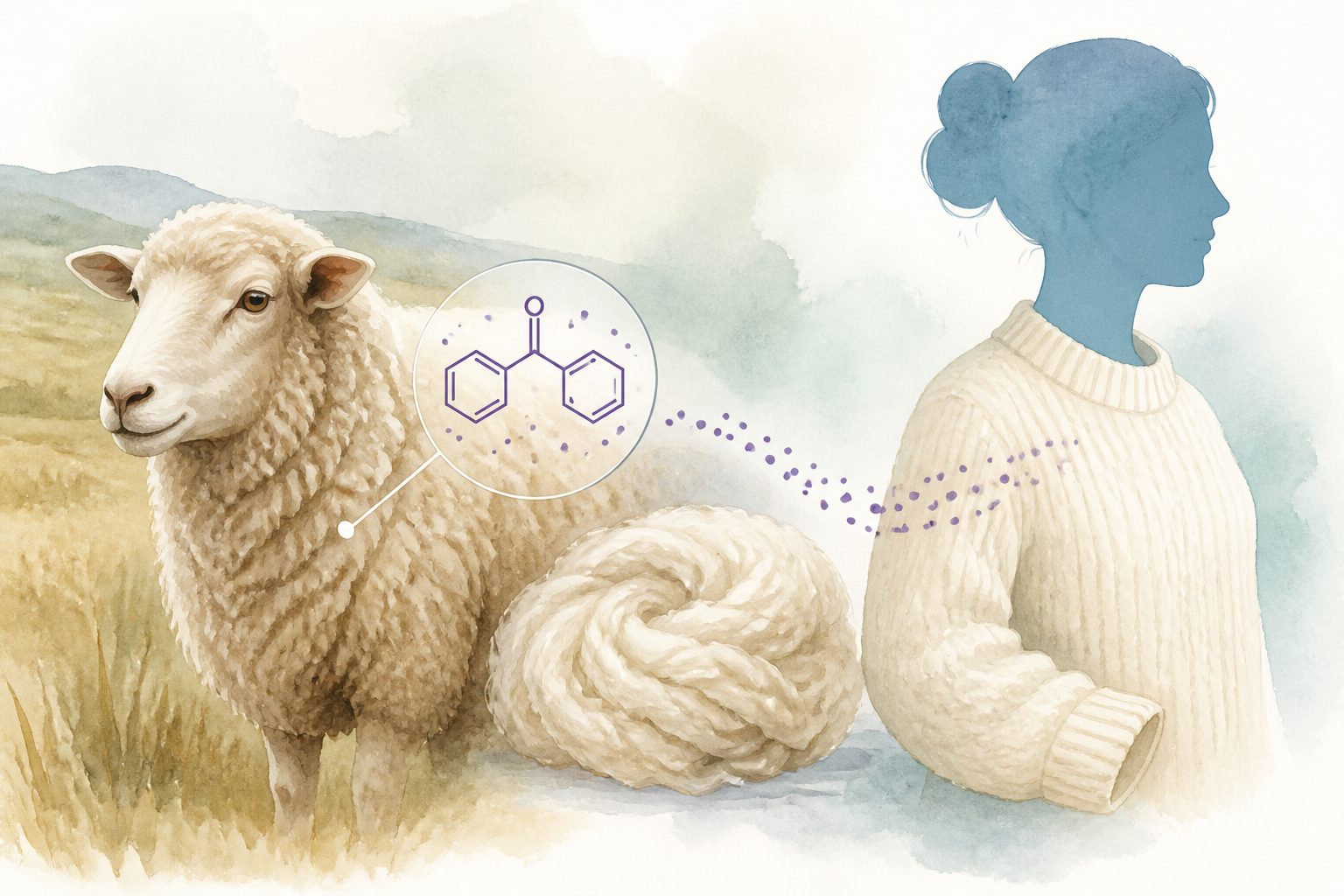
Wool from sheep near Bishkek contained several benzophenones, with the highest levels found for BP-1 and BP-3.
Researchers tested raw wool from sheep raised in two regions near Bishkek for four benzophenones: BP-1, BP-2, BP-3 and BP-8. They used liquid chromatography-tandem mass spectrometry to measure the compounds.
BP-1 and BP-3 were the most common contaminants. BP-3 was above the study’s quantification limit in every sample, while BP-1 exceeded that limit in 72% of samples. The researchers also found differences between regions and individual sheep, especially for BP-1.
What the wool contained
All four benzophenones were detected in the wool samples, but their levels differed substantially. BP-1 had the highest overall concentrations: it was detected above the method’s detection limit in 94% of samples and exceeded the quantification limit in 72%, with concentrations reaching 560.0 nanograms per gram. Its median concentration was 49.9 nanograms per gram, and its mean concentration was 95.7 nanograms per gram.
BP-3 was detected above the quantification limit in all samples. Its concentrations ranged from 2.1 to 32.8 nanograms per gram, with a median of 8.2 nanograms per gram and a mean of 9.5 nanograms per gram. BP-8 was found above the detection limit in 38% of samples and above the quantification limit in 32%. BP-2 was detected above the detection limit in 6% of samples and never exceeded the quantification limit.
BP-8 levels differed significantly between the two regions studied, while the regional differences for BP-1 and BP-3 were not statistically significant. The researchers report that the wool’s contamination pattern is consistent with long-term exposure and may reflect accumulation over the animals’ lifetimes.
Why wool exposure matters
Wool can retain benzophenones over a long period, unlike samples such as blood or urine that reflect shorter-term exposure. That means raw wool may preserve evidence of an animal’s longer-term contact with these chemicals.
The findings also raise the possibility that benzophenones in wool could contribute to human exposure through textile products, particularly products in which lanolin is not removed or is only partly removed. The study does not establish that people are exposed to harmful amounts through wool, so further toxicological research on wool and wool products is needed.
Evidence and caveats
The study analyzed 50 raw-wool samples from sheep raised near Bishkek, Kyrgyzstan, using liquid chromatography-tandem mass spectrometry. It measured four selected benzophenones and compared concentrations between two regions.
Wool can receive contaminants through both the animal’s bloodstream and direct contact with the environment. Although the samples were thoroughly washed, the researchers could not determine how much of each chemical entered by either route. The study also examined sheep from a limited geographic area and did not measure human exposure, health effects, or the amount of benzophenones released from finished wool products. The authors note that natural benzophenones from plants and fungi could also contribute to the levels found.