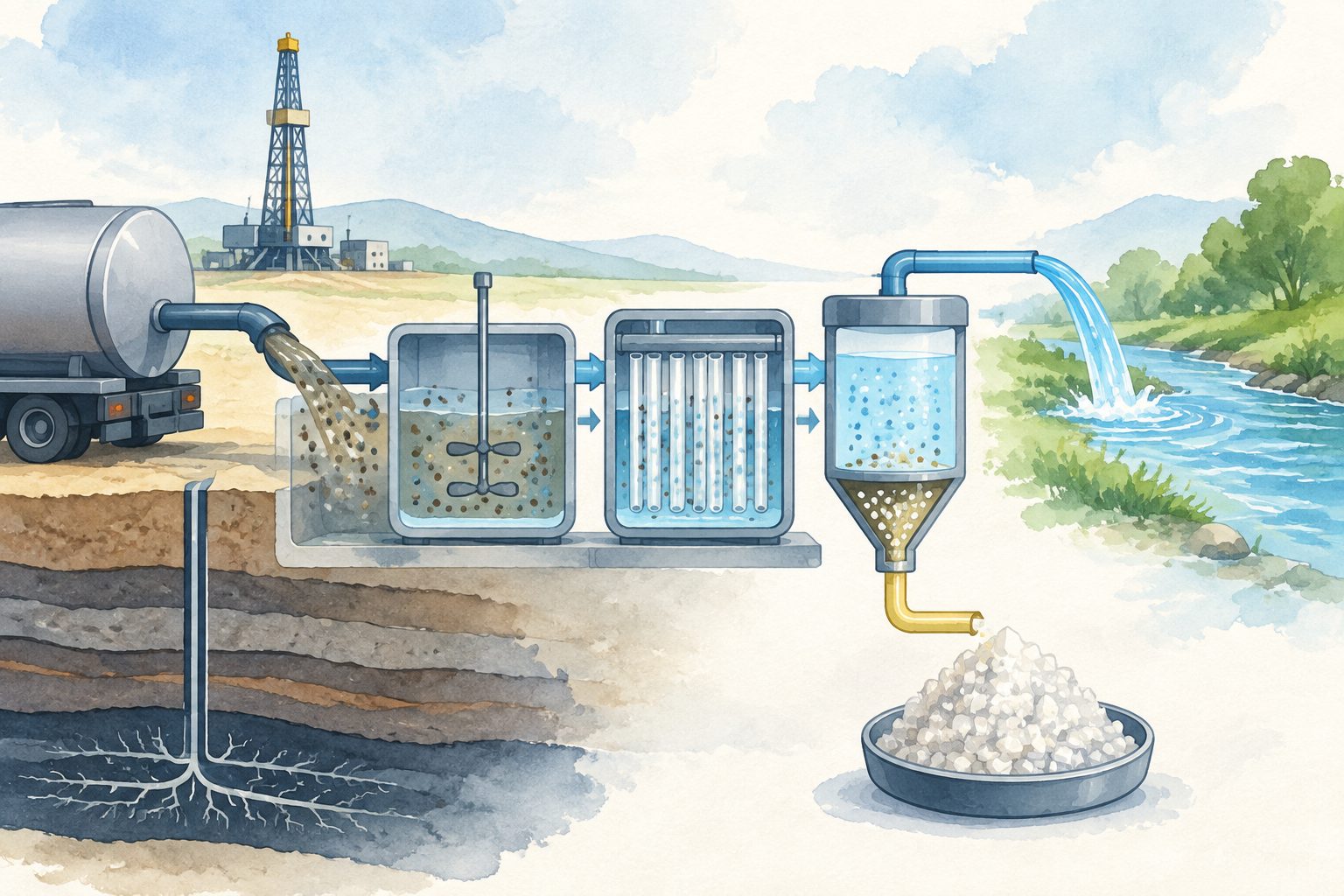
A proposed process recovered lithium from flowback fluid and removed most chemical oxygen demand in a study of a Sichuan Basin well block.
Researchers examined flowback fluid from the Yang 101 well block in China’s Sichuan Basin, where lithium concentrations ranged from 26.01 to 53.89 milligrams per liter. The water also had high levels of dissolved salts and a complex mix of organic and inorganic substances, creating treatment challenges.
They designed a process that first treats the water, then uses an aluminum-based material to capture lithium and membranes to help concentrate and purify it. The study combined laboratory testing with long-term cycling tests, environmental analysis and an economic assessment of a proposed 20-year project.
What the process recovered
The aluminum-based adsorbent captured lithium at a capacity of 3.0 milligrams per gram and achieved an 87% lithium recovery rate. The liquid released from the adsorbent contained more than 500 milligrams of lithium per liter.
The researchers attribute the capture mechanism to lithium ions entering layers in the material and being held by electrical interactions. After 30 adsorption-and-release cycles, the material’s capacity had declined by less than 5%.
The complete process removed more than 90% of chemical oxygen demand, a measure of oxygen-consuming pollutants, and recovered 80% of the water for potential reuse. The study’s environmental assessment estimated emissions of 2.8 kilograms of carbon-dioxide equivalent per kilogram of lithium carbonate—42% lower than the comparison with conventional spodumene mining.
In the researchers’ economic model, the process could produce 30.1 kilograms of battery-grade lithium carbonate per day. The model estimated a net present value of 3.86 million Chinese yuan, an internal rate of return of 7.95% and a 12.19-year payback period over 20 years.
Why the wastewater matters
The findings point to a way of treating a difficult industrial wastewater while recovering lithium from it. That could support more diverse lithium supplies and reuse some of the treated water, while reducing the amount of waste that requires disposal.
The proposed process also had a lower estimated carbon footprint than the conventional mining route used for comparison. These benefits are based on the study’s process design and assessments, rather than evidence that a commercial facility is already operating.
Evidence and caveats
The study combined water-quality measurements from the Yang 101 well block with laboratory adsorption tests, material analyses, 30-cycle stability testing, a life-cycle assessment and a techno-economic model. The reported production, costs, emissions and financial returns are therefore estimates for the proposed integrated process.
The abstract does not report results from a full-scale commercial plant or establish how the process would perform across other shale-gas fields with different water chemistry. The reported stability test covered 30 cycles, and the economic conclusions depend on the assumptions used for the modeled 20-year project.