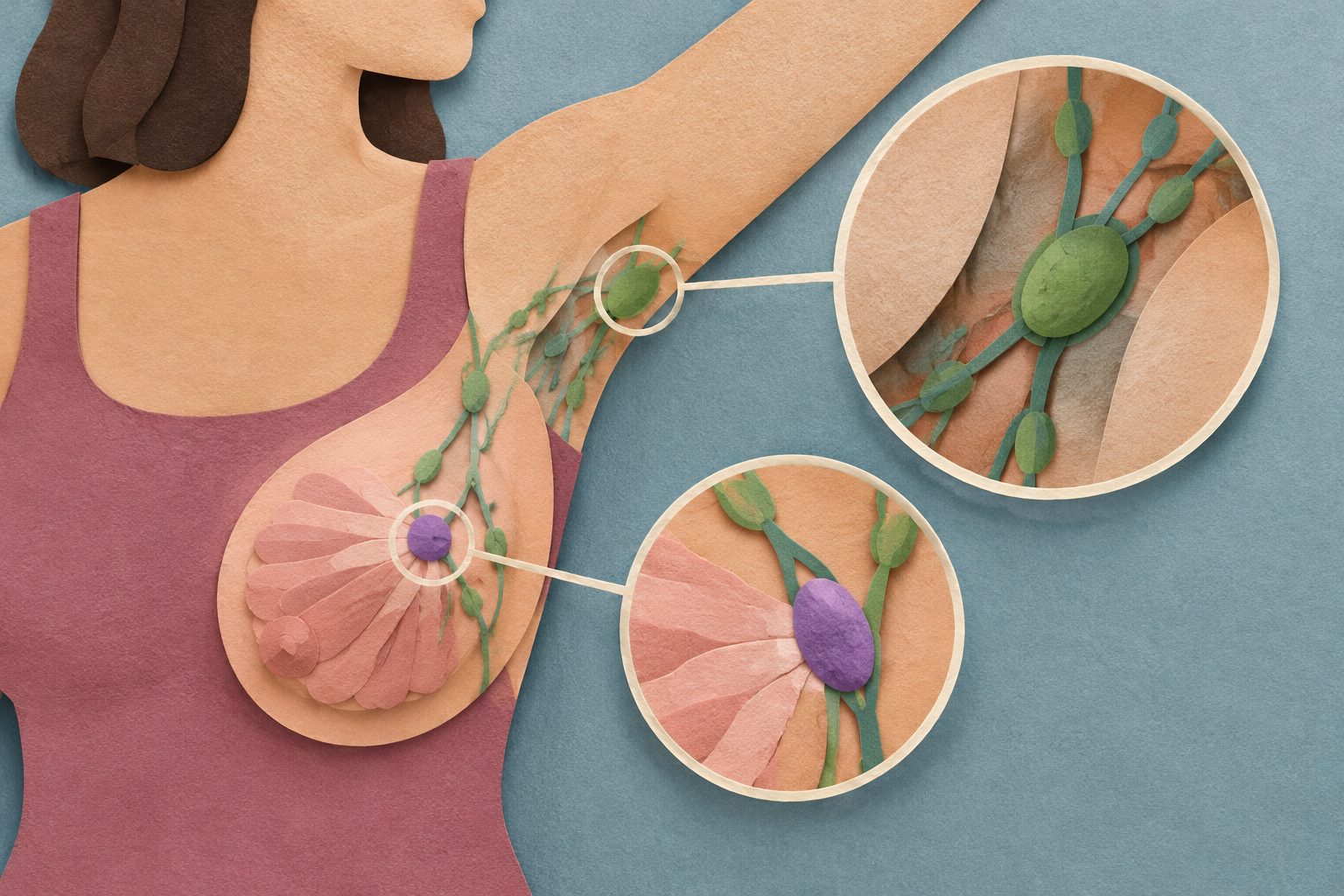
Review links uncommon breast lymph nodes with nearby underarm node involvement
The analysis found an association with underarm lymph-node disease, but the finding was not accurate enough to replace standard staging.
High evidenceReviewSome caution advised
Medical disclaimer: This article summarizes research findings and is for informational purposes only. It is not medical advice.
Editorial illustration — not from the study.
Researchers searched three medical databases and pooled findings on how often intramammary lymph nodes were detected, how often they contained cancer, how they related to underarm lymph-node status, and whether they were linked with outcomes. Across the included studies, pathologically detected intramammary lymph nodes occurred in about 3% of cases, while 32% of patients with these nodes had metastatic involvement.
Positive intramammary-node status was associated with nearly five times the odds of underarm lymph-node involvement in the pooled analysis. The test performance was mixed: pooled sensitivity was 50.5% and specificity was 81.3%. This means a positive result was associated with a higher likelihood of underarm disease, but a negative result did not reliably rule it out. Prognostic findings varied between studies.
The question reviewed
The researchers conducted a PRISMA-based systematic review and meta-analysis registered in PROSPERO. They searched PubMed, Embase, and the Cochrane Library through September 15, 2025, without planned language or date restrictions, although studies lacking sufficient data in languages other than Chinese or English were excluded. Eligible studies were retrospective clinical investigations of adult women with primary breast cancer and pathologically confirmed intramammary lymph nodes, located within the breast tissue or the breast's axillary tail. Twenty-four studies involving 1,482 patients were included.
What the evidence shows
The pooled incidence of pathologically detected intramammary lymph nodes was 3% (95% confidence interval, 1% to 8%). Among patients with intramammary lymph nodes, the pooled metastatic rate was 32% (95% confidence interval, 27% to 37%). Across 12 studies with estimable odds ratios, positive intramammary-node status was associated with underarm lymph-node involvement, with a pooled odds ratio of 4.96 (95% confidence interval, 3.55 to 6.93). Pooled sensitivity was 50.5%, specificity 81.3%, positive predictive value 67.4%, and negative predictive value 71.1%. Lymphovascular invasion, larger tumor size or higher T stage, and higher histological grade were commonly associated with intramammary-node metastasis. Associations with survival or recurrence were inconsistent, so the independent prognostic value of intramammary-node metastasis remains uncertain.
Who this is relevant to
These findings apply most directly to adult women with primary breast cancer and a pathologically confirmed intramammary lymph node, similar to participants in the included retrospective studies. They may not apply to people without breast cancer, people whose intramammary nodes were identified only on imaging, men, or populations with different patterns of disease or access to testing. The pooled predictive values may also differ in settings where the underlying frequency of underarm lymph-node involvement is different. The results do not establish an independent prognosis for any individual patient.
The significance
Intramammary lymph nodes are uncommon in the pathologically assessed breast-cancer population studied, but when cancer was found in them, it was associated with a greater likelihood of cancer in underarm lymph nodes. This may help researchers and clinicians interpret the finding as a marker of regional lymph-node burden. The pooled accuracy was only moderate, however, and the review did not support using intramammary-node status as a substitute for conventional underarm staging. The study assessed associations in existing patient records; it did not show that intramammary-node metastasis itself causes worse outcomes.
Limitations & evidence assessment
The evidence came from retrospective clinical studies rather than randomized trials, so confounding and selection bias may affect the results and causal conclusions cannot be drawn. Only 24 studies and 1,482 patients were included, and the prognostic findings were inconsistent. Positive and negative predictive values depend on how common underarm-node involvement was in the included cohorts, which may differ from an unselected breast-cancer population. The search was intended to have no language restrictions, but studies in other languages were excluded when sufficient clinical and pathological data were unavailable. The provided information does not give enough detail to assess all study-quality ratings, differences between study populations, or the extent of statistical heterogeneity.
Why this evidence level: Meta-analysis pooling multiple studies sits at the top of common evidence hierarchies.
Evidence levels are editorial estimates derived from study metadata — they are not clinical appraisals.
Human forebrain organoids classified artificial tactile Braille signals after a sensor converted the touch data into electrical stimulation. Accuracy averaged 61% with one organoid and rose to 83% when responses from three organoids were combined.
A study in mice found that a peptide targeting the memory-related protein CPEB3 reduced the persistence of traumatic memories and anhedonia, a loss of pleasure. The findings are an early genetic preclinical test of a possible approach for PTSD, not evidence of a treatment in people.
Acute heat and sublethal imidacloprid exposure interacted to reduce male fruit flies’ reproductive success more than either stressor alone in some conditions. Stress experienced by fathers also reduced offspring fertility, while a more diverse gut microbiome partly lessened the effects on males.