Review finds mixed outcomes after fetal shunting for fluid around the lungs
In 416 treated fetuses, about two-thirds survived, while preterm birth and membrane rupture were also reported.
High evidenceReviewInterpret with caution
Medical disclaimer: This article summarizes research findings and is for informational purposes only. It is not medical advice.
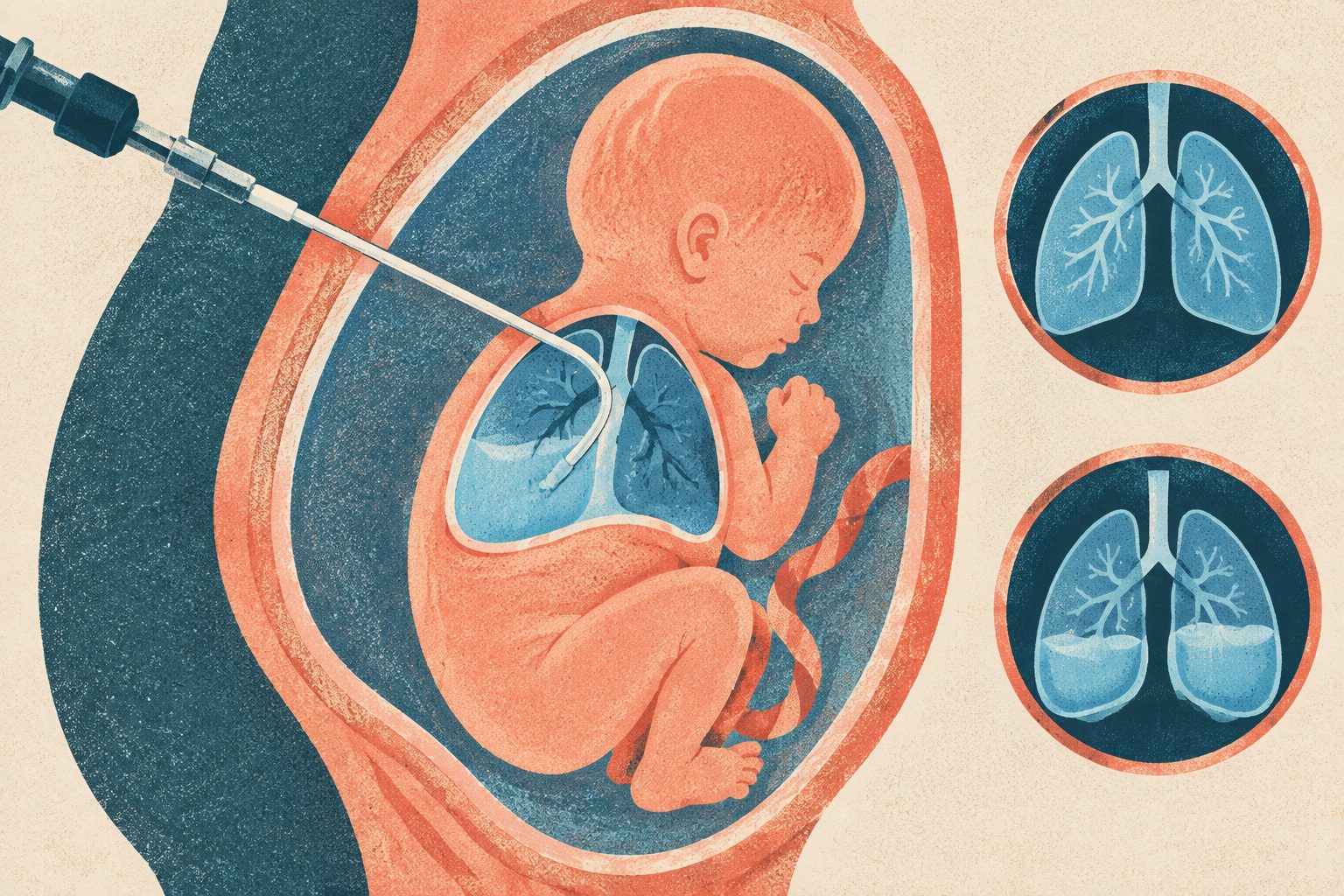
Editorial illustration — not from the study.
This systematic review and meta-analysis examined reported outcomes after a procedure that places a small catheter to drain fetal chest fluid into the amniotic fluid. The studies included fetuses with isolated pleural effusion and did not provide a randomized comparison with other care or no procedure.
Across the included reports, the pooled survival estimate was 65.36%, and fetal hydrops resolved in 62.25% of cases. Catheter displacement occurred in 17.13% of cases, preterm birth in 69.67%, and preterm premature rupture of membranes in 17.65%. These figures describe outcomes among treated fetuses; they do not show that shunting caused or prevented any particular outcome.
The question reviewed
The researchers asked what perinatal outcomes have been reported after pleuro-amniotic shunting for isolated fetal pleural effusion. They searched PubMed/MEDLINE, Embase, Scopus, and the Cochrane Central database, then combined results from 10 retrospective cohort studies involving 416 human fetuses. The analysis used single-arm random-effects meta-analysis, meaning it pooled outcomes in treated cases without a stated untreated or alternative-treatment comparison group.
What the evidence shows
The pooled overall survival estimate was 65.36% (95% confidence interval 59.46% to 70.83%). Resolution of fetal hydrops was reported in 62.25% of cases (95% confidence interval 54.27% to 69.62%). Catheter displacement occurred in 62 cases, with a pooled prevalence of 17.13%. There were 155 preterm births, corresponding to a pooled prevalence of 69.67%. Preterm premature rupture of membranes had a pooled prevalence of 17.65%, but results varied substantially between studies for this outcome. Because the evidence came from retrospective, single-arm studies, these results show reported outcomes after treatment rather than proving the procedure caused favorable or unfavorable outcomes.
Who this is relevant to
These findings may be relevant to fetuses and pregnancies with isolated pleural effusion who are managed in settings similar to those represented in the included specialist studies. They do not necessarily apply to pleural effusions caused by other conditions, pregnancies with additional fetal abnormalities, or patients treated in different clinical settings. The results are population-level estimates and cannot predict an outcome for any individual pregnancy; they also should not be interpreted as evidence that the procedure is appropriate for every affected fetus.
What this could mean
The review provides a summary of outcomes reported for a rare and serious fetal condition and shows both potential benefit-related outcomes and substantial pregnancy risks. The findings may help describe the range of outcomes that has been observed in specialist settings, but they do not determine which fetuses are most likely to benefit, how outcomes compare with other approaches, or whether the procedure itself caused the outcomes.
Limitations & evidence assessment
The evidence was based entirely on 10 retrospective cohort studies, so the results may be affected by differences in patient selection, disease severity, treatment practices, and record keeping. There was no stated randomized or untreated comparison group, making it impossible to determine whether shunting improved outcomes compared with other care. The abstract provides limited information about follow-up, study quality, and possible publication or reporting bias. Results for preterm premature rupture of membranes varied substantially across studies, and the overall sample was 416 fetuses for a rare condition. Prospective studies are needed to clarify patient selection and perinatal care.
Why this evidence level: Meta-analysis pooling multiple studies sits at the top of common evidence hierarchies.
Evidence levels are editorial estimates derived from study metadata — they are not clinical appraisals.
// Source
Advances in Therapy · 2026 · DOI: 10.1007/s12325-026-03809-8
This systematic review examined randomized human trials of concurrent chemotherapy and radiation for locally advanced head and neck, cervical, esophageal, and non-small-cell lung cancers. Across the included trials, combined treatment was reported to provide better overall survival than radiation alone, but it also caused more severe short-term side effects. The review did not provide enough information in its abstract to show how many trials or patients were included.
Researchers pooled results from seven human studies comparing multiple-staged with single-stage removal and reconstruction of congenital melanocytic nevi, sometimes called congenital moles. Staged surgery was associated with fewer major wound complications and recurrences, as well as slightly shorter and narrower scars, but the studies did not find a clear difference in cosmetic or overall patient satisfaction.
A cluster-randomized human study in 210 adults with recently detected stage 1 hypertension in Uzbekistan compared salt-sensitivity testing followed by assigned medication choices with conventional management. After 12 weeks, more participants in the testing-guided group reached the study's blood pressure target, although the study was small, short, and conducted in only three primary care centers.