Review finds cell salvage may not reduce total transfusions in spine surgery
An analysis of 22 observational studies found less postoperative transfusion volume but no clear reduction in overall transfusion exposure.
High evidenceReviewSome caution advised
Medical disclaimer: This article summarizes research findings and is for informational purposes only. It is not medical advice.
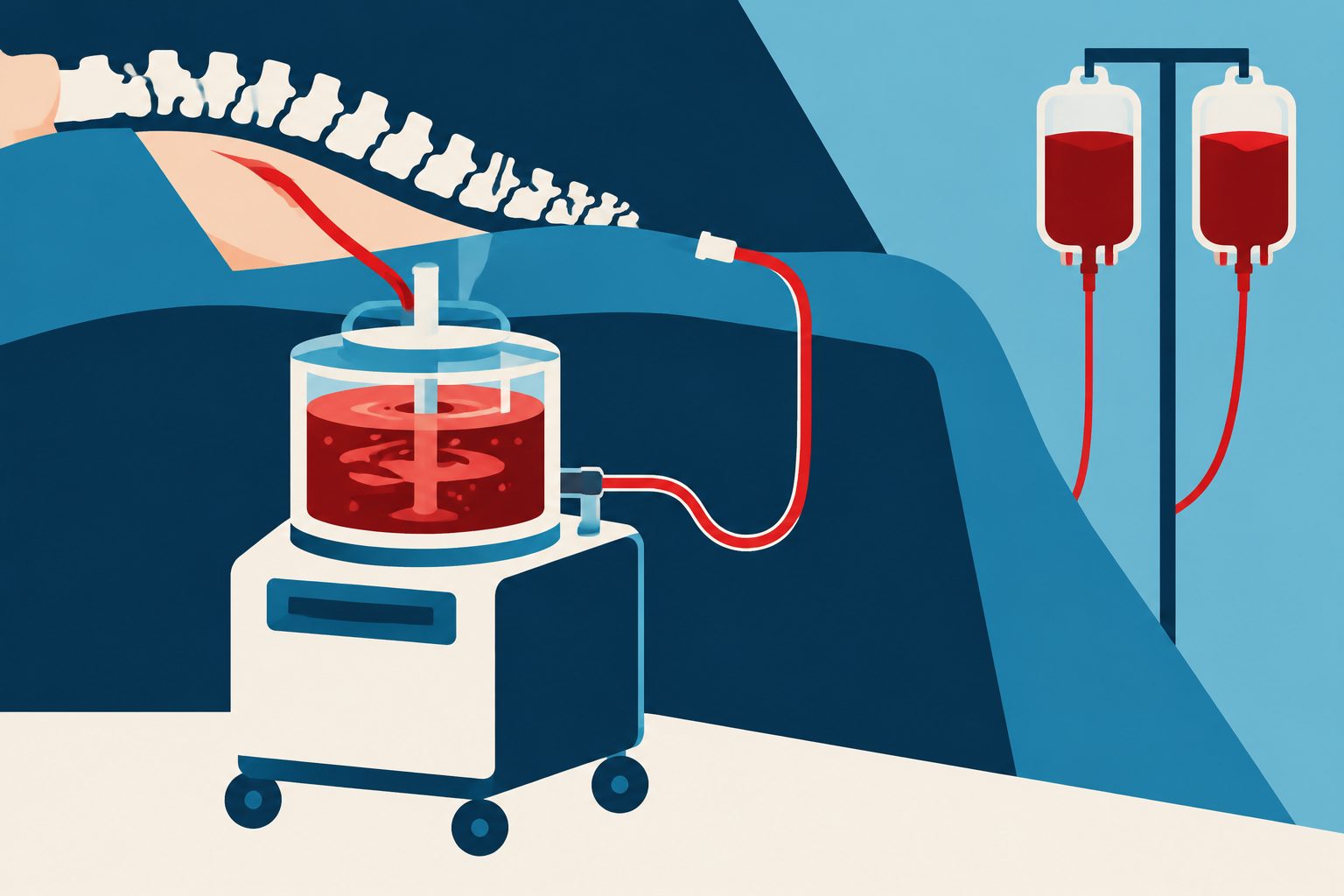
Editorial illustration — not from the study.
This systematic review and meta-analysis examined whether cell salvage improves outcomes in spinal deformity surgery. The included studies compared surgery using cell salvage with surgery without it, in the setting of current blood-loss medicines and more restrictive transfusion practices.
The analysis did not find a clear reduction in blood transfused during surgery or across the entire perioperative period. It also found no significant differences in overall complications, transfusion-related costs, or hospital stay. Because all included studies were observational, the findings show associations rather than proof that cell salvage caused the observed differences.
What the review examined
The researchers searched PubMed, Embase, and CENTRAL through December 2025 for studies comparing spinal deformity surgery performed with versus without intraoperative cell salvage. They included 22 observational studies involving 2,977 patients: 1,851 in cell-salvage groups and 1,126 in comparison groups. Outcomes included the amount of blood transfused during and after surgery, hemoglobin and hematocrit on postoperative day 1, complications, the proportion of patients receiving transfusions, costs, and length of hospital stay.
Key conclusions
Cell salvage was not associated with a reduction in intraoperative transfusion volume or total perioperative transfusion volume, and it was not associated with a lower likelihood of receiving any perioperative transfusion. It was associated with a modest reduction in postoperative transfusion volume, reported as a standardized mean difference of 0.25, with a 95% confidence interval from 0.04 to 0.46. The review also reported higher postoperative day 1 hemoglobin in the cell-salvage group, with a reported mean difference of -0.42 g/dL and a 95% confidence interval from -0.76 to -0.07; the direction of this estimate reflects the analysis coding, while the authors interpreted the finding as higher early postoperative hemoglobin. No significant differences were found in overall complications, transfusion-related costs, or length of hospital stay. These are associations from observational studies and do not establish that cell salvage caused these outcomes.
Who this may apply to
These findings may be relevant to people undergoing spinal deformity surgery in settings similar to those represented in the included studies. They do not necessarily apply to other types of surgery, children or adults not represented in the studies, or hospitals using substantially different blood-management practices. The review does not identify which individual patients are most likely to benefit, and it should not be interpreted as determining care for a particular person.
What this could mean
Spinal deformity surgery can involve substantial blood loss, so reducing exposure to donated blood is a clinically relevant question. In this review, cell salvage was associated with some early postoperative blood-count benefit but not with a clear reduction in total transfusion exposure. The results therefore describe a possible limited or temporary effect in the studied surgical settings, rather than establishing that cell salvage benefits all patients or all spinal operations.
Limitations & evidence assessment
The main limitation is that all included studies were observational, so the groups may have differed in ways that influenced transfusion needs and outcomes. The 22 studies may also have varied in surgical procedures, patient characteristics, cell-salvage methods, transfusion thresholds, blood-loss medicines, and reporting quality. The abstract does not provide enough information to judge the risk of bias, statistical heterogeneity, or the follow-up duration in detail. The findings may therefore be affected by confounding and differences between studies.
Why this evidence level: Meta-analysis pooling multiple studies sits at the top of common evidence hierarchies.
Evidence levels are editorial estimates derived from study metadata — they are not clinical appraisals.
This systematic review examined randomized human trials of concurrent chemotherapy and radiation for locally advanced head and neck, cervical, esophageal, and non-small-cell lung cancers. Across the included trials, combined treatment was reported to provide better overall survival than radiation alone, but it also caused more severe short-term side effects. The review did not provide enough information in its abstract to show how many trials or patients were included.
Researchers pooled results from seven human studies comparing multiple-staged with single-stage removal and reconstruction of congenital melanocytic nevi, sometimes called congenital moles. Staged surgery was associated with fewer major wound complications and recurrences, as well as slightly shorter and narrower scars, but the studies did not find a clear difference in cosmetic or overall patient satisfaction.
A cluster-randomized human study in 210 adults with recently detected stage 1 hypertension in Uzbekistan compared salt-sensitivity testing followed by assigned medication choices with conventional management. After 12 weeks, more participants in the testing-guided group reached the study's blood pressure target, although the study was small, short, and conducted in only three primary care centers.