Researchers searched three medical databases through June 22, 2026, for reports involving adults with suspected or confirmed metal hypersensitivity after spinal implant surgery. The review included 13 single-patient case reports and two small case series, covering 19 patients.
Health & Medicine1 month ago
Review examines rare metal reactions after spinal implant surgery
The analysis found varied symptoms and reported improvement after implant removal in many, but not all, documented cases.
Low evidenceReviewInterpret with caution
Medical disclaimer: This article summarizes research findings and is for informational purposes only. It is not medical advice.
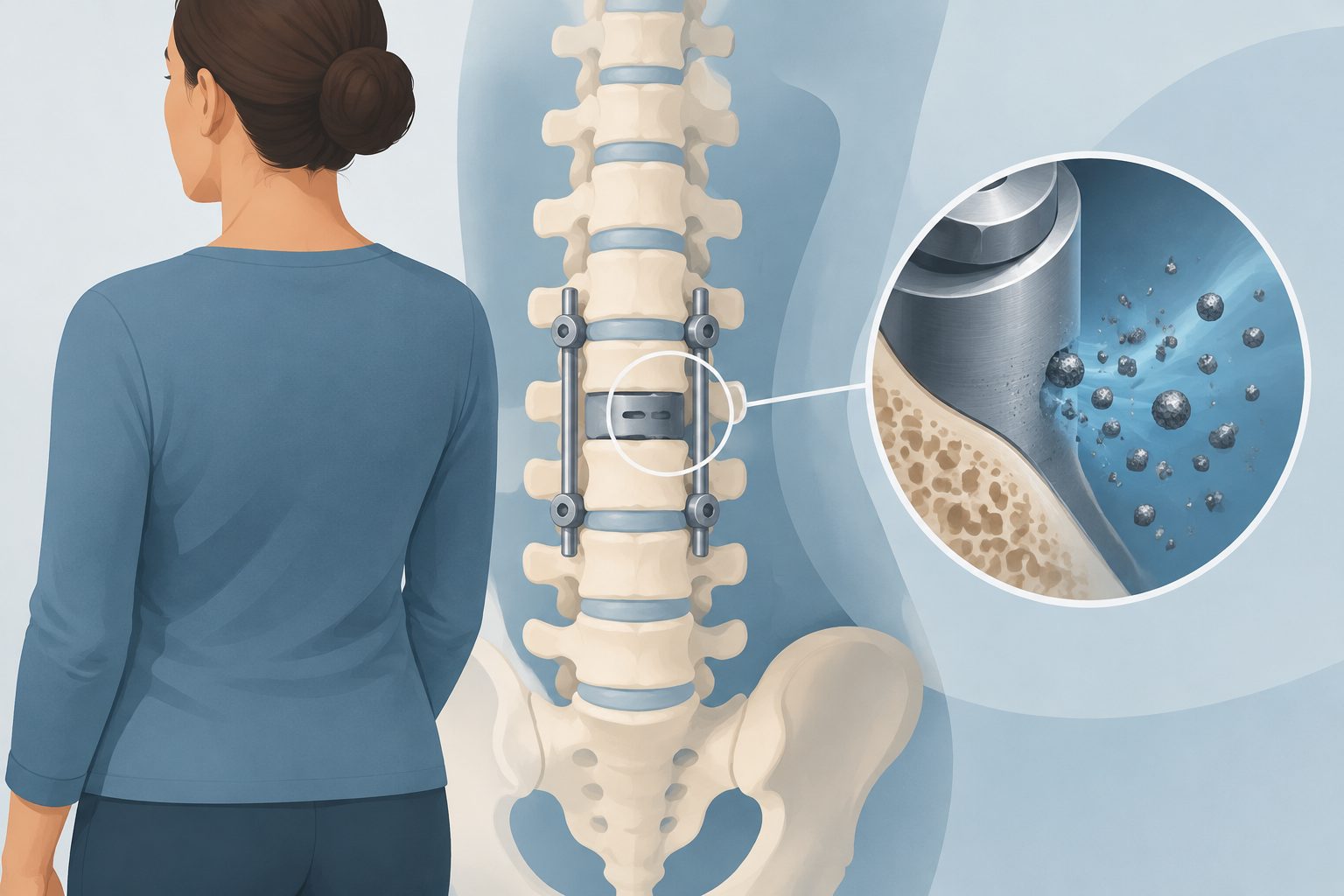
The question reviewed
The researchers asked how metal hypersensitivity after spinal implant surgery presents, how it is evaluated, and what outcomes are reported after implant removal or revision. Two reviewers independently screened records and extracted patient-level information, with disagreements handled through discussion or a third reviewer. The review included adults with metallic spinal implants and relevant clinical outcomes; animal and laboratory studies were excluded. The included evidence consisted of 19 patients from 15 studies, most of which were case reports.
Key conclusions
Pain was the most common reported symptom, occurring in 11 of 19 patients (58%). Skin findings such as rash, redness, itching, or dermatitis were reported in 8 patients (42%), while neurologic symptoms occurred in 5 (26%). Symptoms began within six months of surgery in 9 patients and later than six months in 10 patients, so both early and delayed presentations were described.
Patch testing and/or lymphocyte transformation testing supported an immune-related hypersensitivity diagnosis in 11 patients (58%); 8 patients (42%) were diagnosed clinically after infection and mechanical problems were ruled out. The review also separated four metal-on-metal cases as uncertain because their findings were more consistent with reactions to wear debris than with confirmed primary metal hypersensitivity.
Eighteen patients underwent implant removal or revision. Among the 16 patients with a reported outcome, 14 (88%) were described as having clinical improvement. This was a narrative outcome rather than a result measured with validated outcome scales, and the case-based design cannot establish that implant removal caused the improvement.
Where this may apply
These findings apply most directly to adults described in published reports who developed suspected or confirmed metal-related problems after spinal implant surgery. They do not establish risk or expected outcomes for all people with spinal implants, people without spinal implants, children, or patients whose symptoms have other causes. The review also does not provide enough evidence to determine whether a particular diagnostic test or implant-removal approach would produce the same result in another patient.
The significance
The review highlights that suspected metal hypersensitivity can resemble more common problems after spinal implant surgery, including infection or mechanical failure, and can sometimes include skin symptoms. It also shows that the published evidence is sparse and based on selected reported cases rather than a representative group of patients. The findings may help describe the range of presentations reported in adults with spinal implants, but they do not establish how often these reactions occur or predict outcomes for individual patients.
Limitations & evidence assessment
The main limitation was the very small evidence base: only 19 patients were included, drawn largely from case reports and small case series. There was no control group, and the reports may overrepresent unusual or severe cases. Diagnostic testing was not uniform, test reliability was described as inconsistent, and 8 patients were diagnosed clinically rather than through immunologic testing. Most patients had incomplete information about previous metal allergy. The reported improvement after removal or revision was based on narrative descriptions, not validated outcome measures, and the review could not separate true metal hypersensitivity from wear-debris reactions in every case. Because the review included only reported cases, it cannot determine prevalence or prove that hypersensitivity or implant removal caused the observed symptoms or improvements.
Why this evidence level: Although this was a systematic review, it included only 19 patients from 13 case reports and 2 small case series. The review authors classified the evidence as Therapeutic Level V, and the reported outcomes were not measured with validated outcome tools.
Evidence levels are editorial estimates derived from study metadata — they are not clinical appraisals.
// Source
PubMed Central · 2026 · DOI: 10.2106/jbjs.rvw.26.00099
Authors: Joseph Abbo, Jacob Thomas, Christian Stipho, Erik Nakken, Rakesh Patel, Joshua David Piche, IIyas Aleem
Institutions: University of Michigan, Oakland University